Data Centers & Planning Commission
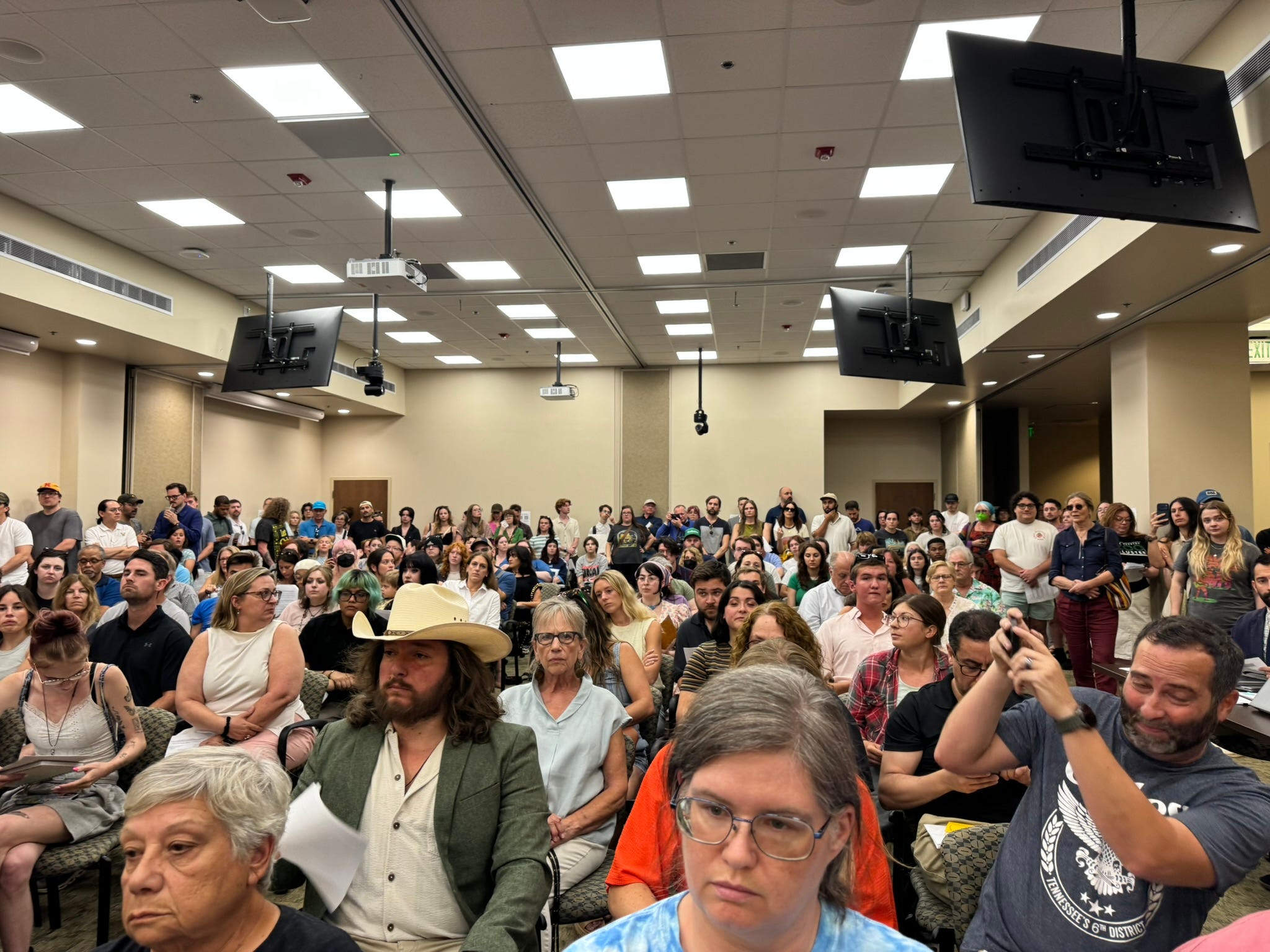
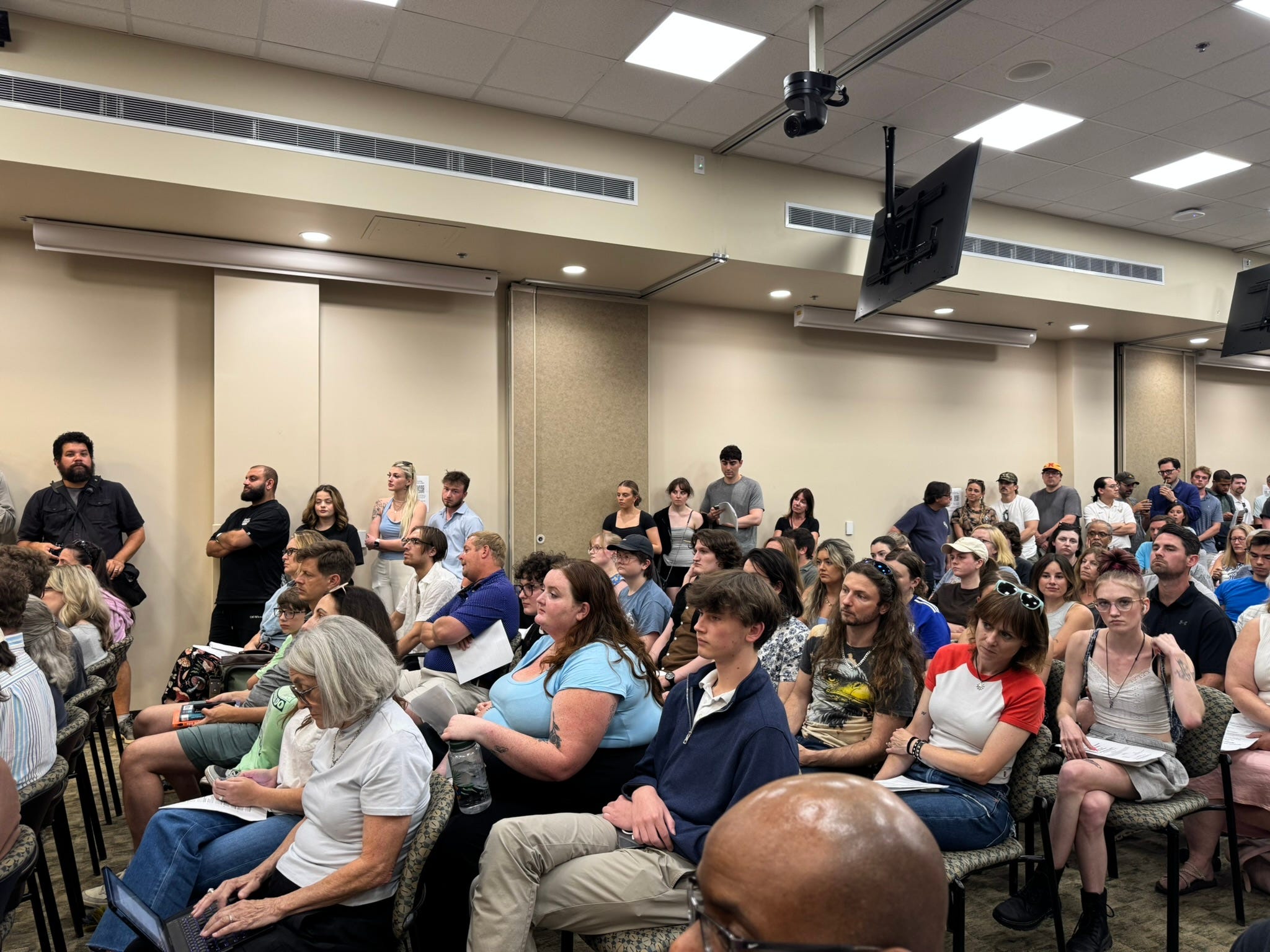
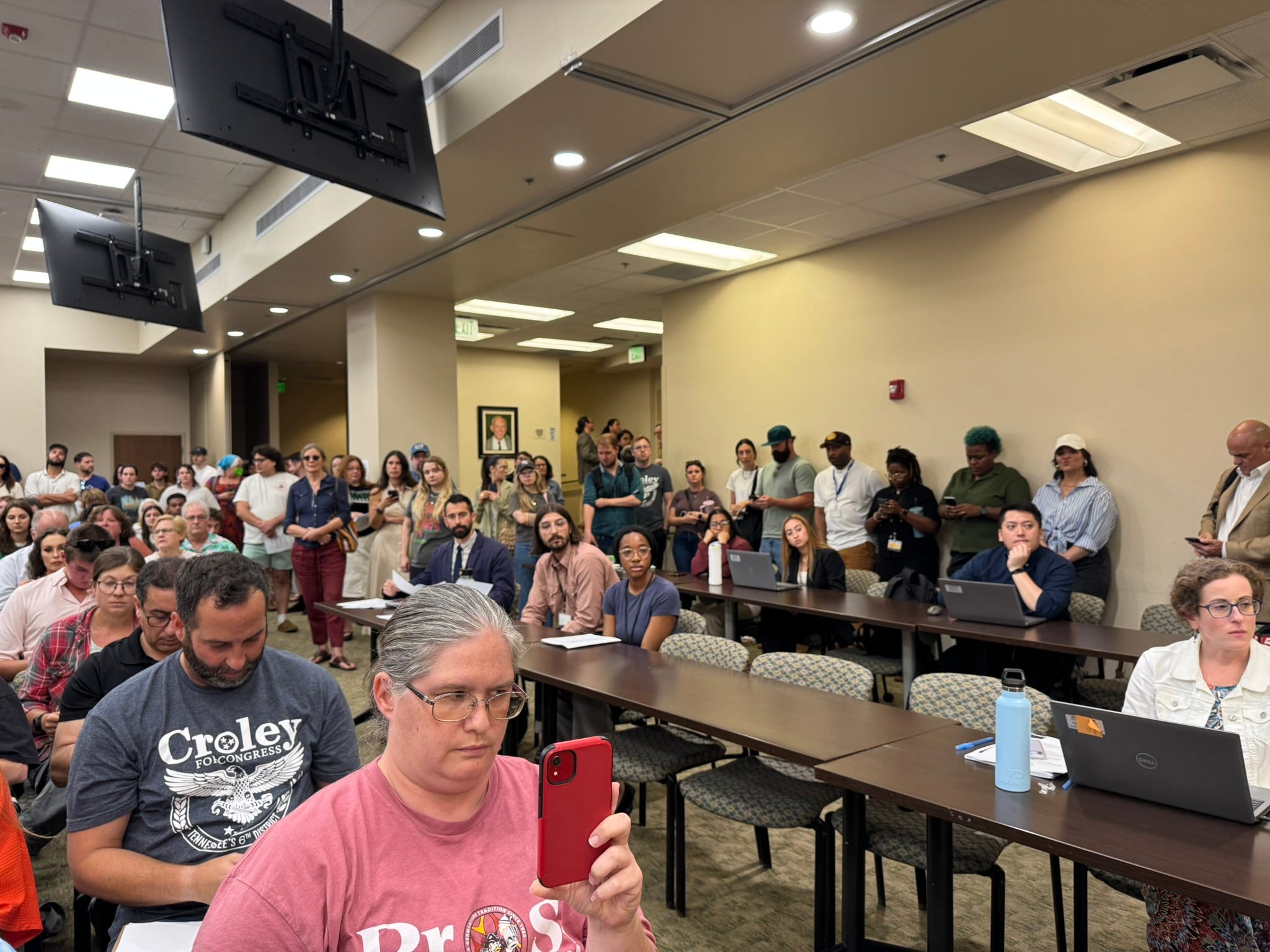
148 people from diverse backgrounds and a cross-section of the city testify FOR Regulations, if not a full Moratorium

Attendees wanting to speak at the Planning Commission Public Meeting regarding Item #8, Councilperson Horton’s REGULATION bill, to limit the footprint and impact of proposed Data Centers in Nashville/Davidson County. The following pictures were taken at the beginning of the 6-hour meeting, when the line of people wanting to testify wrapped around the exterior of the Howard Office Building.
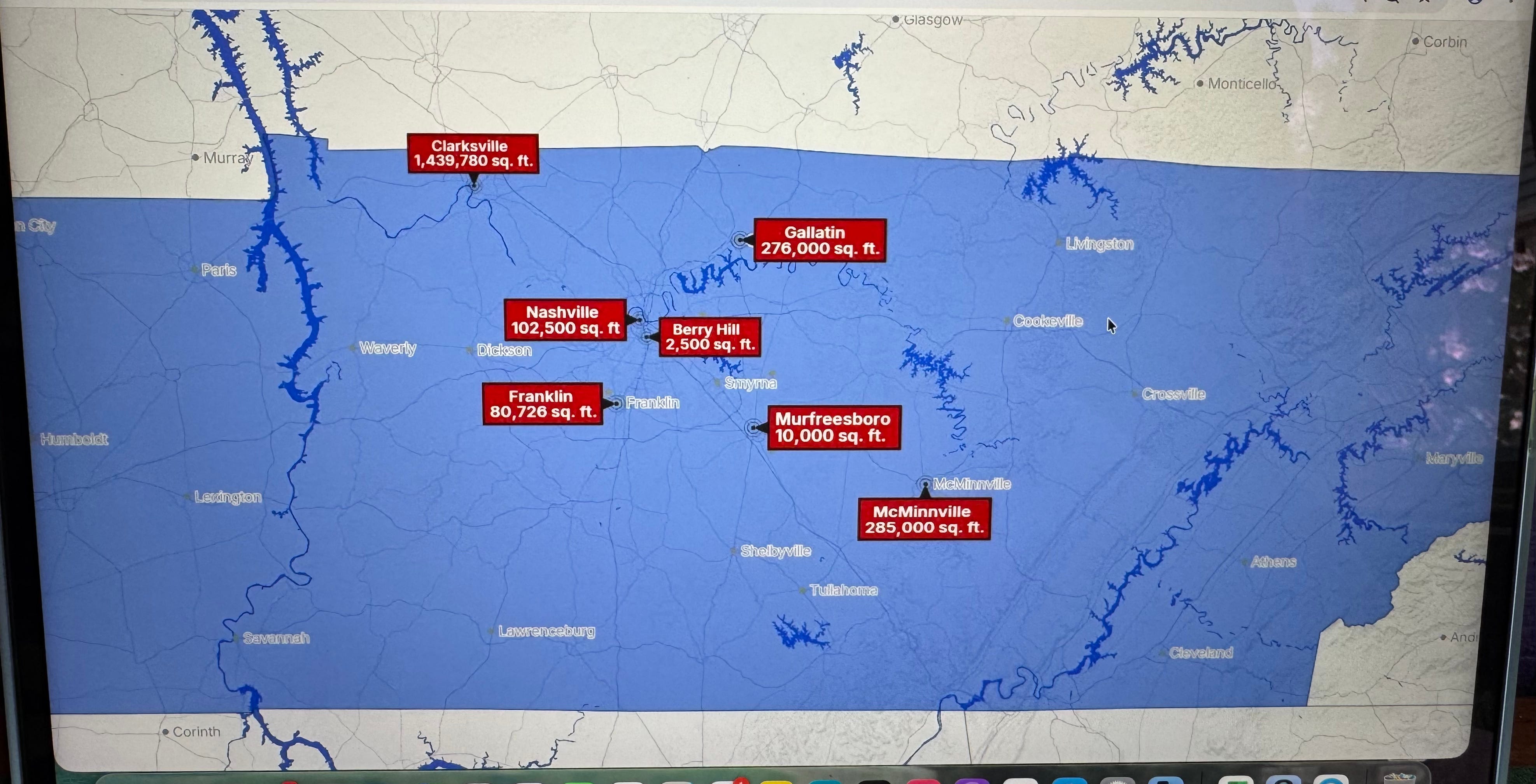
A map of the major Data Centers currently in operation in Middle TN (found HERE):
Friends, I waited to post about Data Centers until after Thursday night’s Metro Planning Commission meeting (June 11) where, according to my count, 148 people waited to SPEAK IN FAVOR of Councilperson Horton’s REGULATION bill (BL2026-1391). (The full bill is included at the end of this Post.)
Only ONE PERSON spoke against Horton’s bill, the Chief Revenue Officer for DC Blox, the Data Center proposed adjacent to the Zoo. He was roundly booed when, displaying his sense of privilege, he refused to cease talking when his 2 minutes expired, something every other person who testified had calmly respected.
Co-sponsors of this legislation, along with their District numbers are: Benedict (7) Bradford (13) Cortese (4) Evans (12) Ewing (34) Gadd (24) Hill (At-Large) Huffman (14) Johnston (26) Kupin (19) Parker (5) Preptit (25) Porterfield (At-Large) Sepulveda (30) Spain (35) Toombs (2) Vo (17) Weiner (22) Welsch (16 )
At the Tuesday, June 2nd Council meeting, Horton’s REGULATION bill passed by voice vote. It was referred back to the Planning Commission for additional review, recommendations, and the holding of a Public hearing, which began at 4:00 PM on Thursday.
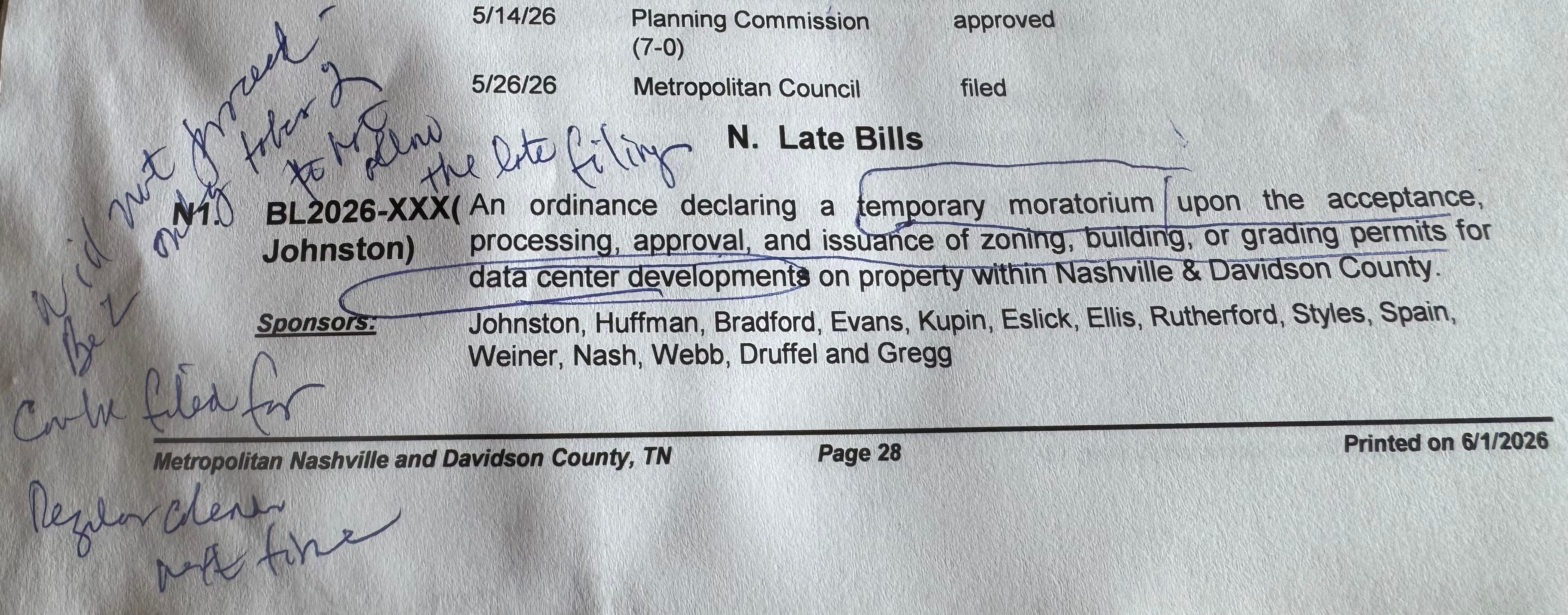
At the same June 2nd Council meeting, the late-filed Temporary MORATORIUM bill sponsored by Johnston FAILED to be heard because, according to protocol, two Council members objected. As drafted, the bill would have TEMPORARILY HALTED the establishment of any NEW Data Centers until 11/1/26, or until Permanent Data Center REGULATIONS were officially enacted, such as those being developed under Horton’s bill, or whichever came first. Johnson’s Council District includes the Data Center proposed for the property adjacent to the Nashville Zoo. The other Council members sponsoring Johnson’s Temporary MORATORIUM legislation were:
Druffel (District 23) Eastlick (District 11) Ellis (District 29) Evans (District 12) Greg (District 15) Huffman (District 14) Kupin (District 19) Nash (District 27) Rutherford (District 31) Spain (District 35) Styles (District 32) Webb (District 10) Weiner (District 22)
(NOTE: Those who signed on as Sponsors to BOTH Horton’s REGULATION bill and Johnston’s Temporary MORATORIUM bill are noted in BOLD, with the addition of Johnston, who also signed onto both)
During the Public Comment period segment of the June 9th Special Metro Council Meeting (primarily called to focus on the Capital Improvements budget, which was on its final and 3rd reading) two people spoke in favor of Johnston’s late-filed Temporary MORATORIUM bill, asking that it be considered on First-Reading that night. The first person was a Board member of the Nashville Zoo, Lauren Curry.
The second was the head veterinarian of the Nashville Zoo, Dr. Heather Schwartz.
Community activist Manny Hall addressed a number of very serious problems experienced by community members who live, work, or play near existing Data Centers in Tennessee and elsewhere.
Johnston urged her colleagues to vote in favor of her late-filed Temporary MORATORIUM bill (BL2026XXX) listed as Section Item #F1 of the Agenda. It declared a 90-day halt on the implementation of any new Data Centers in Nashville/Davidson County.
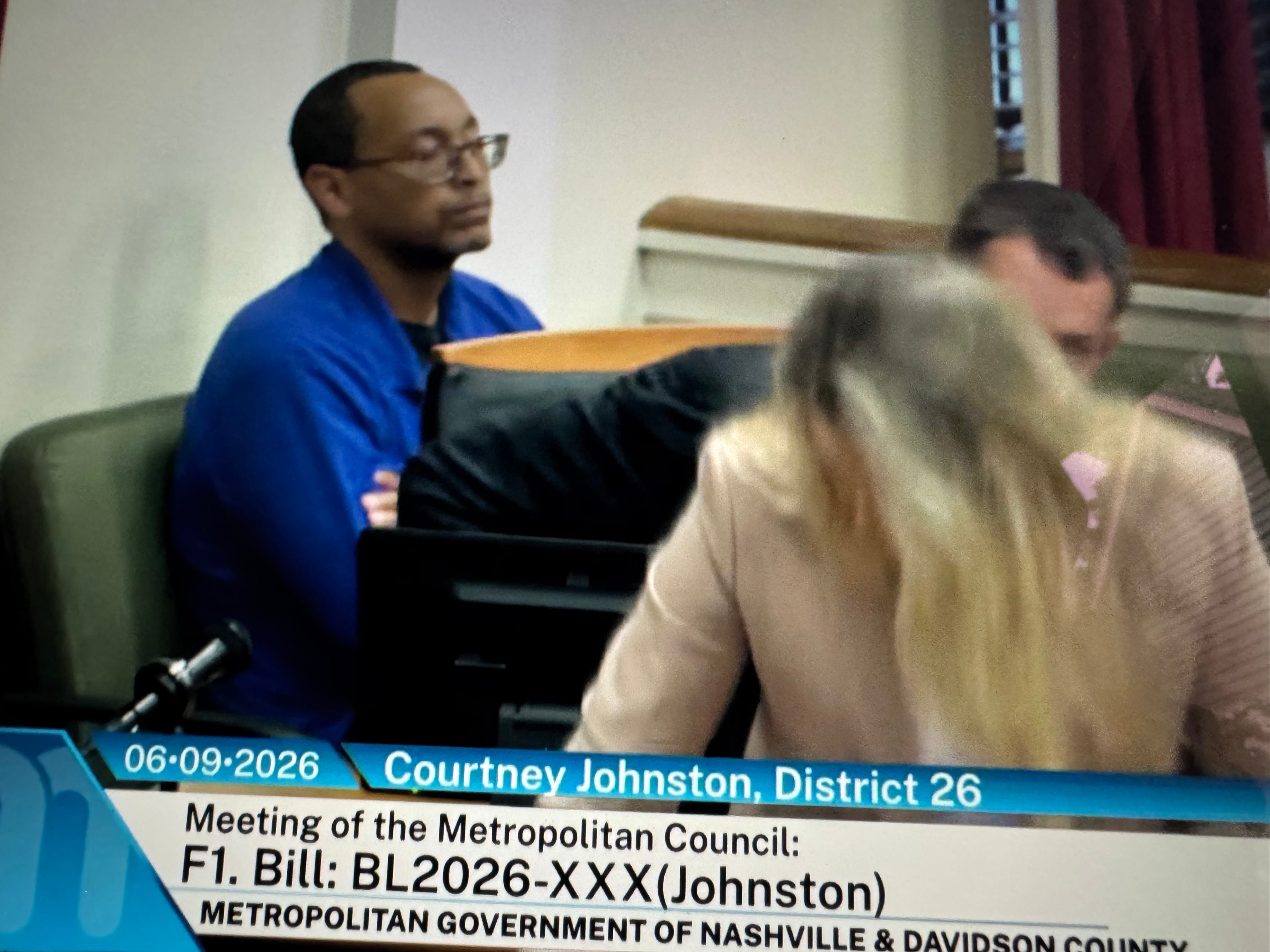
Councilmembers Benedict, Kupin, Cortez, and Gadd spoke in support of passing Johnson’s Temporary MORATORIUM. Toombs asked a few clarifying questions while Horton pointed out why the bill was not needed, given how quickly his REGULATION bill was moving through the Council process.
Porterfield identified 3 major reasons why she did not support Johnson’s Temporary MORATORIUM late-filed bill, primarily expressing concern that passage would open Metro to legal challenges, as has happened in other cities, and given that Horton’s bill is expected to pass quickly, given the support of so many Council members, it would be redundant.
Only Porterfield voted against Johnston’s Temporary MORATORIUM bill, which passed 26-1. The next step is for it to be on the Second Reading Agenda at Tuesday’s (June 16th) Metro Council meeting, when a Public Hearing will be held (6:30 PM, Metro Courthouse, 1 Public Square).
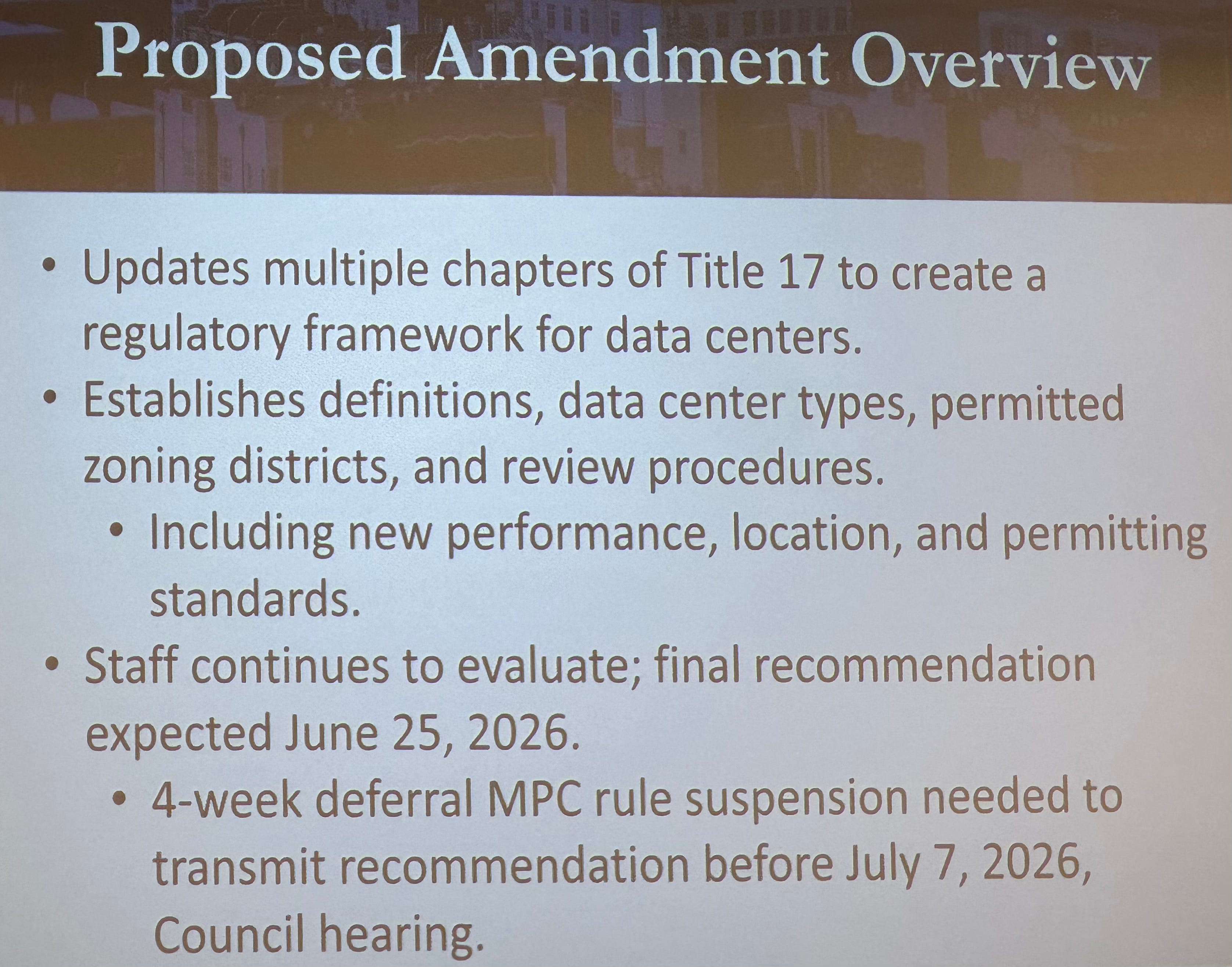
Meanwhile, regarding Horton’s REGULATION Bill, the Planning staff will pull together another draft, reflecting the comments and questions raised by the public and Commissions at Thursday’s meeting, and share their new recommendations with the Commissioners by 6/18 in preparation for the follow-up Planning meeting (6/25 at 4:00 PM, Howard Office Building). If Horton’s REGULATION bill passes at the 6/25 Planning meeting, it will be presented to the Metro Council at its regularly scheduled meeting on July 7th, when it will be on Second Reading, which includes a Public Hearing.
It’s important that lots of people show up and testify at the 6:30 PM scheduled Public Hearings, given that both bills are now being considered for passage: Tuesday, 6/16 for Johnson’s MORATORIUM bill AND Tuesday, 7/7 for Horton’s REGULATION bill
If passed, the bills move on to Third and Final Reading the following Tuesday, and become law at that point (Johnson’s Temporary MORATORIUM bill on 7/7 and Horton’s REGULATION bill on 7/21).
It is fitting that, given the amount of public interest and concerted effort to let their opinions be known, Councilmembers are working together to protect the Nashville Community as best they can, and that we all SUPPORT THEIR EFFORTS BY CHAMPIONING BOTH BILLS.
What I know from experience at the Tennessee Legislature, if we try to pass legislation that would BAN DATA CENTERS COMPLETELY, the State will most likely step in to set the rules, and we know how this has worked in the past (just remember the Musk Tunnel debacle). Sharing your expertise with Council members via telephone calls and emails, so they are educated about the best protections to include in the REGULATIONS, is critical right now (See Horton’s bill in full below).
Nashville is viewed nationwide as the place that successfully fought back against city-wide surveillance, because we successfully halted the efforts of the Metro Nashville Police Department and the Downtown Partnership to install license plate readers and FUSUS, among other tools, promoted by over-policing advocates. DATA CENTERS ARE MERELY ANOTHER SUPER TOOL to SURVEIL us, unless we pass laws to hyper-regulate their use. Otherwise, these Data Centers will be everywhere mining our private information for private corporate gain. Musk’s plans with Starlink are a good example, as reported in Slate’s recent podcast, “IPO to the Moon” (HERE ), leading to the Orweillian Big Daddy in the Sky (Hope you enjoy the musical interlude at the end of this Post).
Our freedoms are at stake, and we must stand in the way of their further erosion.
We are not gold to be mined but people to be cherished and protected.
This list of items is fully covered in the sections below. Scroll to what interests you.
Personal Comments (General Recommendations, Fisk, The Nashville Zoo)
Pictures and Videos of several Current Nashville Data Centers identified by Channel 4
Pictures and Videos of Two Controversial Proposed Data Centers (Fisk and The Nashville Zoo)
June 2 Council Meeting- Horton’s REGULATION Bill
June 11 Planning Commission Agenda
June 11 Planning Staff Analysis of Horton’s REGULATION bill
Video of TESTIMONY at 6/11 Public Hearing (NOTE: My camera died early in the evening, but the entire hearing regarding Horton’s REGULATION bill (BL2026-1391) can be viewed HERE)
Notes of Public Comments at 6/11 Public Hearing
Comments and Questions by Planning and Zoning Commissioners following 6/11 Testimony
Fisk University Petition
Nashville Zoo Petition
Select Media Coverage
Research articles about Data Centers
Full text of Horton’s REGULATION bill
Text of Johnson’s late-filed Temporary MORATORIUM bill, 6/2 Council meeting
“Big Daddy in the Sky- Still the Same Video”
(To find your Metro Council District and Representative, put your address in the Council Member LOOKUP HERE).
Even though the night was long, it was exciting and encouraging to hear the comments provided by so many well-informed people from diverse backgrounds who are paying attention to the challenges they, their community, and others are facing regarding Data Centers. Keep talking up, Nashville!
It is WE who determine our own future, and that of those living among us, as well as coming along behind us. As Mother Jones reminded the members of the United Mine Workers Union in 1905, we should “Pray for the Dead, but fight like hell for the living.”
So, “Fight like hell for Nashville. If we pay attention, stay engaged, and willingly weather the struggle, we will win!” You got this!!! Michele
A FEW PERSONAL COMMENTS
GENERAL:
Every newly proposed Data Center needs to be evaluated for its impact on sentient beings and the surrounding environments, at the time it is reviewed for a permit to operate, and also each year when it is monitored to ensure compliance with the Data Center Regulations. The most up-to-date science and health information available must be utilized as the basis for this evaluation.
Currently operating Data Centers should also be evaluated utilizing the same Regulatory tool created to issue a permit for a new Data Center. When the company plans to modify or expand a Data Center, the current REGULATIONS for Data Centers should be applied to them, just as though they were being newly established and seeking an operating permit.
Members of the community living near each new and existing Data Center must be educated by Metro when there is a proposed plan for installation or expansion, along with its benefits and potential harms, and their concerns should be the guiding light for every step undertaken by the Data Center and during the yearly evaluation process by Metro.
A moral analysis of Data Center impact, alongside a scientific and environmental assessment, should occur when arguments are made in favor of the positive financial benefit of a Data Center that also risks the health and welfare of individual residents and the environment.
Every effort should be made to limit the number, size, scope, and location of Data Centers in the Nashville/Davidson County area, including height as well as width.
Building strong accountability structures into the Regulations is a primary need and should be reflected in the adoption of robust enforcement mechanisms.
FISK UNIVERSITY (See videos posted below):
When I first arrived in Tennessee in 1984, I worked for the Tennessee Hunger Coalition, housed in a small office at the Matthew Walker Health Center, located on Herman Street, just around the corner from Fisk University. While I take a strong stance against locating a Data Center in a neighborhood, especially one surrounded by people living in subsidized housing and students in dormitories, it’s important to pause so that the economic challenges facing Fisk and the institutional inequities lingering in Nashville post slavery and the Jim Crow era, coupled with a federal government intent on eliminating funding for HBDU’s, are not overlooked and simplified.
For context, Vanderbilt University opened its Data Center in 2003 with little if any engagement of students or the surrounding community (as far as I could find) and few if any questions . Located at 231 18th Avenue South, on the Peabody Campus, it appears to have two aspects:
1.) The Hill Data Center (HDC) is the university’s main on-campus facility that manages “general networking, servers, and IT infrastructure” for its institutional needs.
2.) The ACCRE Cluster (Advanced Computing Center for Research and Education) manages high-level research and supercomputing workloads that could be contracted out to other partners interested in utilizing these services.
Similarly, in 2025, Meharry Medical Center opened the Enterprise Data and Analytics Center located in Dorothy Brown Hall. I could find no reporting of their engagement with its employees or the surrounding community.
I posit that no Data Center in the Nashville/Davidson County area up to this point has chosen to be accountable to the community in which they are located. Community engagement by institutions, the government, and corporate entities attempting to leverage local land, money, or people resources for their own benefit is critical, given that local stakeholders have historically had the least to gain and the most to lose by any development deal.
It is precisely because of its rich history and cultural assets that Fisk University is being held to a higher standard than other educational institutions with established Data Centers. Fisk is being called to repair its damaged credibility from failing to engage its students, faculty, alumni, employees, and members of the surrounding neighborhood in its plan to locate a Data Center on its campus. According to the Nashville Scene article referenced below, Fisk University has yet to publicly name the corporate or technology partners it has approached and secured for the 30-megawatt, $400 million technology facility, which will be “part of the university’s broader $1 billion ‘Quantum Leap’ master plan.”
There is an understandable interest on part of 12,405 signers of the Change.org petition started by Winston Wright protesting the installation of a Data Center on the Fisk Campus. This was magnified by media coverage of those supporting the demonstration led by Representative Jones on the Fisk campus itself to bring attention to this matter. Many residents are also expressing concerns given the environmental impacts of Data Centers on predominantly African American communities, such as Memphis, which have been overlooked, defunded, gentrified, uncared-for, and displaced by insiders and outsiders knowingly mining the people of their culture and property resources.
In addition to public statements that it is willing to abide by the Regulations governing Data Centers expected to pass Metro Council, this moment presents an opportunity for Fisk to intentionally engage the stakeholders noted above, share information with the public about its plans and operational partners, investors, and users, and commit to informing the community as the development process unfolds regarding the Data Center. If contracts have already been signed, this information should be fully disclosed and feedback solicited. No one wants to see the associated pollution and high levels of noise experienced by other communities lead to residents of North Nashville, who have survived the rampant gentrification of the past few years, being unable enjoy living and thriving in their claimed homes.
Also, outside of its history, educational reputation, and cultural legacy, Fisk’s main economic asset is the land upon which it sits. Fisk should not allow this long-held asset to be transformed into the inflictor of harm and trauma on the very people most aligned with the University’s mission, the North Nashville community.
Equity means holding everyone to a similar standard. Thus, we in the general public should be careful not to disparage an under-resourced institution led by and dedicated to mostly African American under-resourced students, in a city that is thriving on a mostly white tourist industry featuring predominantly white artists.
We also need to question, were the leader of Fisk to be a white male, would we be applauding their business acumen at identifying a critical source of revenue to float a desperately under-resourced but reputationally important HBCU- ranked 7th in the country. How can we as a community help to bring this gem on a hill in North Nashville into economic stability so that it matches the academic brilliance of its students? When was the last time Nashville as a city, and each of us individually, invested in Fisk’s financial and infrastructure needs, the way we did when others we hold dear, such as our local public radio station, faced financial setbacks?
Let’s all pull our weight here to build a stronger beloved community that embraces and enhances each area of Nashville that we call home.
A few suggestions:
1.) A series of educational meetings held with students, faculty, on-campus workers, and members of the surrounding neighborhood to outline the potential health, economic, and environmental impacts of the proposed Data Center, would be beneficial. This includes investigating water source limitations and possible pollution, impacts on electricity availability and cost increases, air pollution from needed generators in the exact area with high concentrations of children with asthma, and expected effects on local transportation due to the construction and operation of the facility, among other challenges, which have made it difficult for people in other communities to live, work, and play near Data Centers.
2.) It would be wise to inform alumni and current faculty, along with other stakeholders, about who has approached Fisk about becoming a partner in the development and operation of the proposed Data Center. As this changes, updated information should be provided to all stakeholders.
3.) Fisk holds a great resource in the form of its alumni, current and former staff, and students who are long-time and valued investors in the institution. Their knowledge, commitment, and expertise could be “mined” to continually evaluate the efficacy of the proposed Data Center, along with other similar propositions, in this era when AI and other technological innovations are glamorized but often at the expense of the very people Fisk recognizes are its primary audience and essential partners.
4.) The greater Nashville community has the chance, and I suggest we harness the will, to help Fisk avoid what may very well be a regrettable compromise of money over principle. While it may be a simplistic suggestion, it is one that could demonstrate the real value this institution has in the minds and hearts of our community. We could each make a personal monthly financial investment in Fisk University to demonstrate that we believe in its importance, align with its mission and goals, and want to be a part of sustaining it into the future. Find out more about the University HERE and DONATE HERE.
THE NASHVILLE ZOO (See videos posted below)
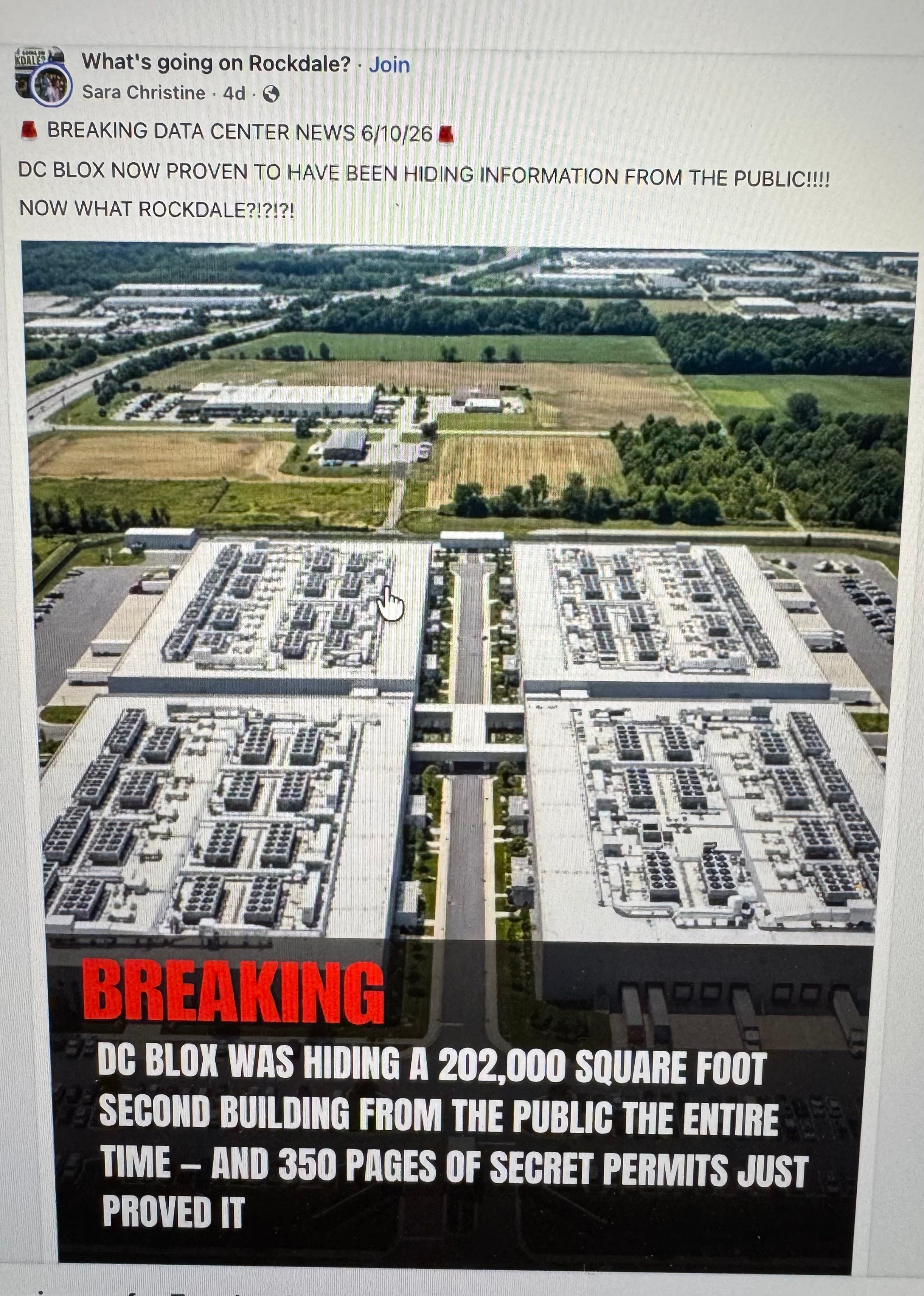
WSMV broke the story that the Atlanta-based DC Blox company misled the public about the size of the Data Center facility it planned to develop on the property adjacent to The Nashville Zoo at Grassmere, as outlined in their published Facebook Post HERE.
After perusing nearly 350 pages of permits, WSMV learned that instead of just the one-story, 69,000 square foot, 10 megawatt Data Center that DC Blox had led the public to believe was the full impact on the zoo, it had all along planned a second undisclosed 3-story, 202,000 square foot facility operating at 40 megawatts across the parking lot from the zoo.
“This is why 360,000 people (who signed the petition against the proposed Data Center) were right to demand more than promises. This is why the Nashville Council was right to vote 26-1 for a moratorium. This is why communities across America are right when they say: we need to see the full plan before a single permit is approved… Because the full plan is never the first plan they show you.”
The public must continue to make both the moral AND scientific arguments against the proposed Data Center. Given its size and megawatt capacity, expected negative effects on water supply and quality, generator usage draining the electric grid, profound health effects on animals, children, and residents within the immediate area, there is no upside to the proposed Data Center at the Zoo.
The Zoo has a rich history (HERE). It is beloved by many living in the Nashville area and beyond. It would be hard to find someone in the city who has not taken themselves, their children, and grandchildren to enjoy a romp at the Nashville Zoo. The current 413,176 petition signers, along with the majority of the 178 people who stood in line for almost 6 hours to testify at the recent Planning meeting against the Data Center, identified the Zoo as a critical piece of Nashville’s cultural and entertainment quilt and a beloved destination worth preserving.
The Chief Revenue Officer of DC Blox, the sole person speaking against Horton’s REGULATION bill, was unwilling to disclose the large footprint the prosed Data Center would cover, even after the WSMV article. He even failed to address any of the many concerns raised by the speakers who passionately outlined their objections and requested that the city establish protections for the Zoo and the neighborhoods surrounding it from the installation of a Data Center in the vicinity.
There’s not much to say except don’t allow a Data Center to be installed in proximity to the Zoo. Period.
PICTURES and VIDEOS of SEVERAL CURRENT NASHVILLE DATA CENTERS
NORTH NASHVILLE
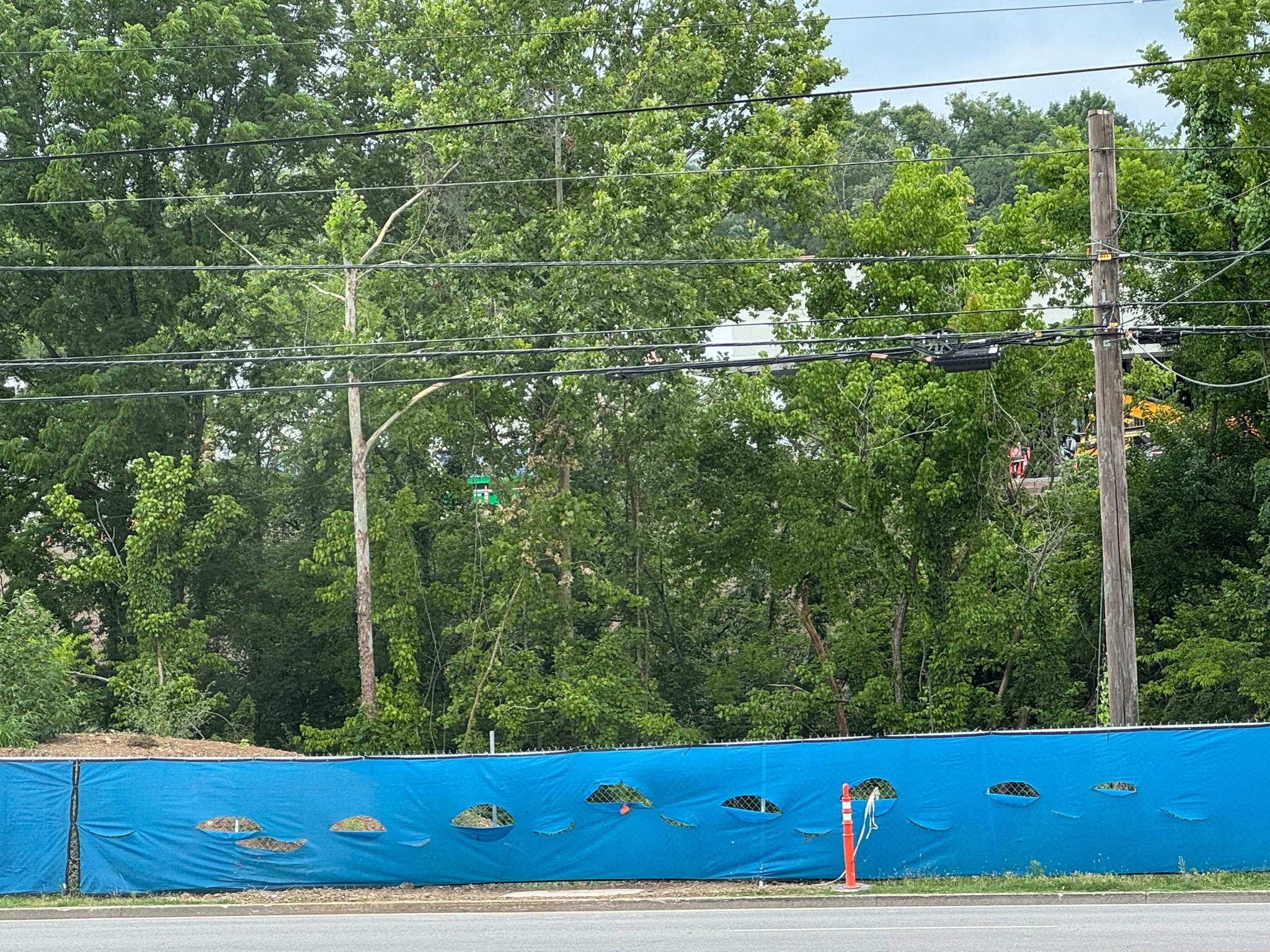
-2902 Brick Church Pike (District 2, Toombs) features three gates a distance apart opening into a quite large construction site in Trinity Hills, (102,500-square-feet) that is mostly an industrial area on that side of the road, but is located just across from the Middle School named for civil rights leader and judge, Richard H. Jenkins. More information about the developer“Radius DC” can be found HERE.
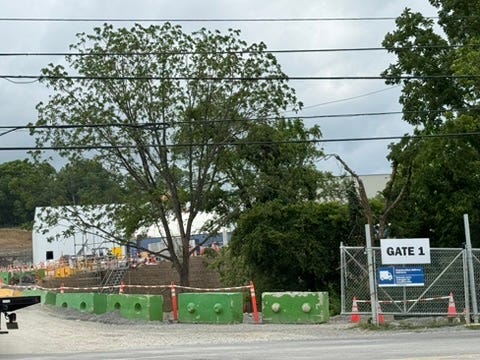
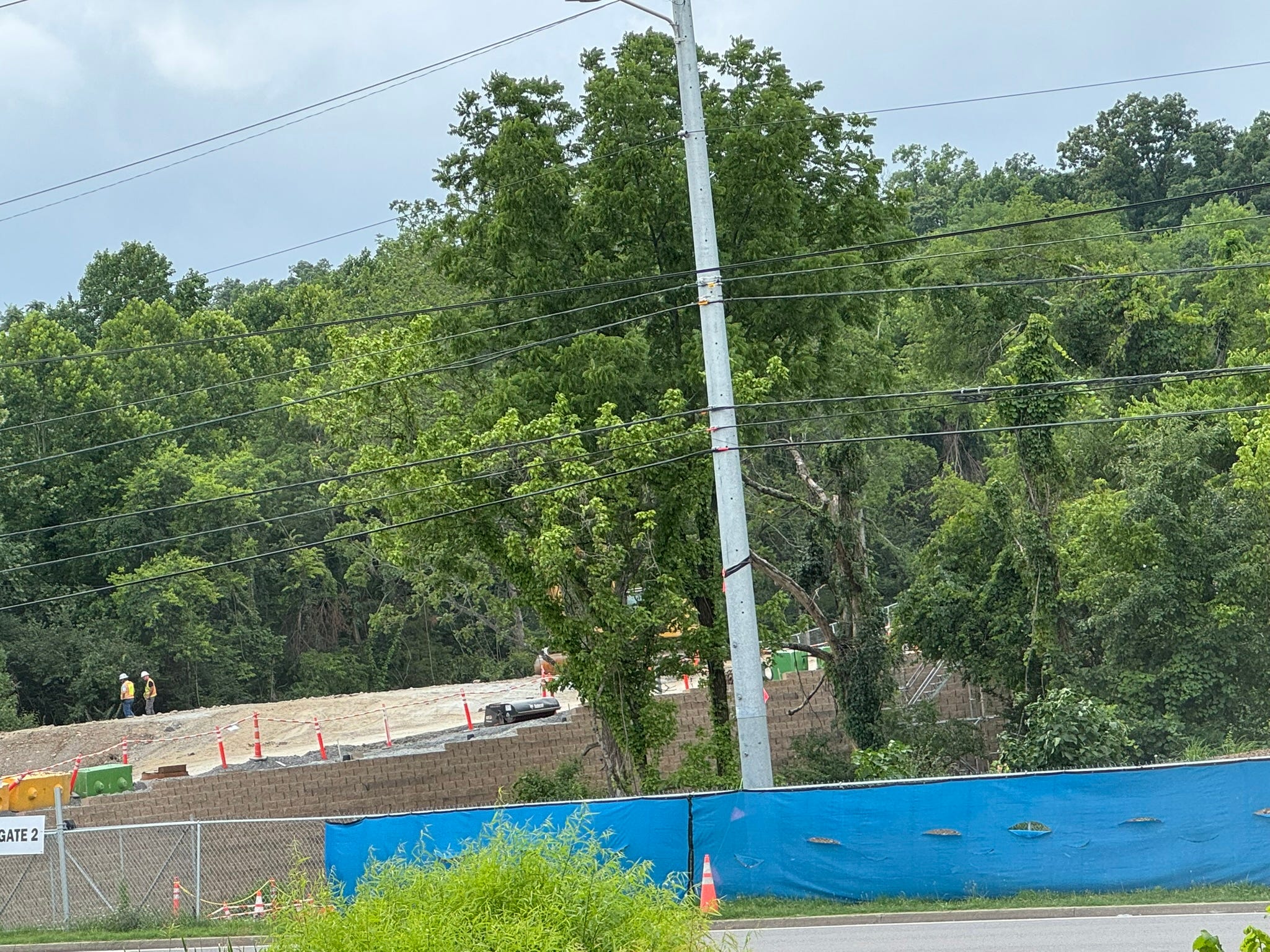
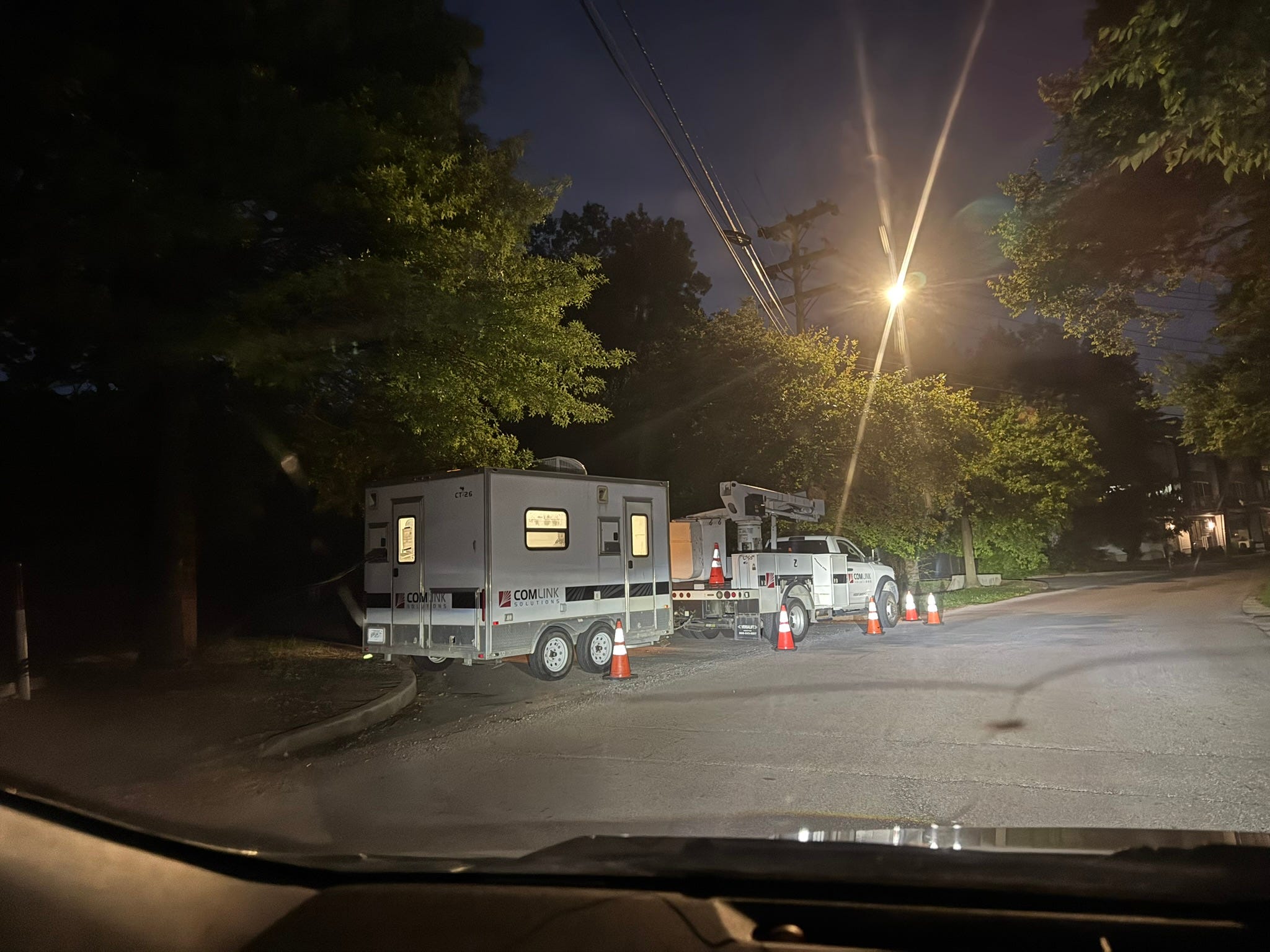
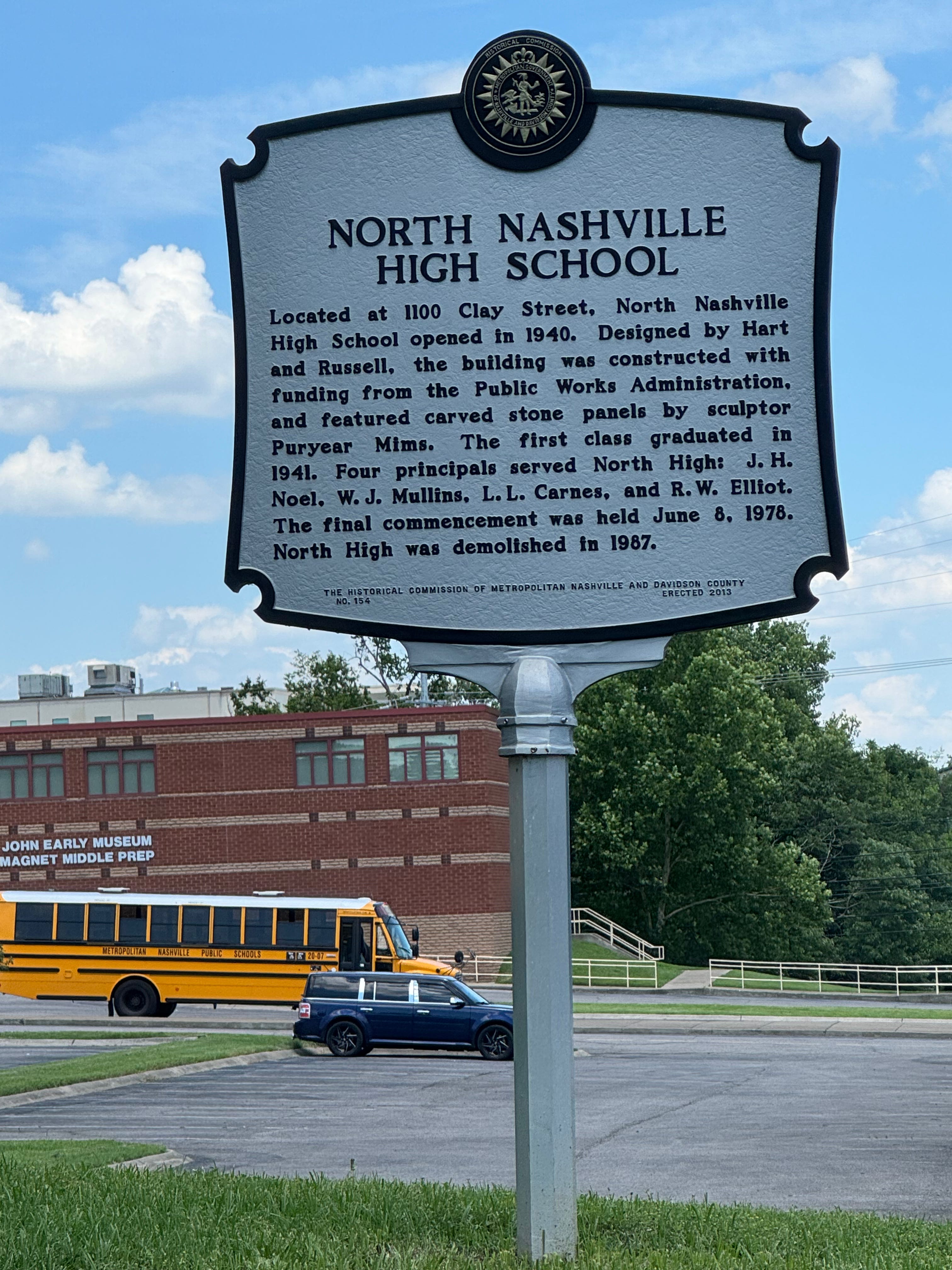
-2208 9th Ave. North (District 2, Toombs), this Data Center is located in the Buena Vista neighborhood, around the corner from John Early Middle School on Dominican Street.
Night View
Day View
DOWNTOWN
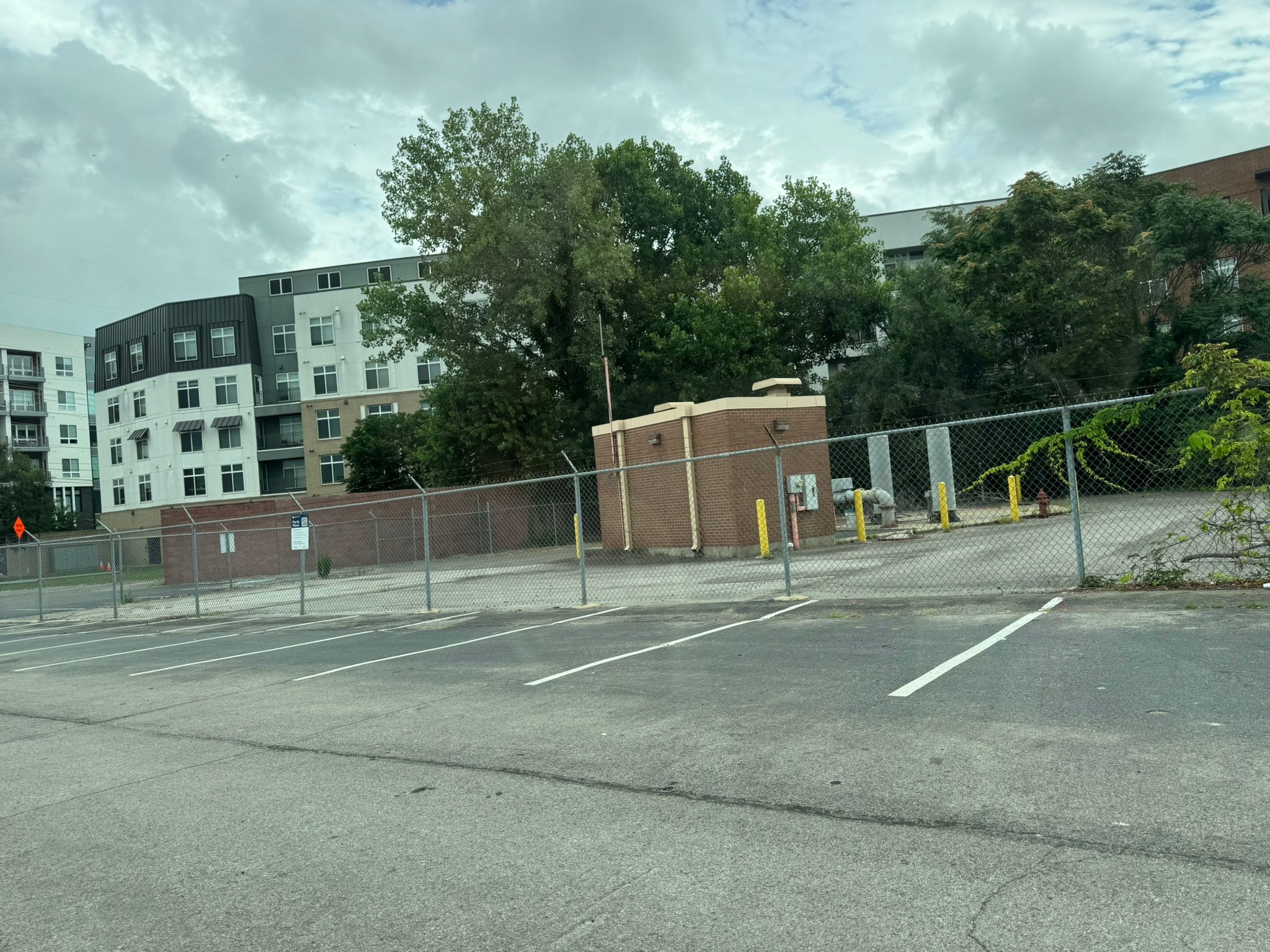
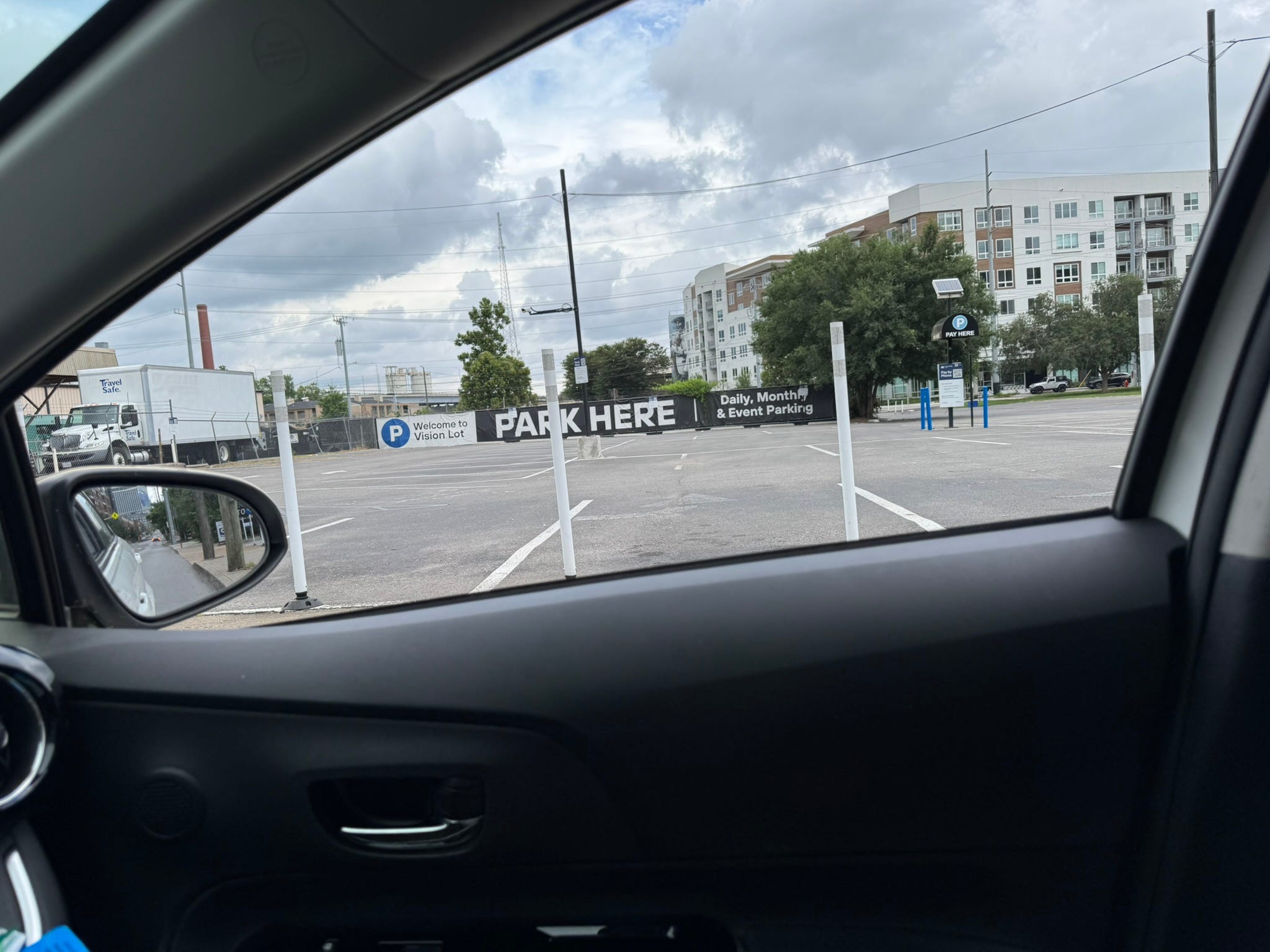
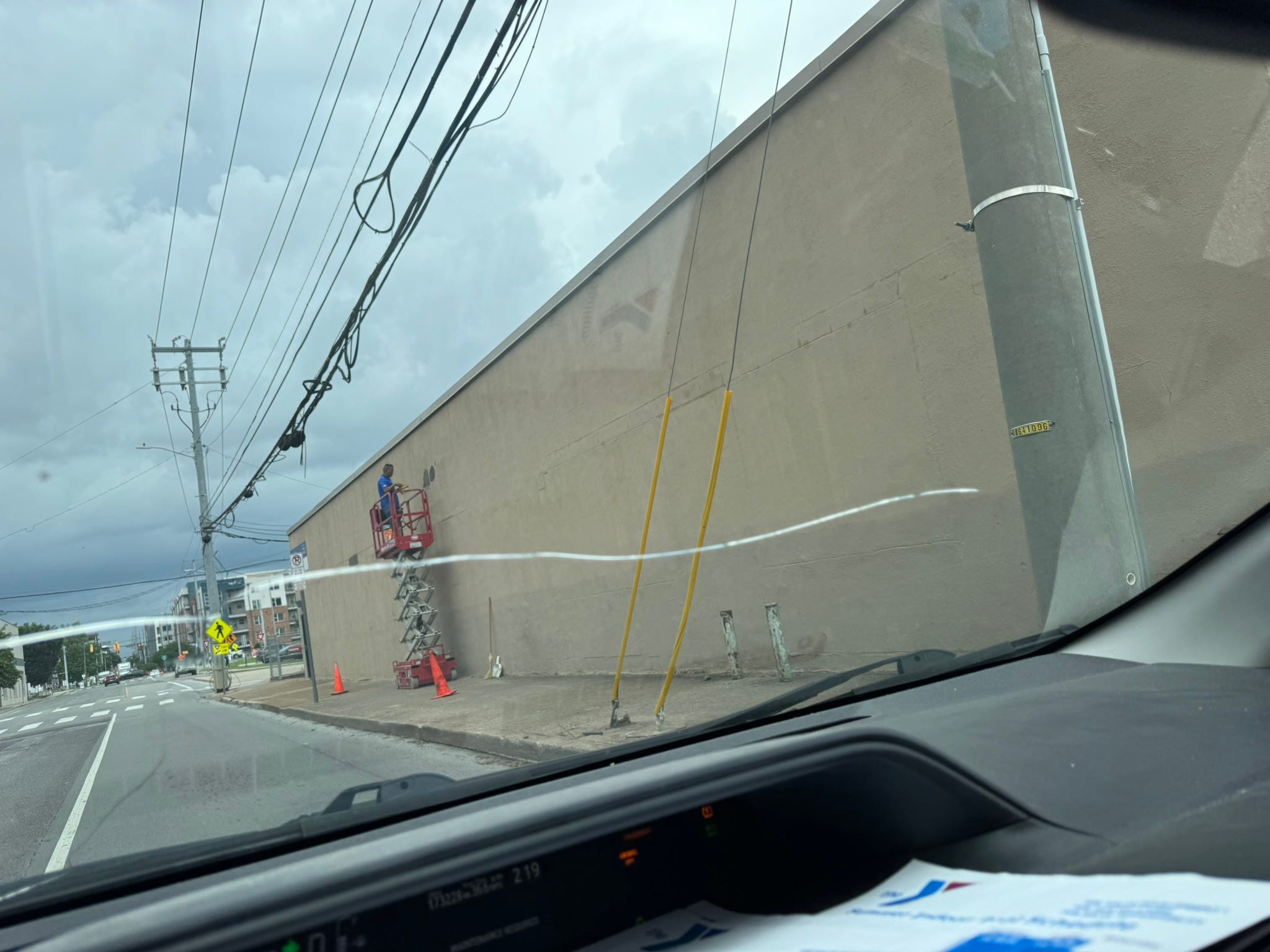
-940 3rd Ave. North (District 19, Kupin), is located across from Germantown in the North Nashville adjacent area, behind the Nashville Sounds Baseball Stadium, and in a newly developed downtown neighborhood. It was difficult to determine exactly which area housed the Data Center, so there are a couple of different photos of the unmarked properties at this address.
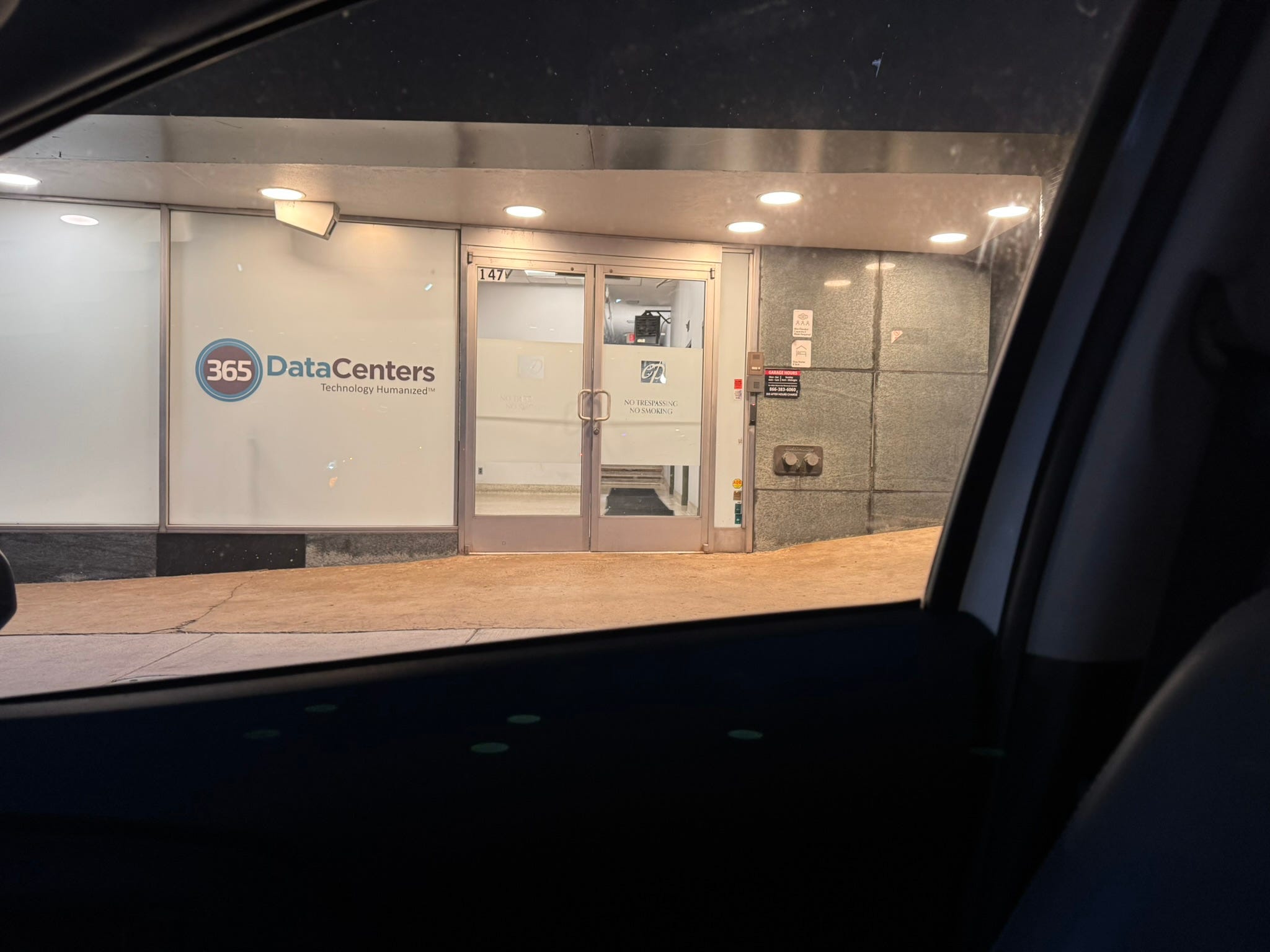
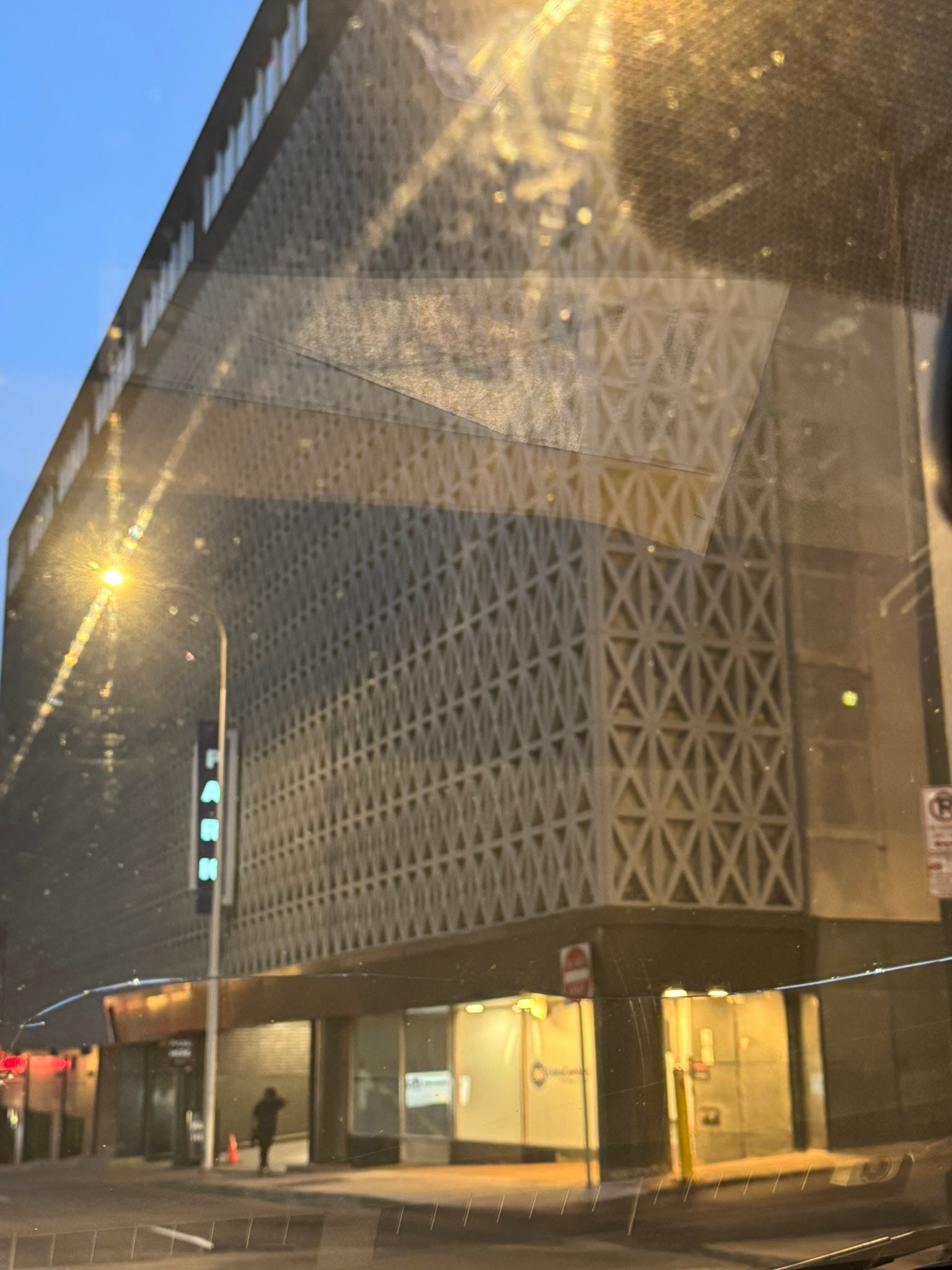
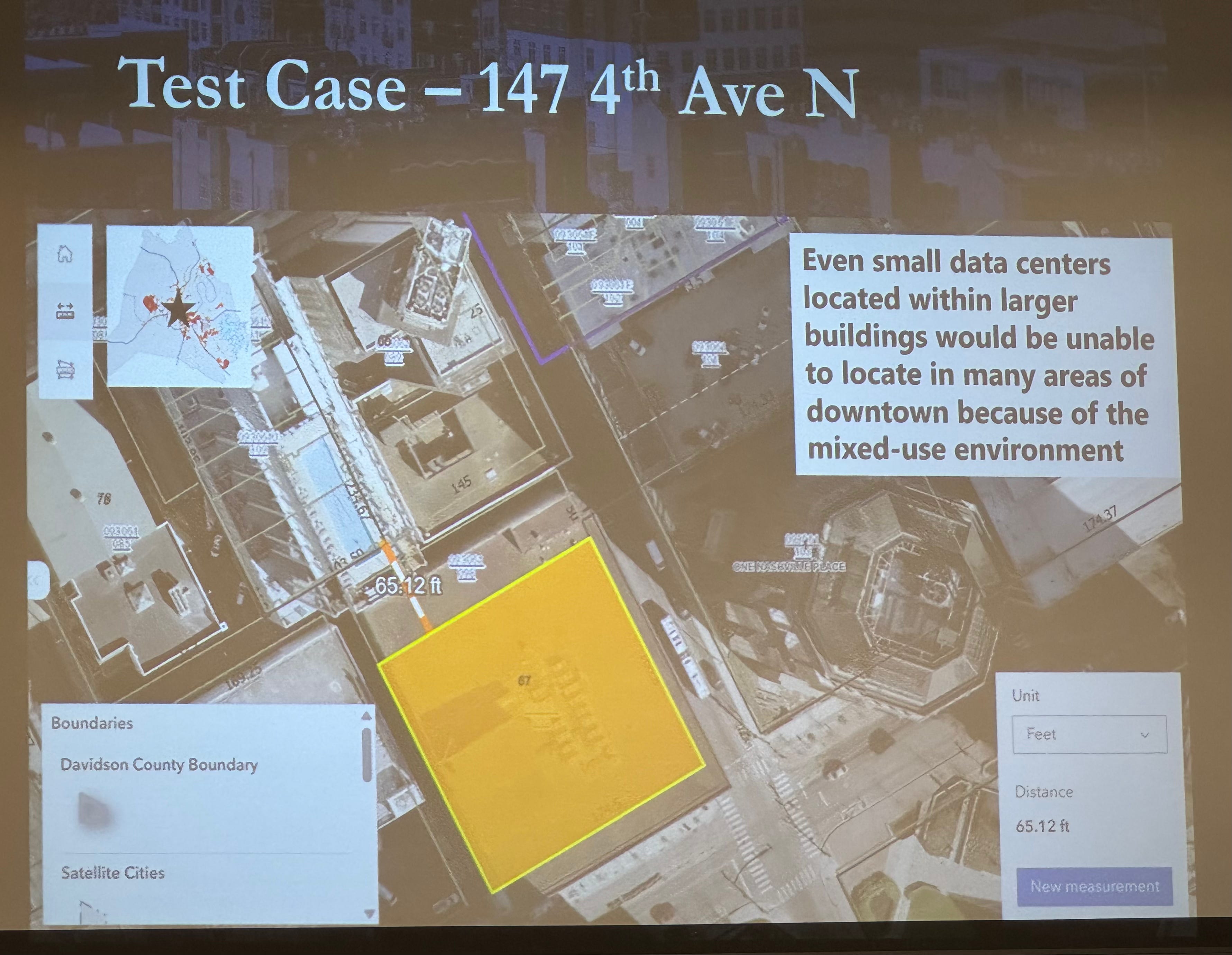
-147 4th Ave. (District 19, Kupin) is located in a large building along 4th Avenue between Commerce and Church Streets.
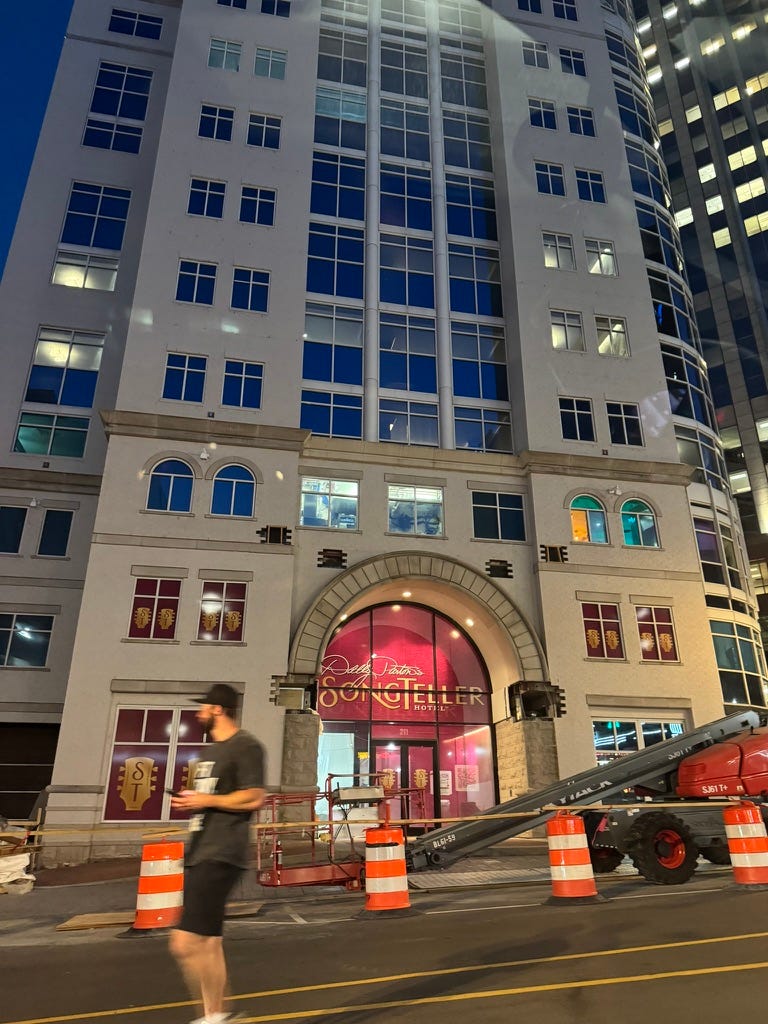
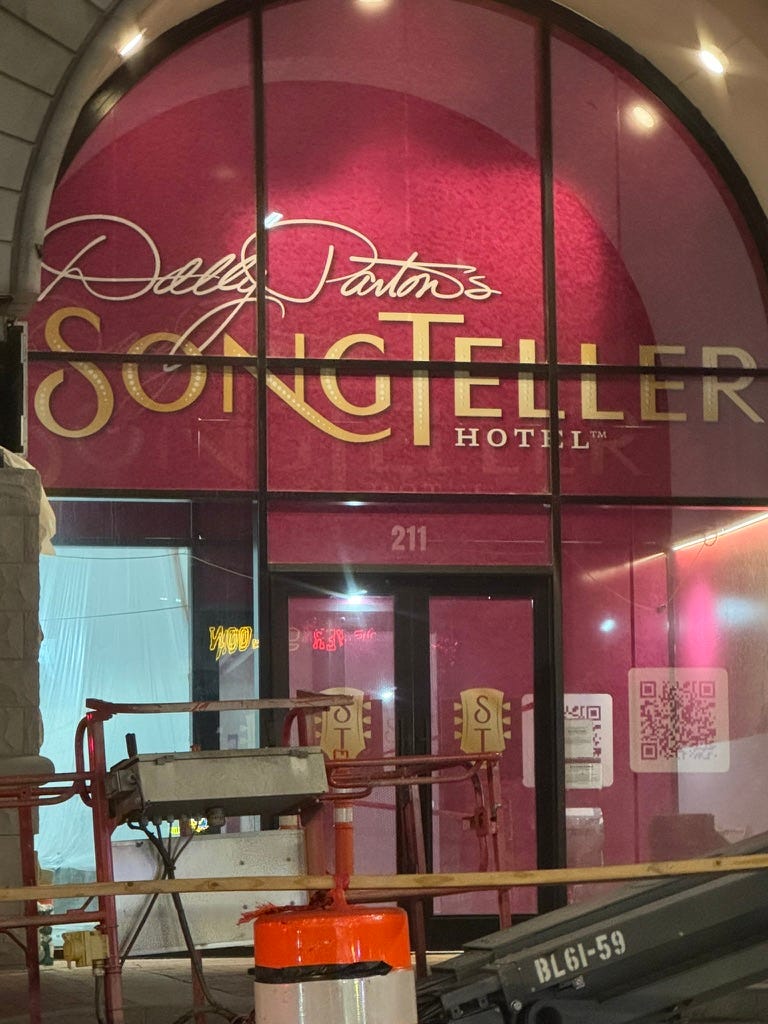
-211 Commerce St. (District 19, Kupin), is located at Dolly Parton’s “Songteller Hotel,” between 2nd and 3rd Streets.
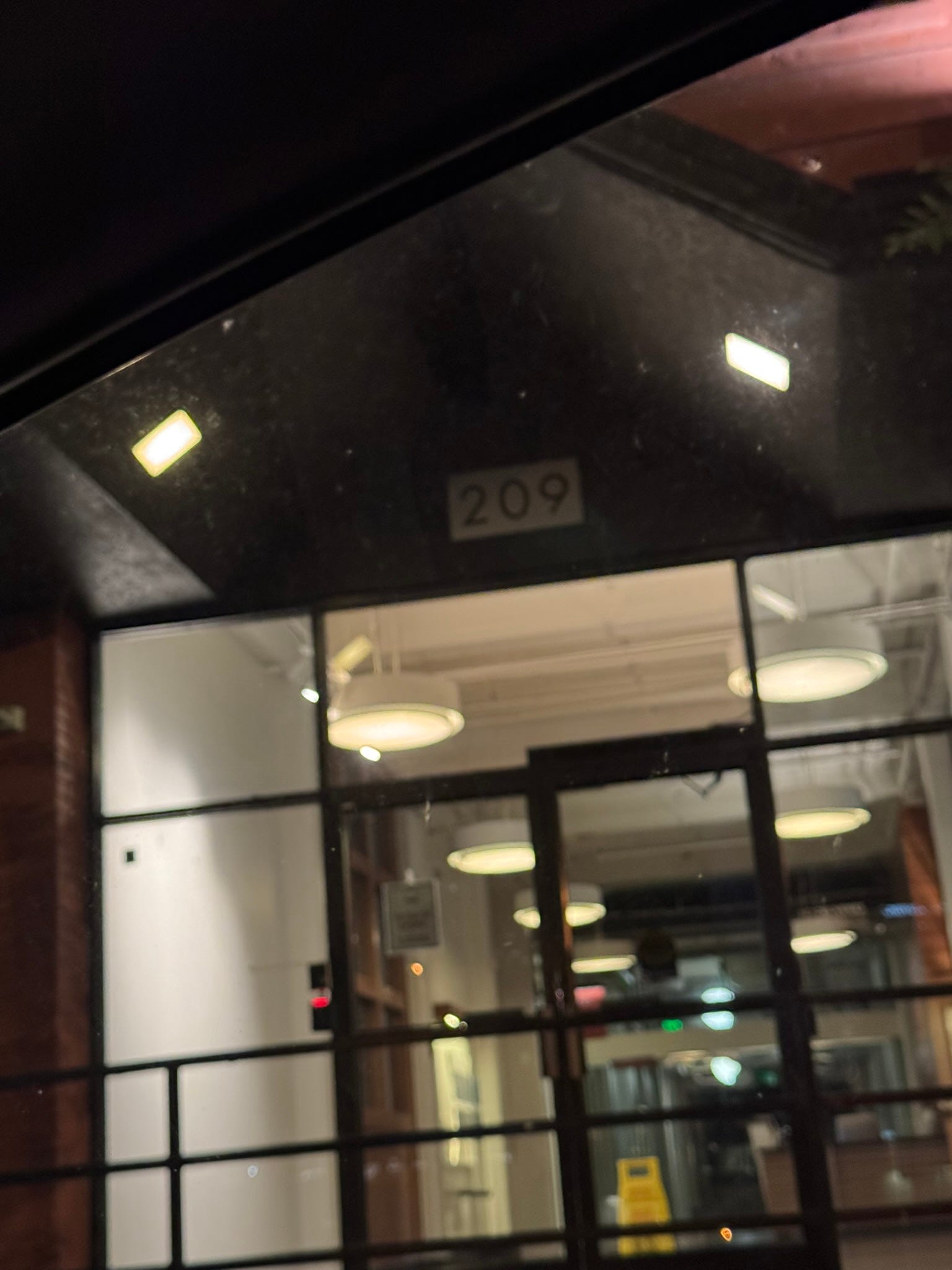
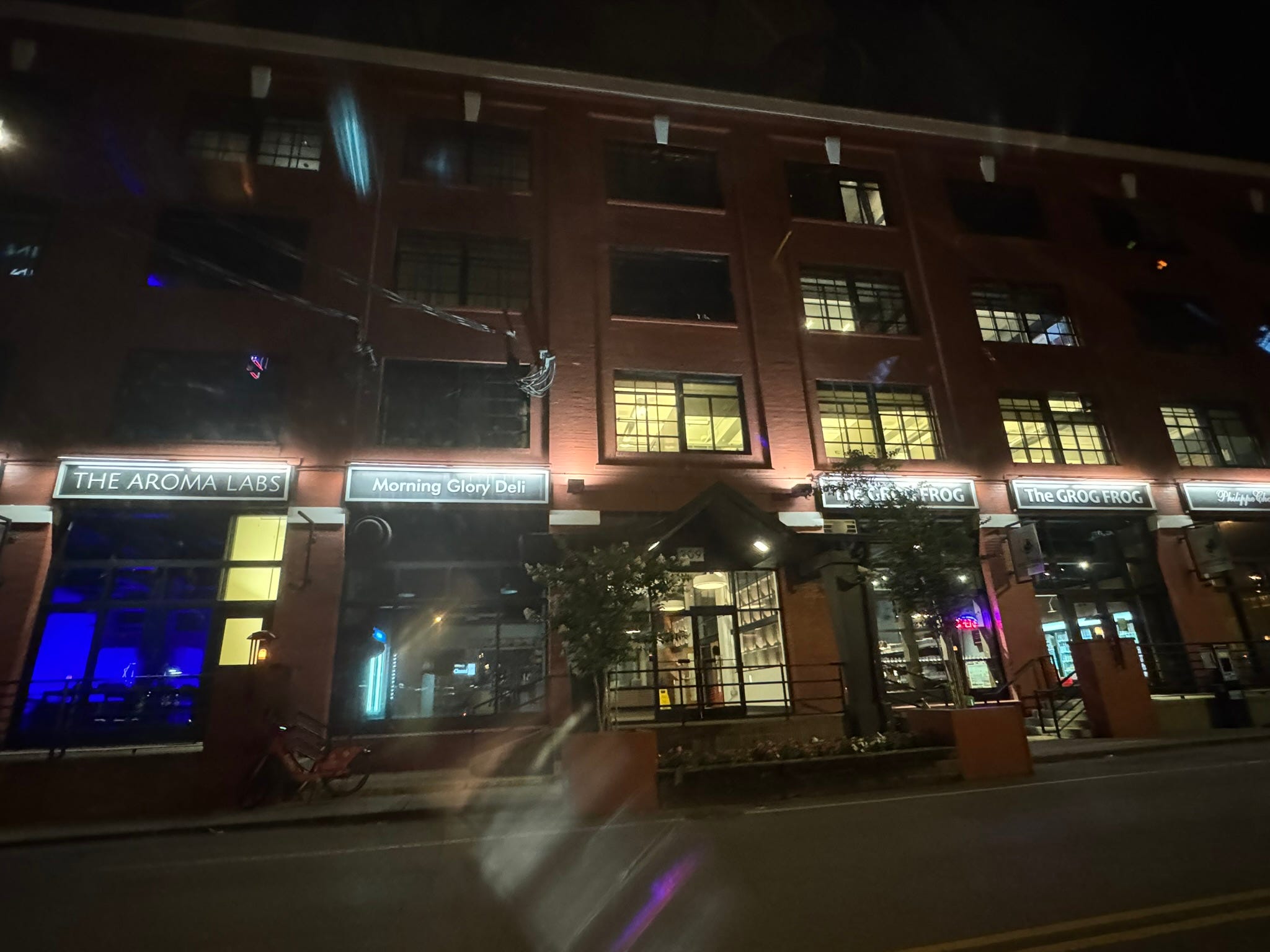
-209 10th Ave., South (District 19, Kupin) is located at Cummings Station, which sits at the corner of Demonbruen and 10th Streets, across from the back parking lot of the Frist Art Museum.
SOUTH NASHVILLE
-2990 Sidco Drive (District 26, Johnston) is an industrial area adjacent to Berry Hill and behind Hundred Oaks Mall, at the corner of Armory Street and Sidco Drive.
You can hear the noise coming from inside, and the sign “Lumen” on the door, which is an AI-linked company.
-708 Melrose (District 26, Johnston), is a “Century Link” company operating a fiber network and providing business telecommunication services, located in an industrial area, somewhat adjacent to the Berry Hill community.
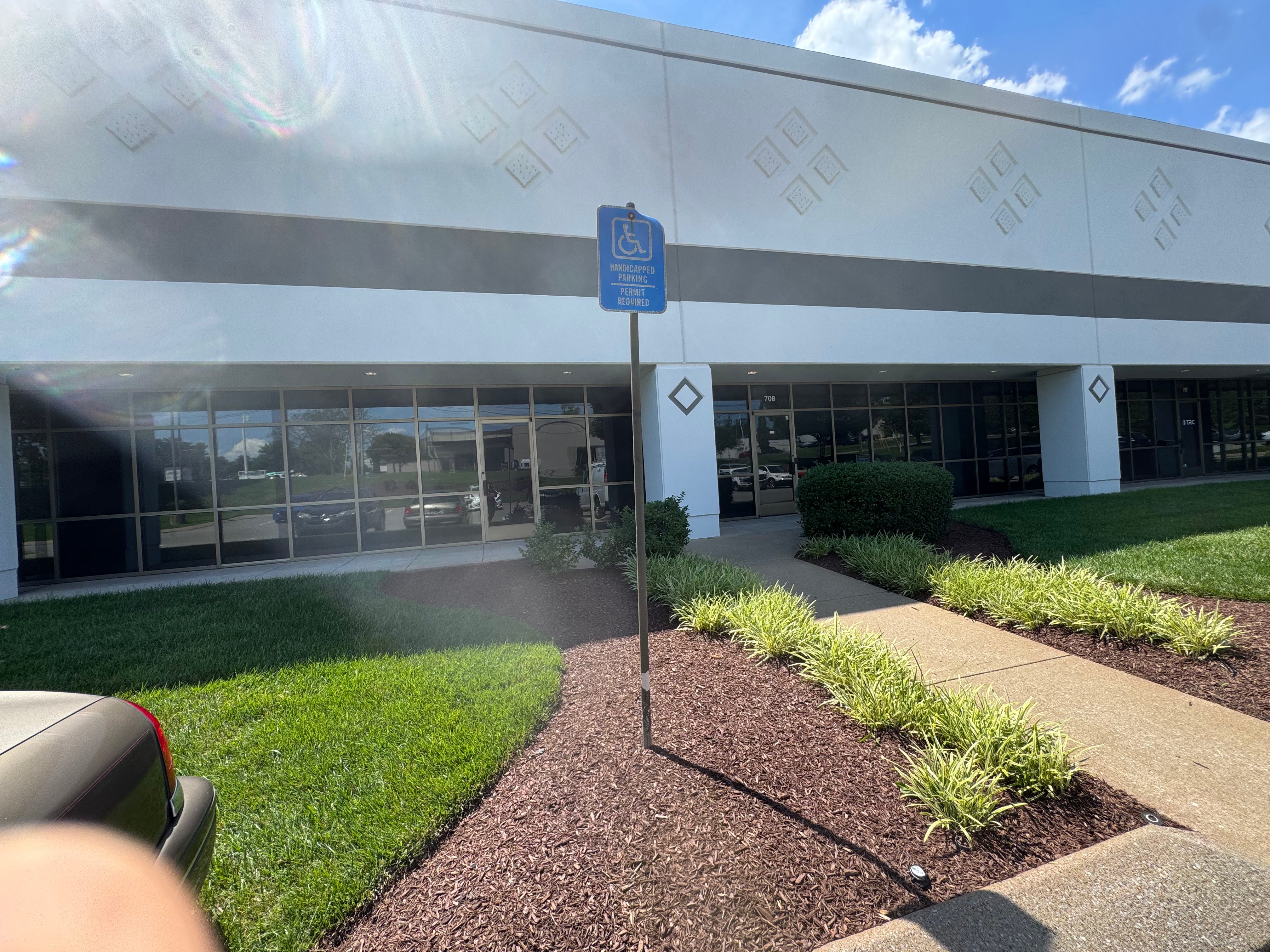
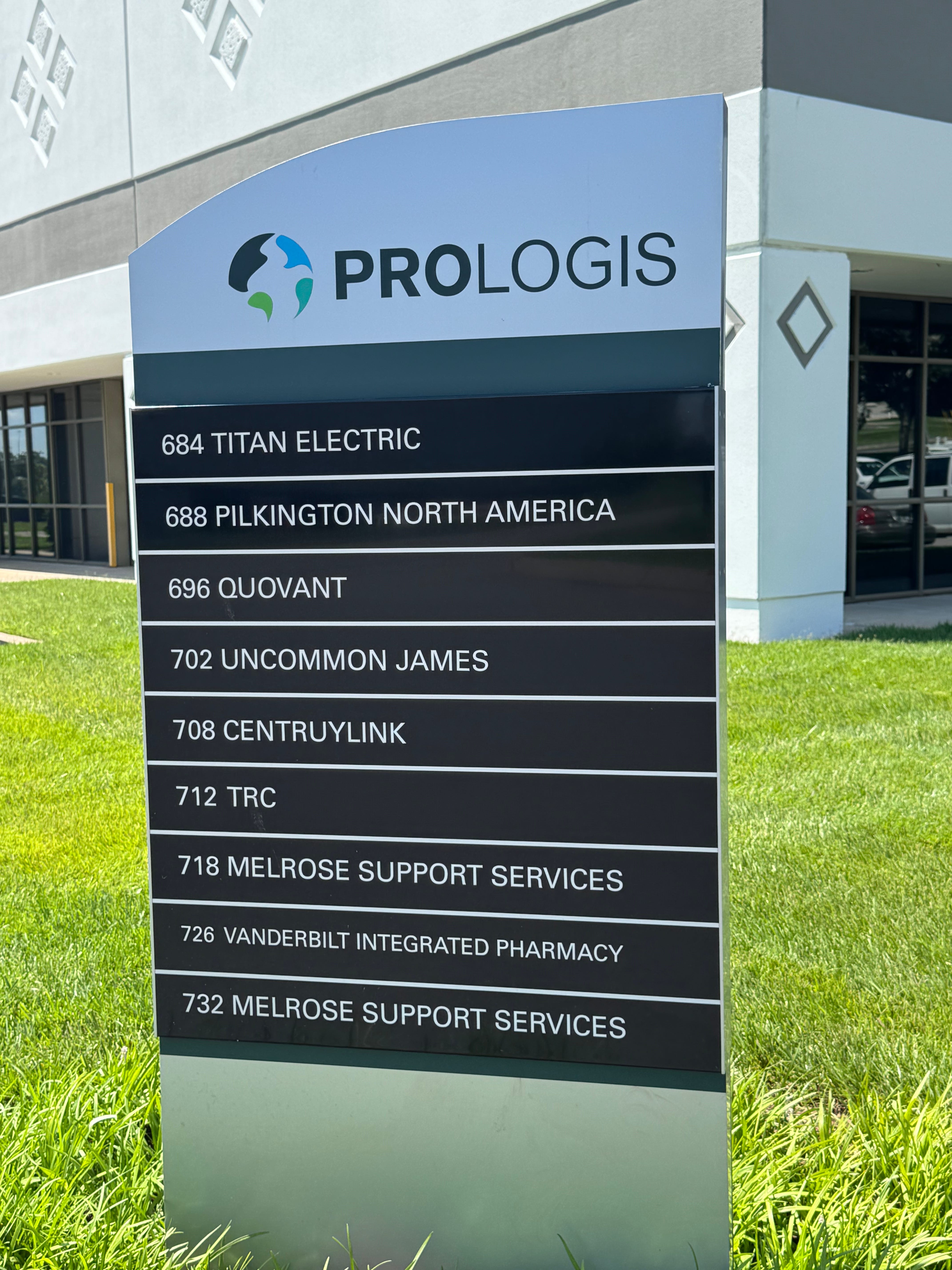
-338 Woody Crest Ave. (District 16, Welsch) is the location of a signless company along a street that includes varied quasi-industrial sites, such as a storage lot for Metro Nashville schools buses, and sits directly across from a residential neighborhood with lots of houses.
-1841 Air Lane Rd. (District 15, Gregg) is located off Elm Hill Pike in an Industrial Park area owned by “Prologis,” the largest industrial real estate owner in Nashville. Their properties comprise over 67 warehouse/logistics buildings covering 17.5 million square feet across the Middle TN region.
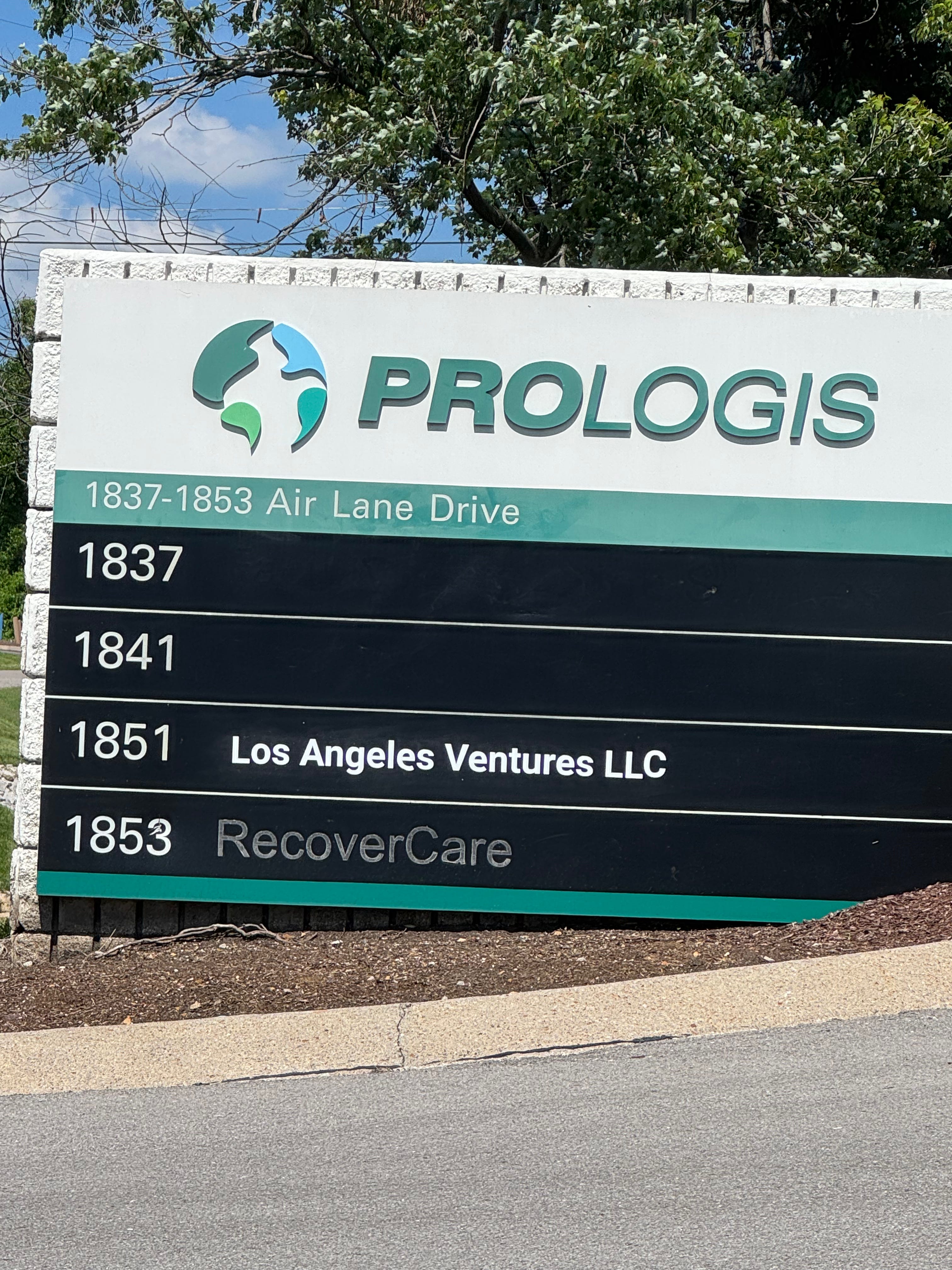
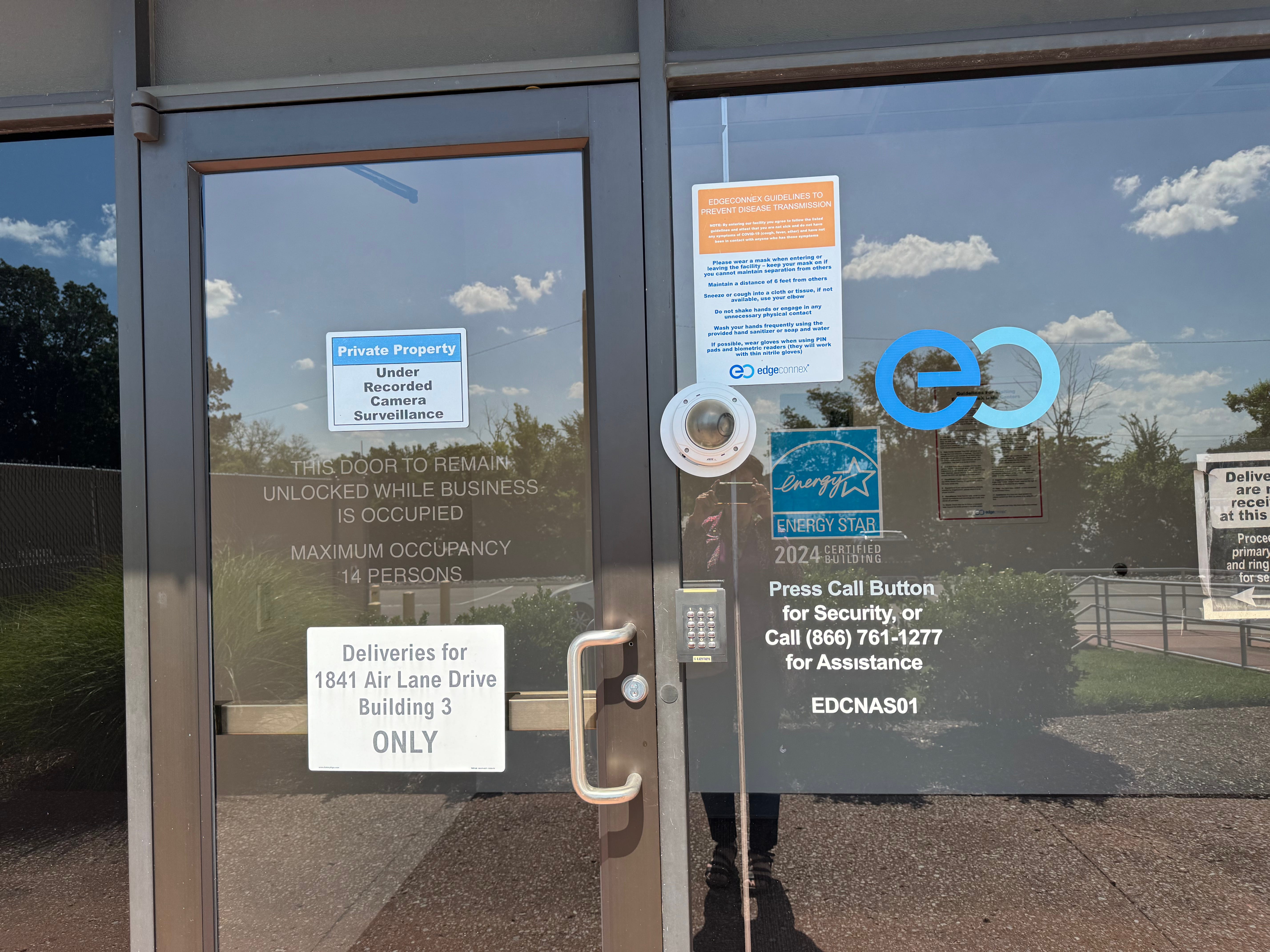
This is a quick video of the sound coming from the left side of the entrance, where there was a gate around the machines.
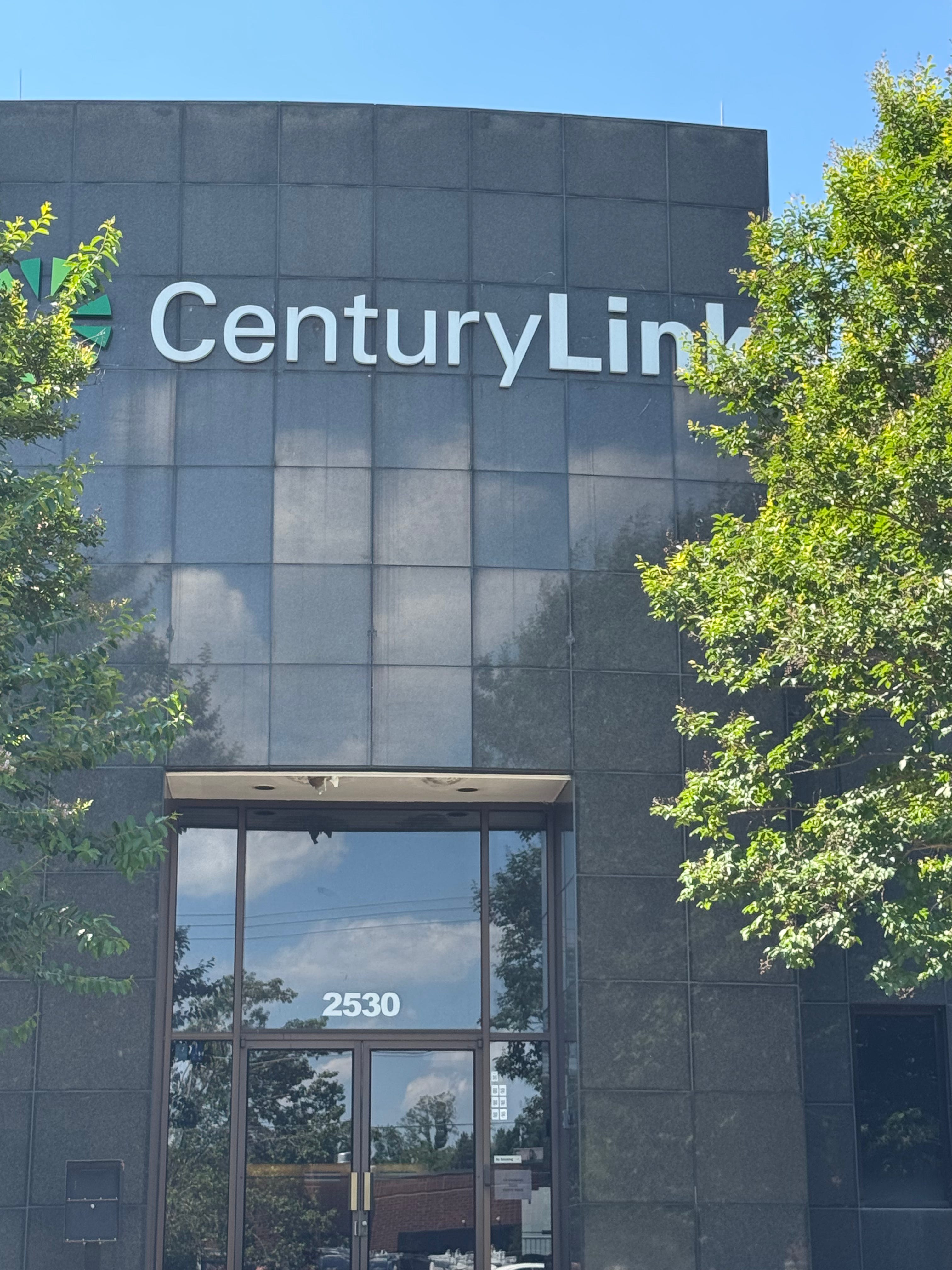
-2530 Perimeter Place Dr. (District 15, Gregg), is another “Century Link” property (see 708 Melrose above) located in an industrial park.
TWO CONTROVERSIAL PROPOSED DATA CENTERS
FISK UNIVERSITY, 1000 17th Avenue North, (Taylor, District 21)
The proposed Data Center at Fisk University is part of the intended 100,000-square-foot facility entitled the “Innovation Center.” It will be divided into a 70,000 square-foot technology/data center and 30,000 square feet of academic and workforce development space.
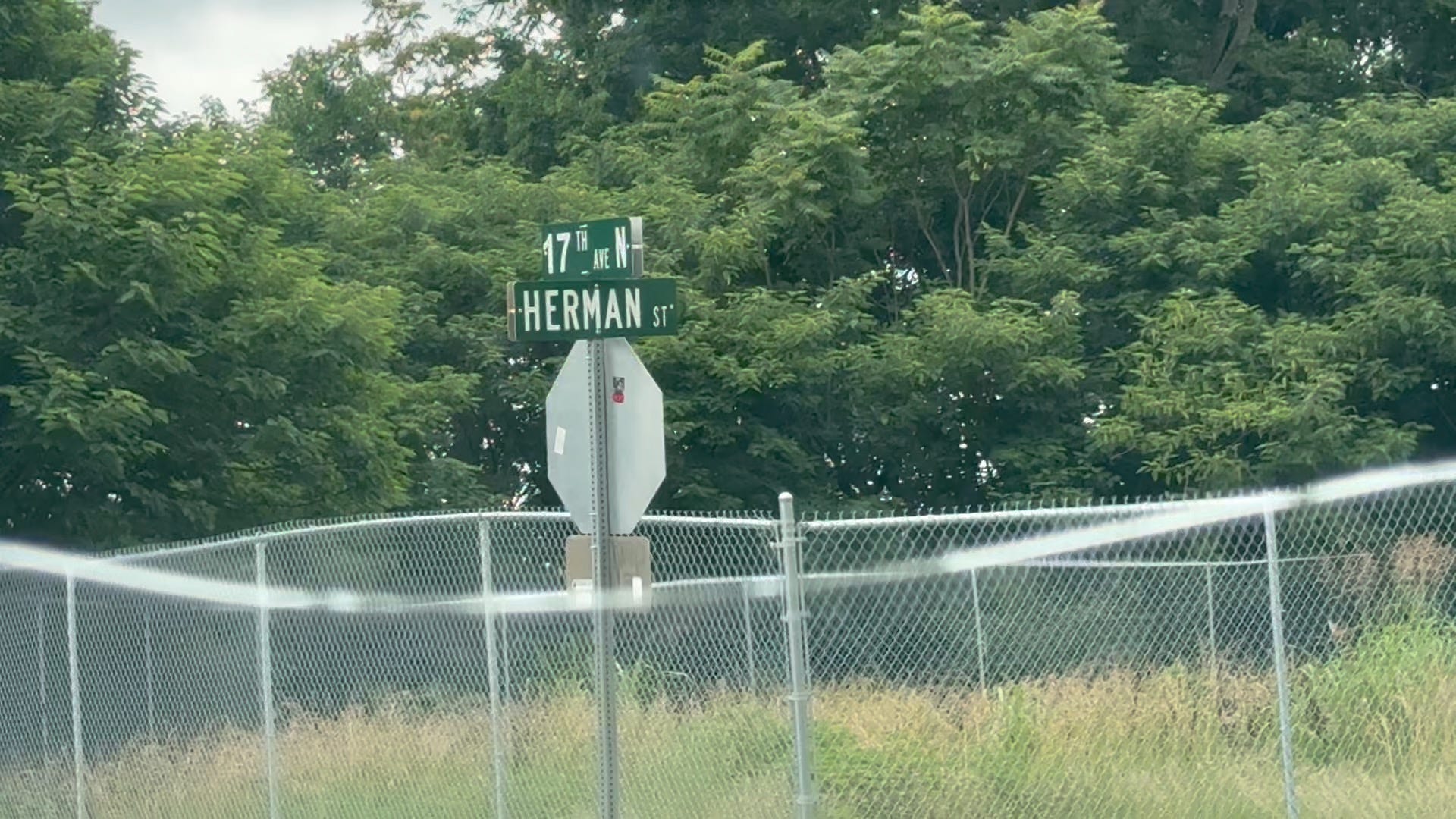
Located at the corner of Herman and 17th streets, it is just down from the main gate at the Fisk entrance, beside a dorm, across a field from what looks like public housing, and ends at a Railroad crossing.
Across the Street from proposed site at Fisk
Ends at the corner of the sign for 17th and Herman, adjacent to a railroad crossing (it’s unclear what the fence is protecting)
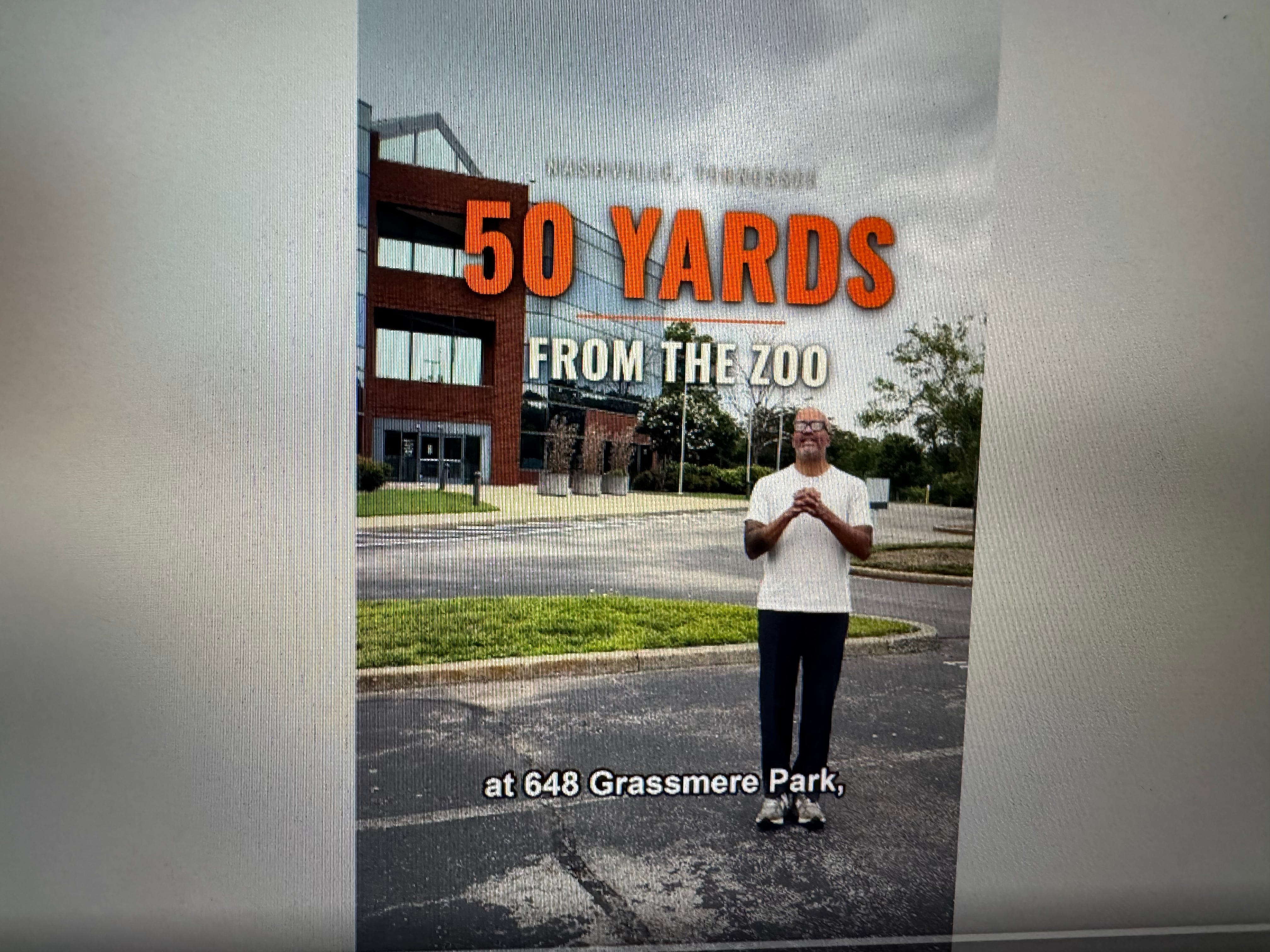
NASHVILLE ZOO, 648 Grassmere Park (Johnson, District26)
BC BLOX Data Centers, is the developer of the proposed Data Center on the property adjacent to the Nashville Zoo (WEBSITE HERE). Below is a map showing their expansion into five states, in addition to Tennessee.
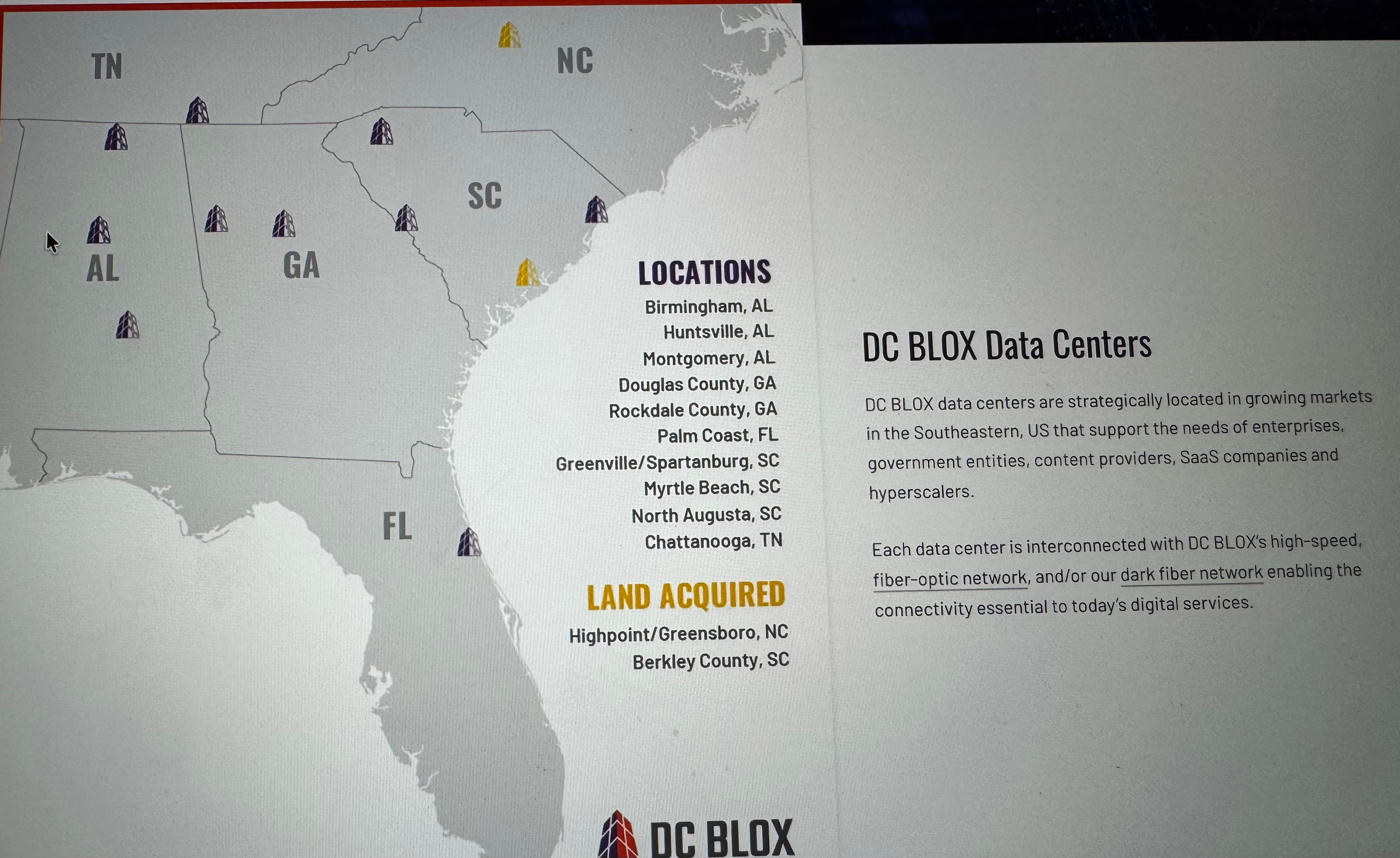
According to the publication DDC, the Petition against the DC Blox proposal to locate a Data Center adjacent to the Nashville Zoo has garnered more than 413,176 signatures at the time of this writing. In the same article, the company states that the total footprint of this company is 470MW and 2.78 million sq ft (258,270 sqm) across 23 facilities and “DC Blox recently added $600 million to its existing debt facility to fund data center projects in the southeastern US.”
This is a screenshot of the WSMV post:
Local resident Carlos Whittaker posted a Facebook video of the proposed site (VIEW HERE).
6/2 PROPOSED DATA CENTER REGULATIONS (Horton’s Bill, BL2026-1391)
-As presented at the Council meeting, Item #37 (BL2026-1391 and companion, BL2026-1392)
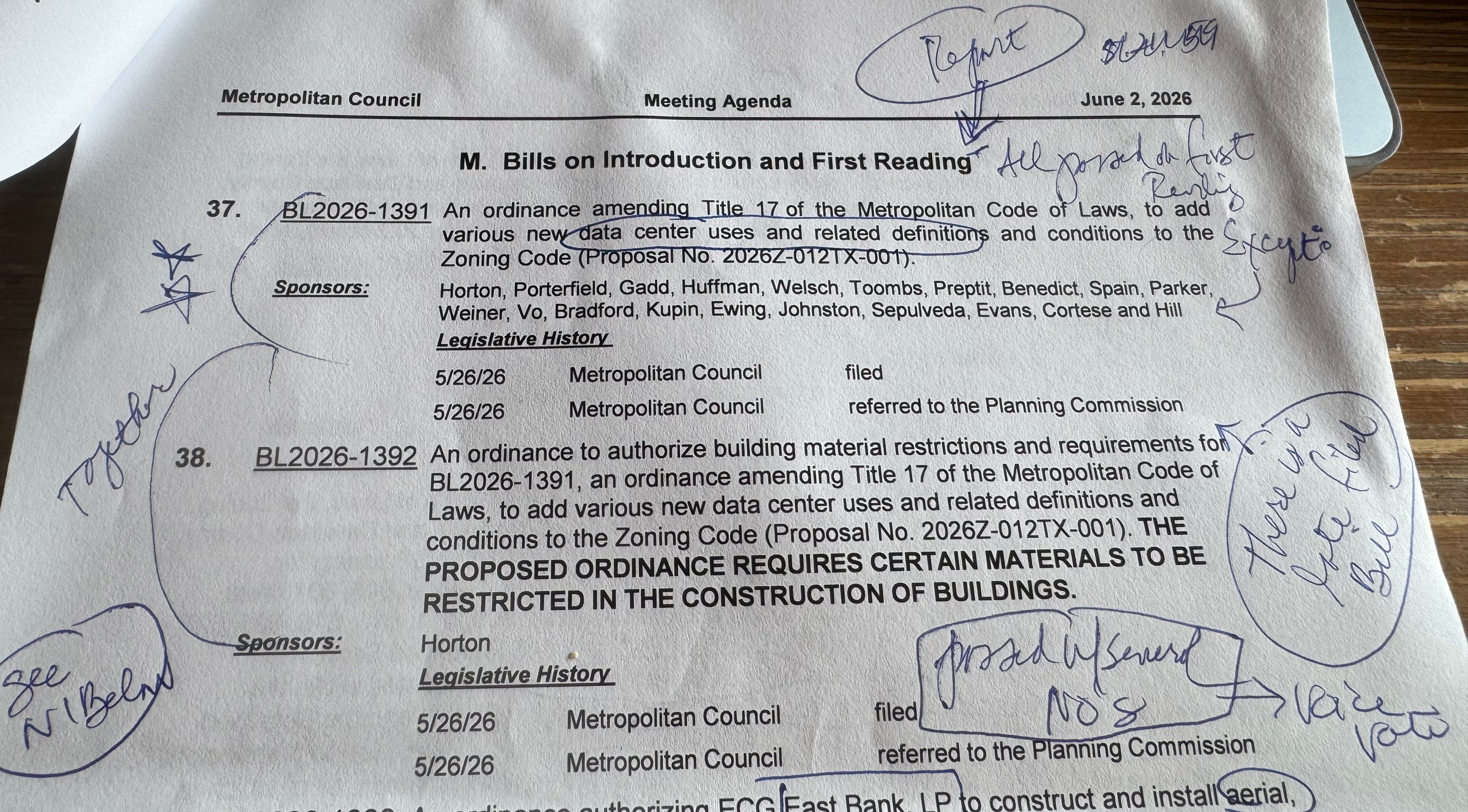
< <Full text found at the bottom of this post and HERE >>
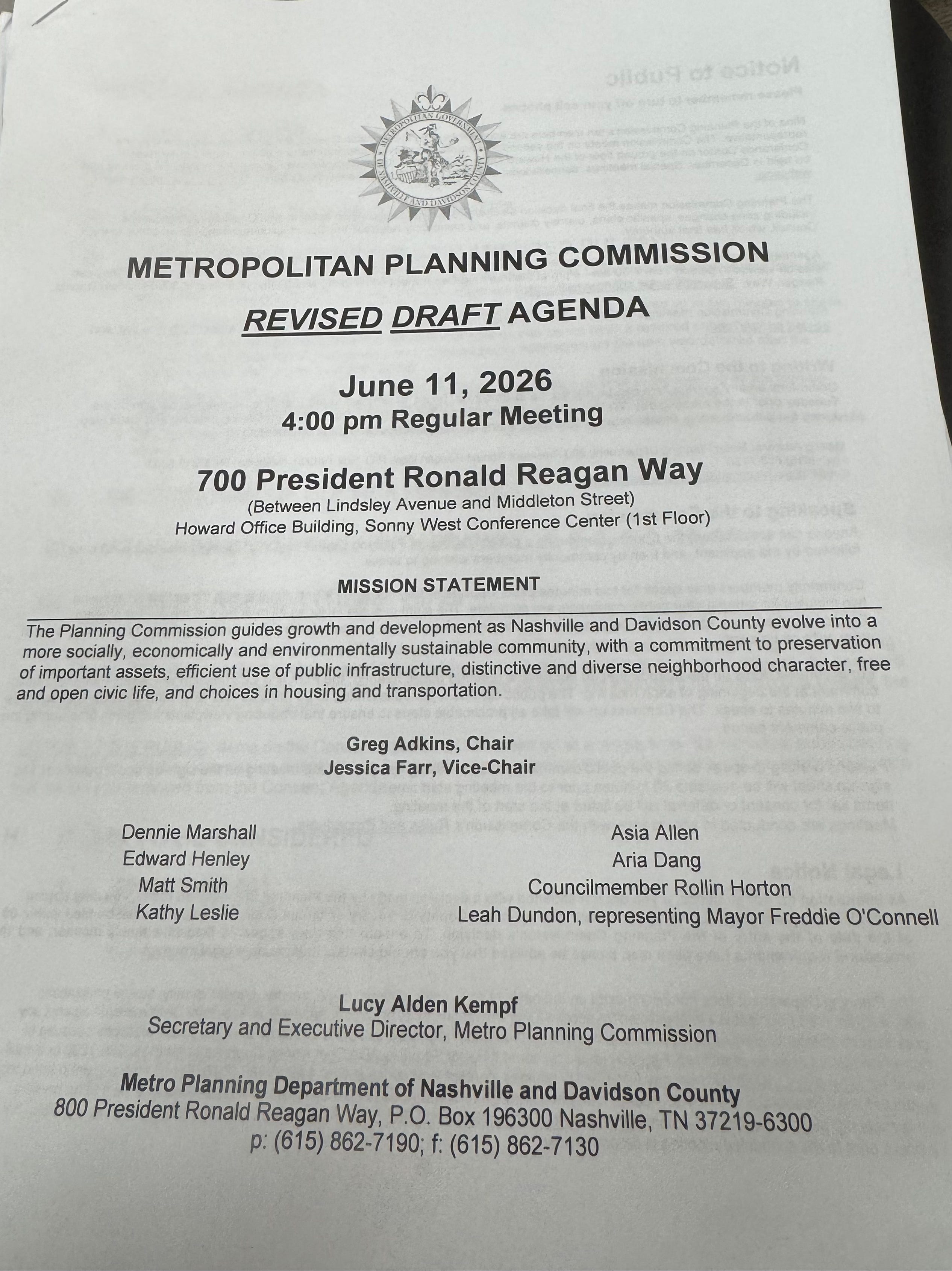
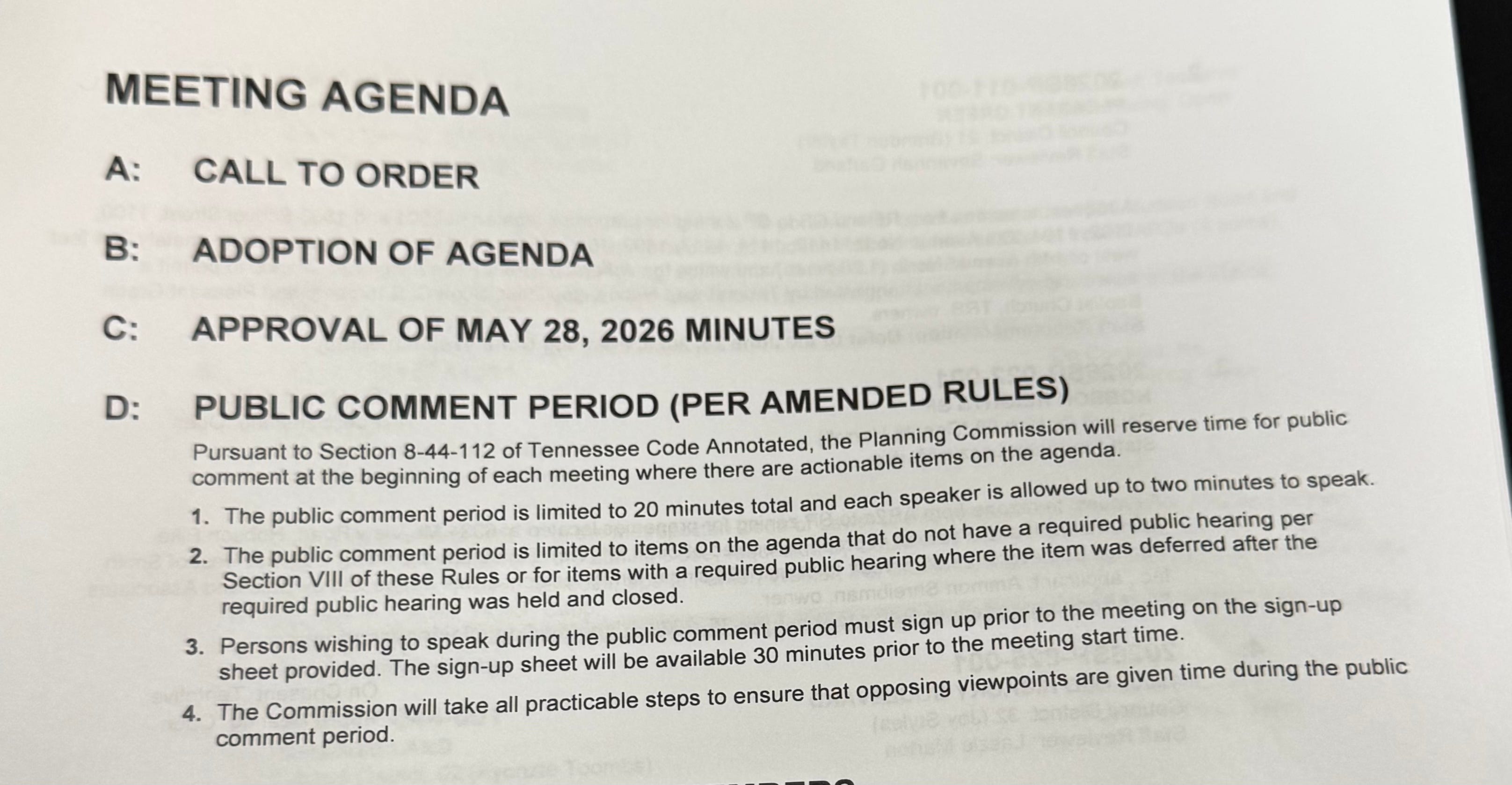
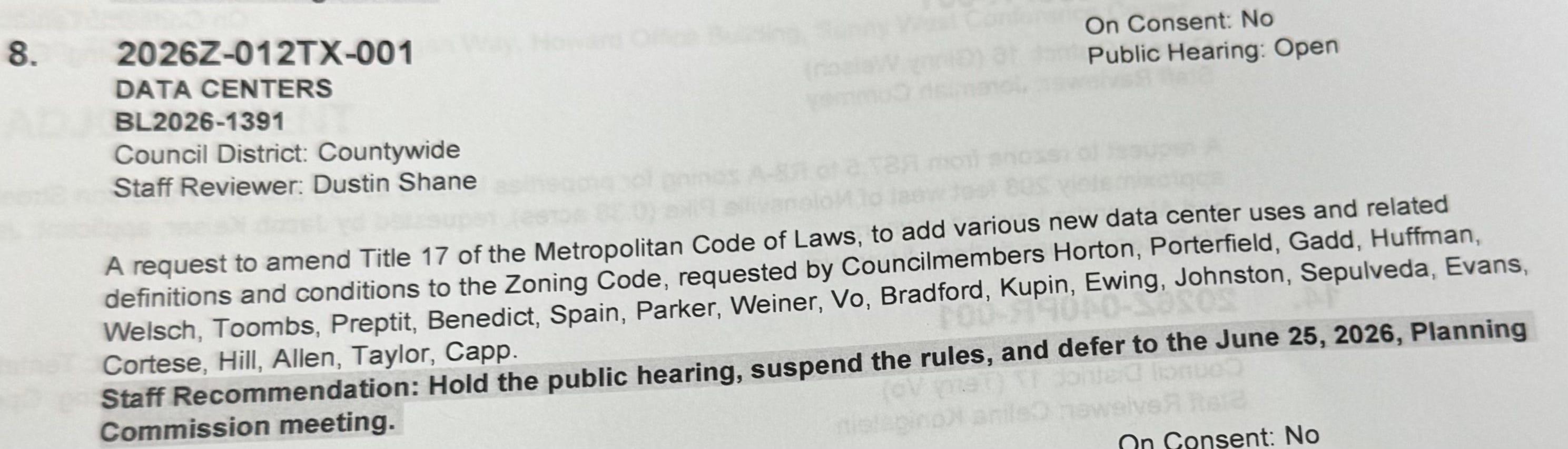
JUNE 11 PLANNING COMMISSION AGENDA (key pages, see Item #8)
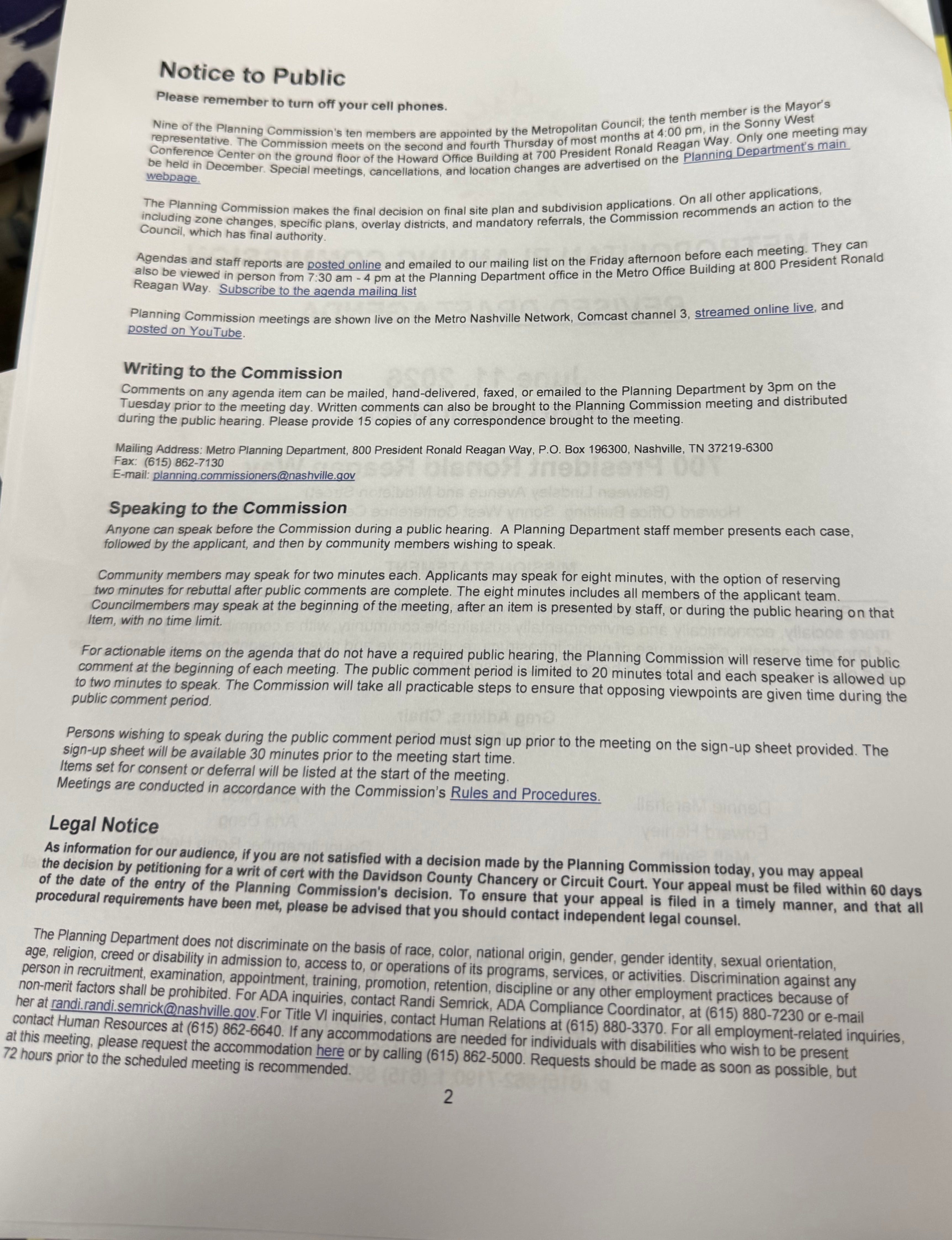
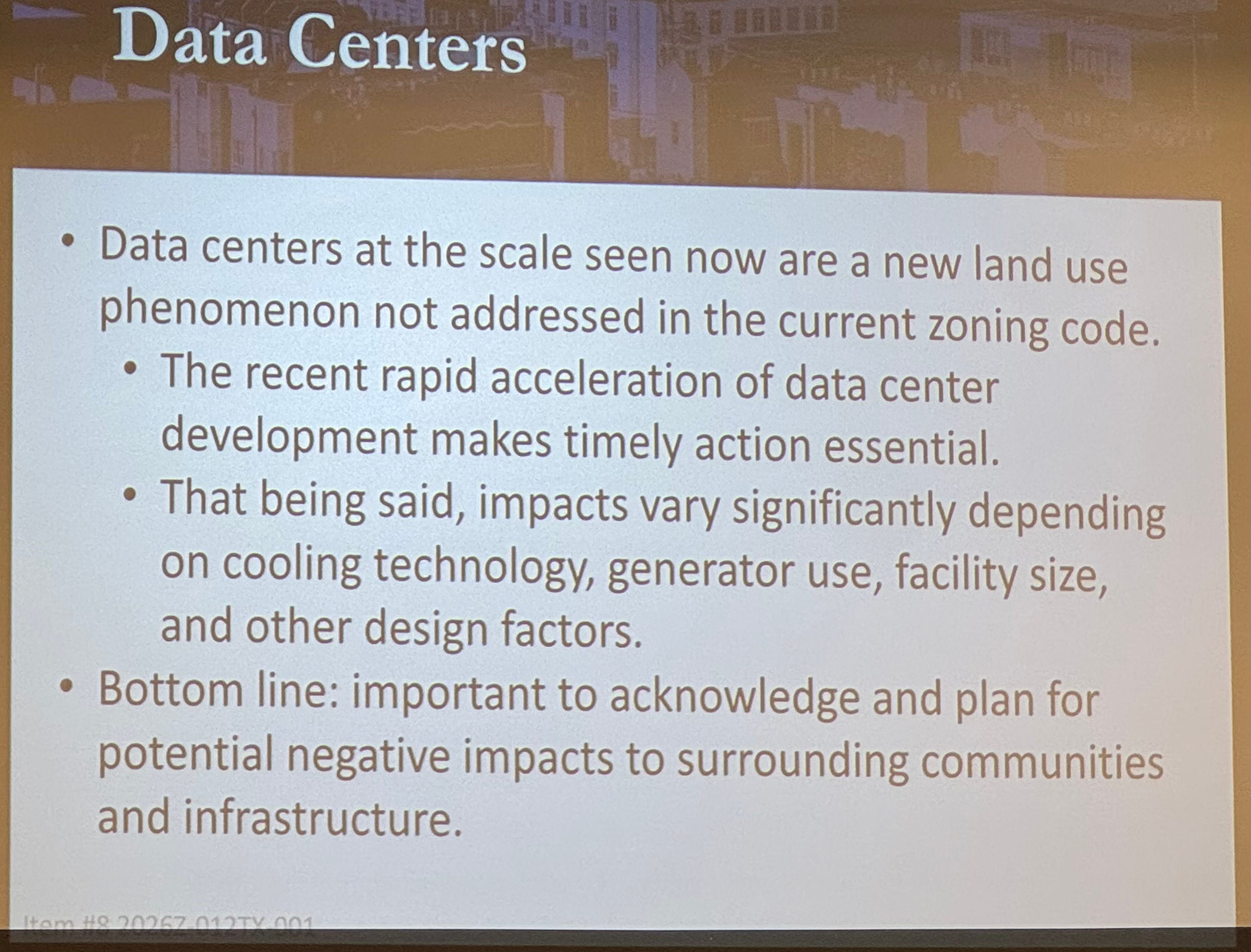
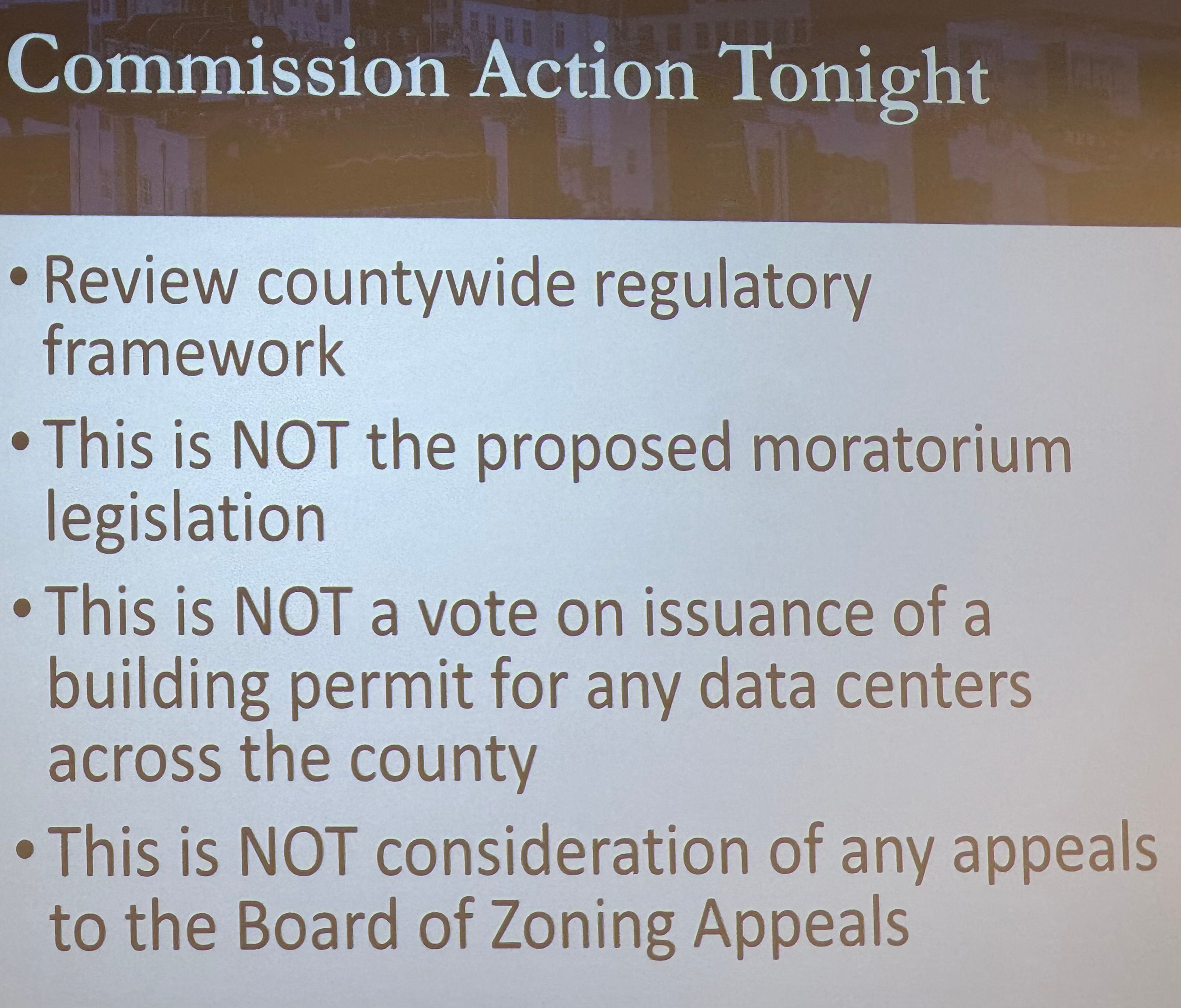
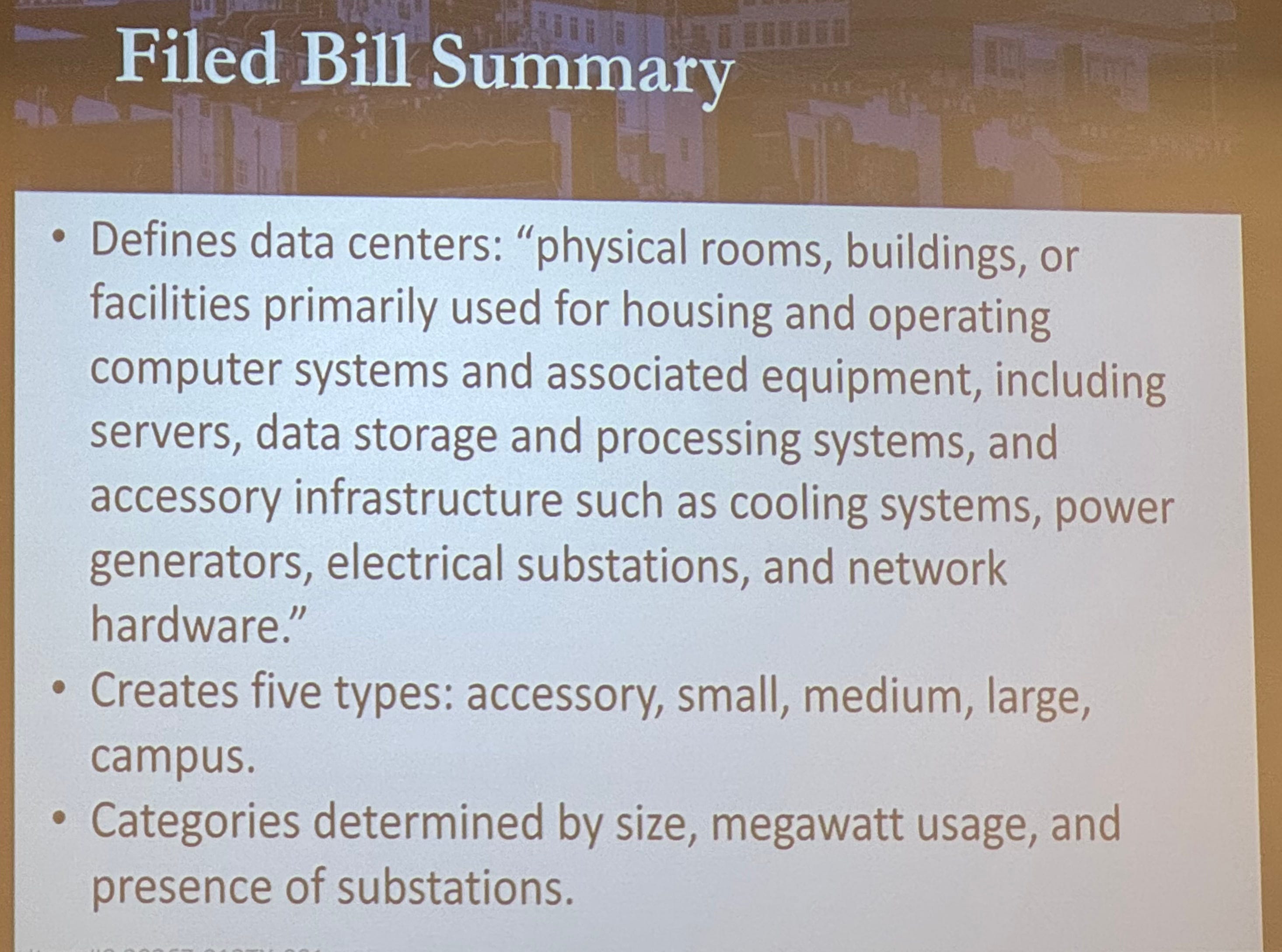
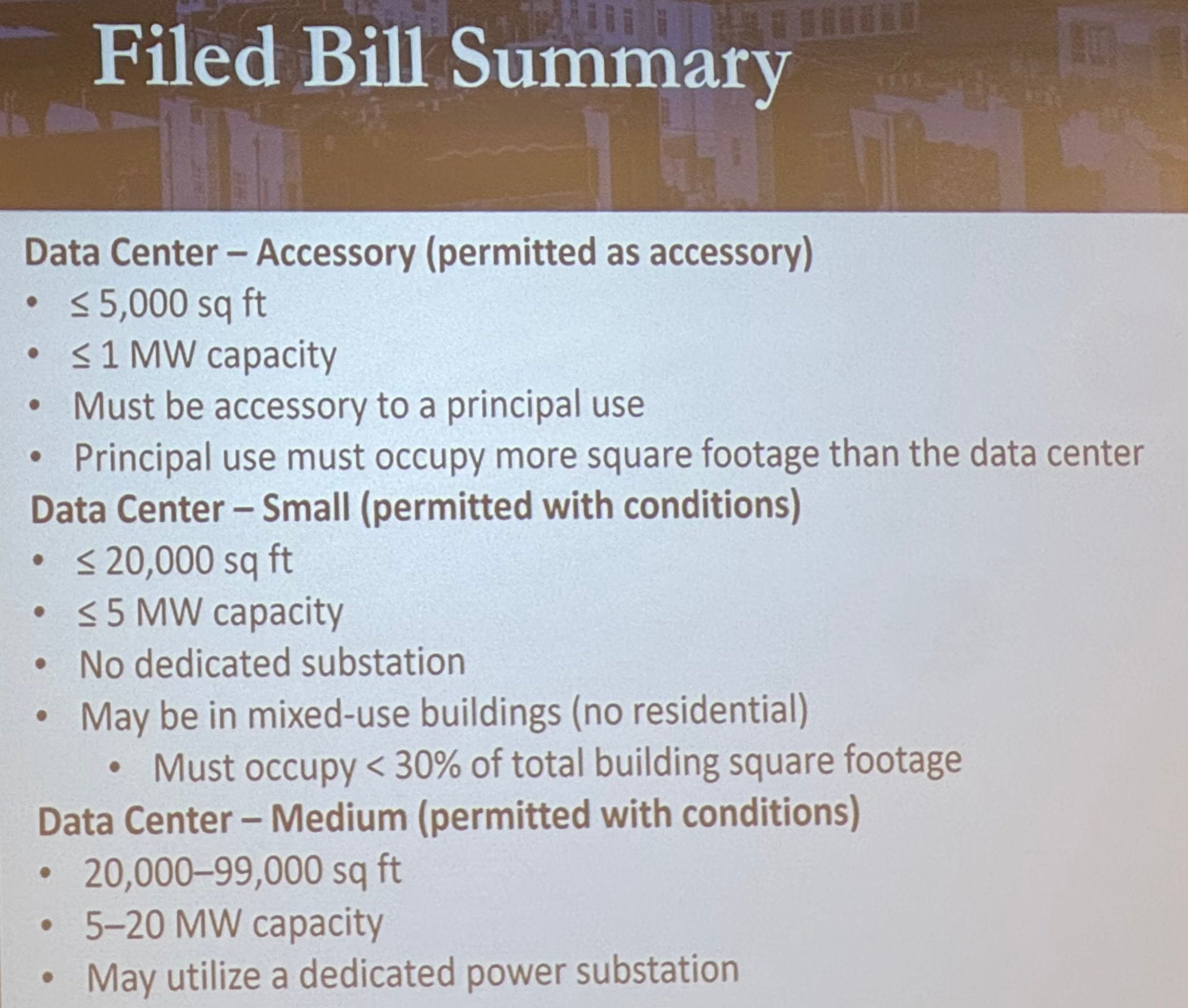
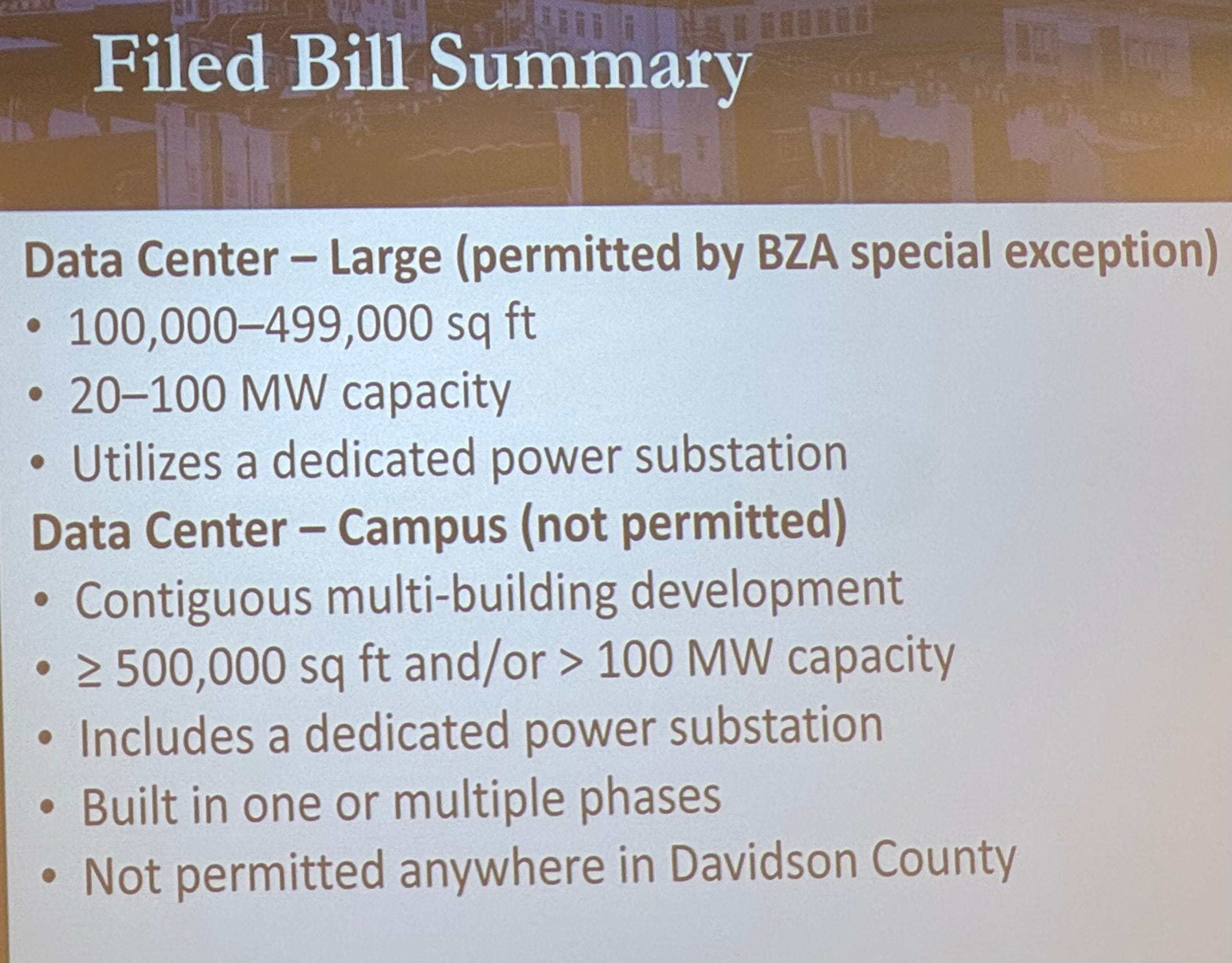
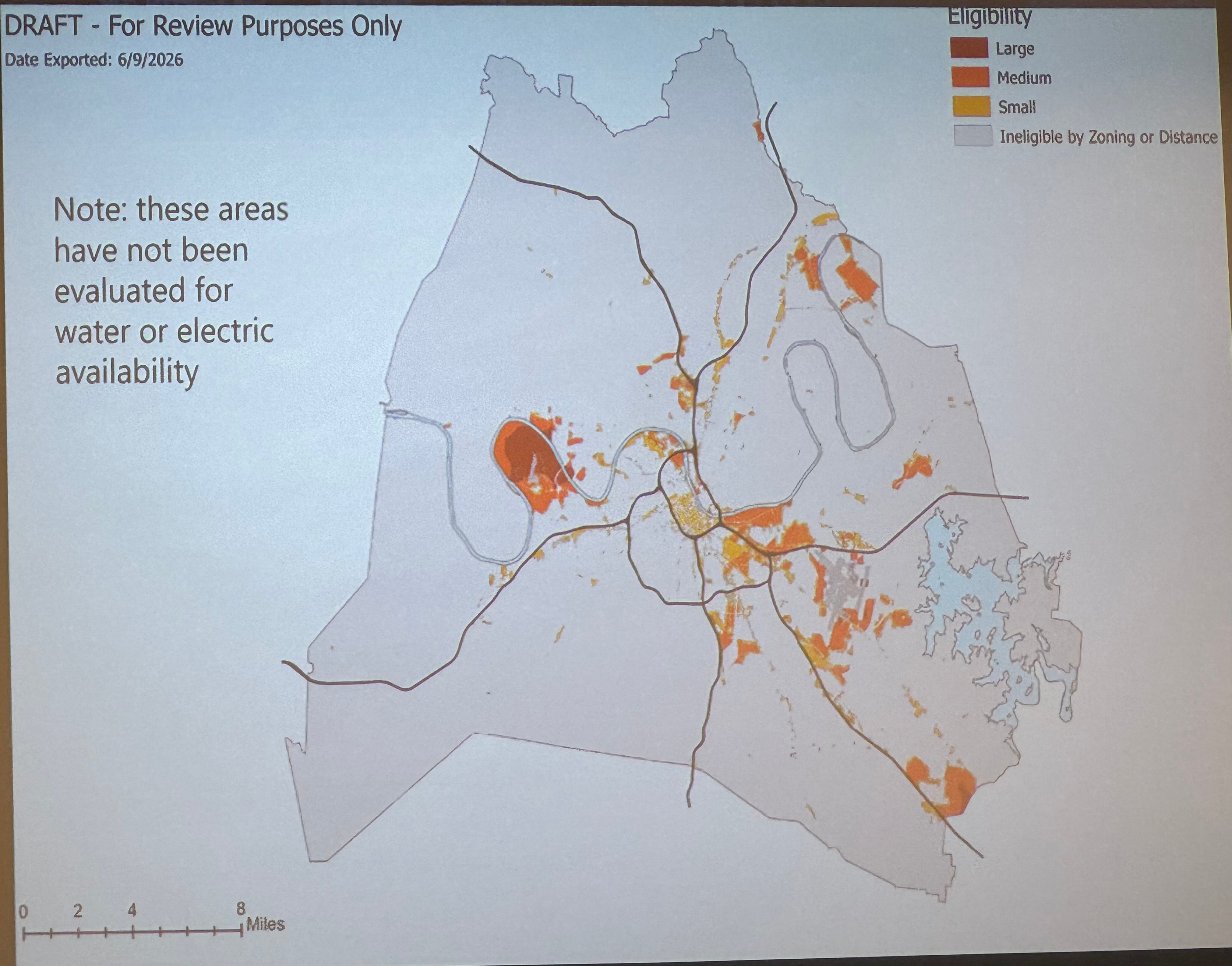
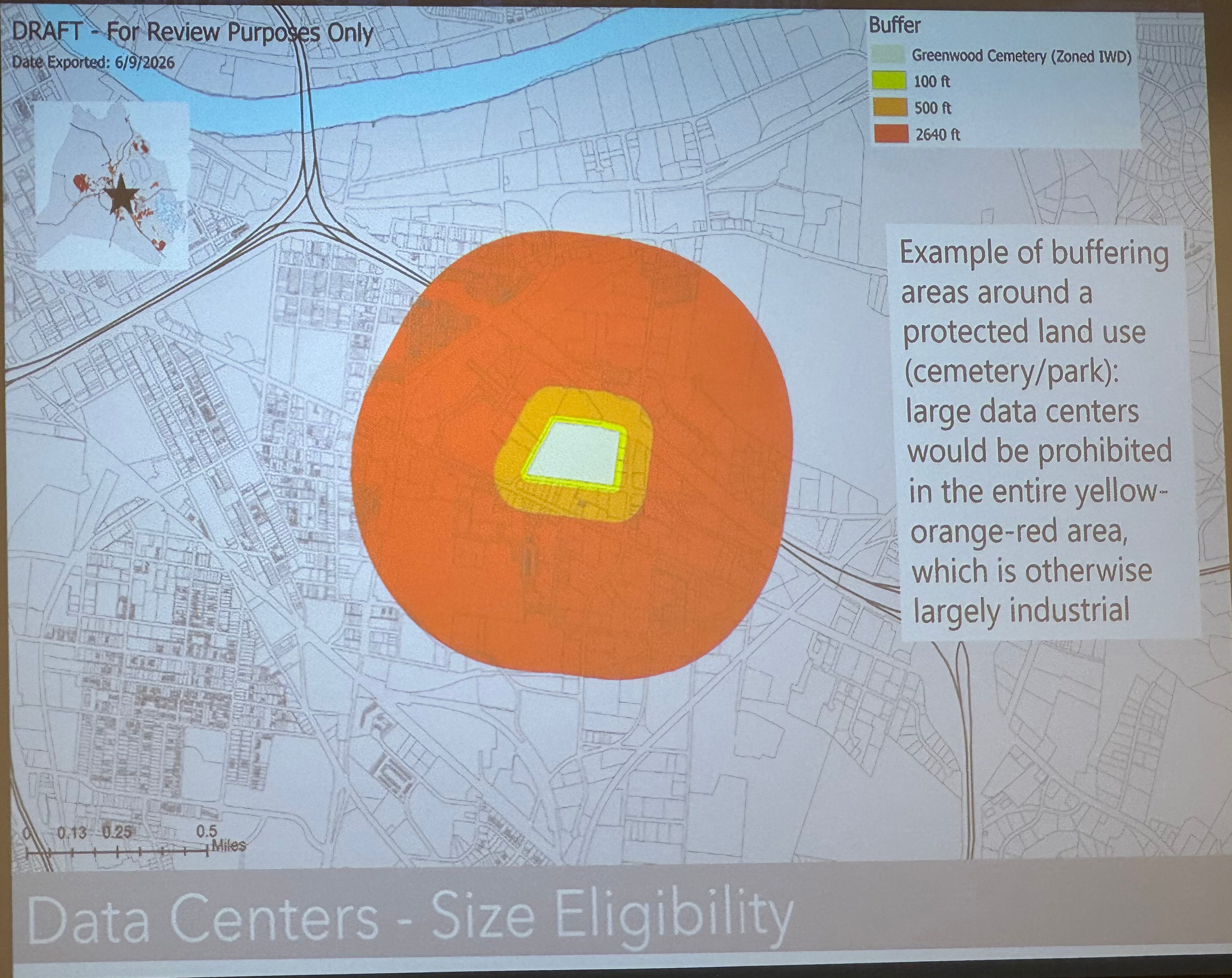
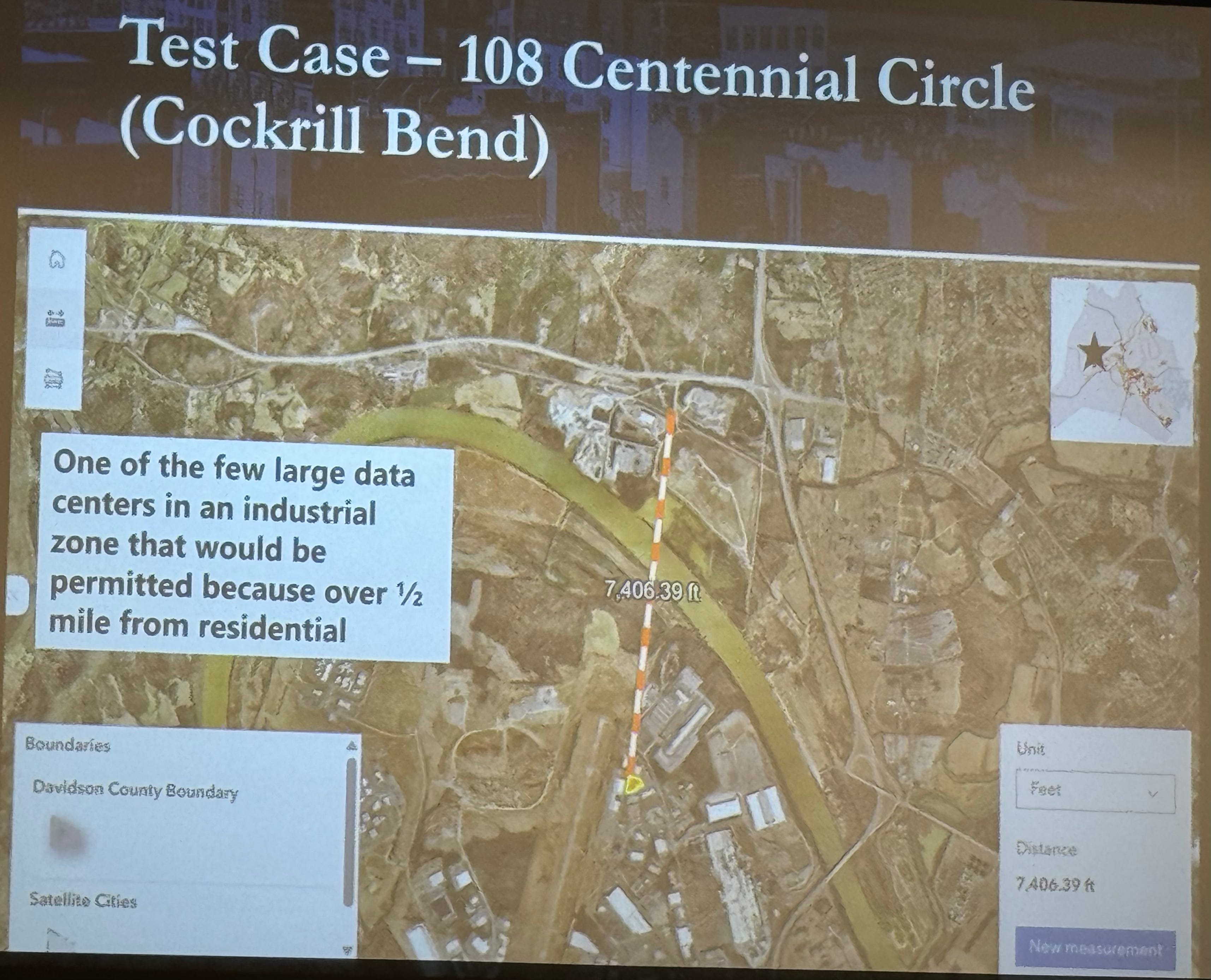
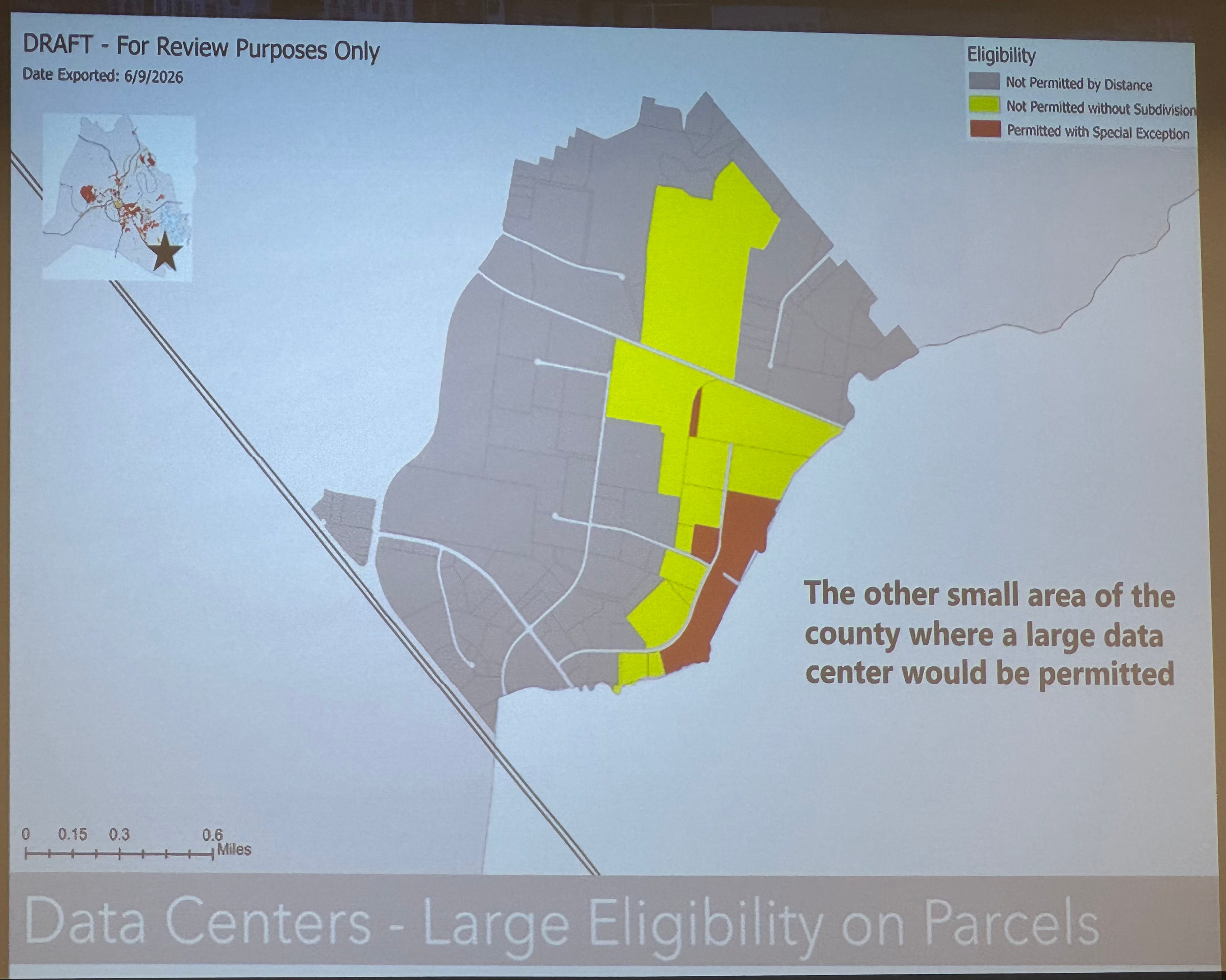
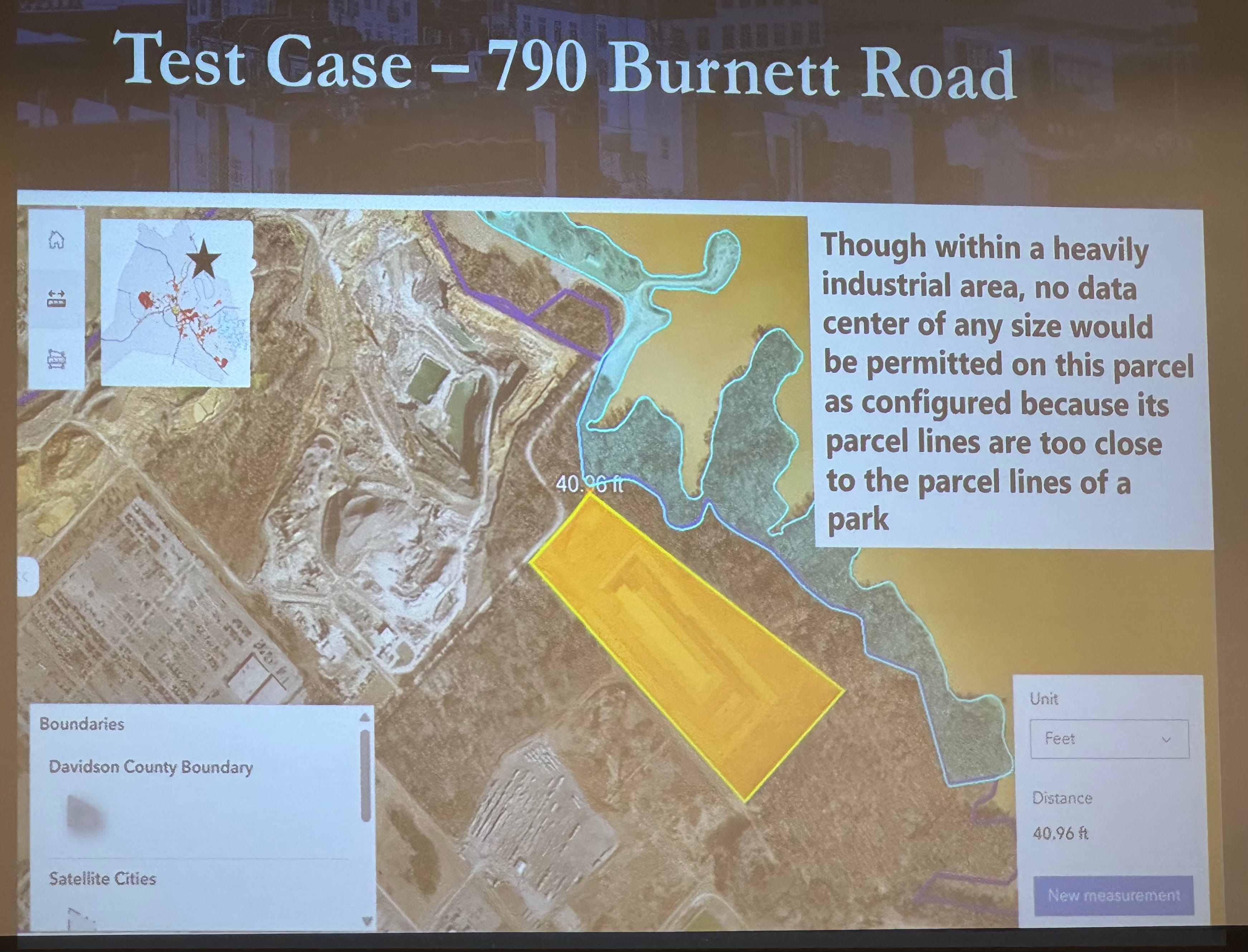
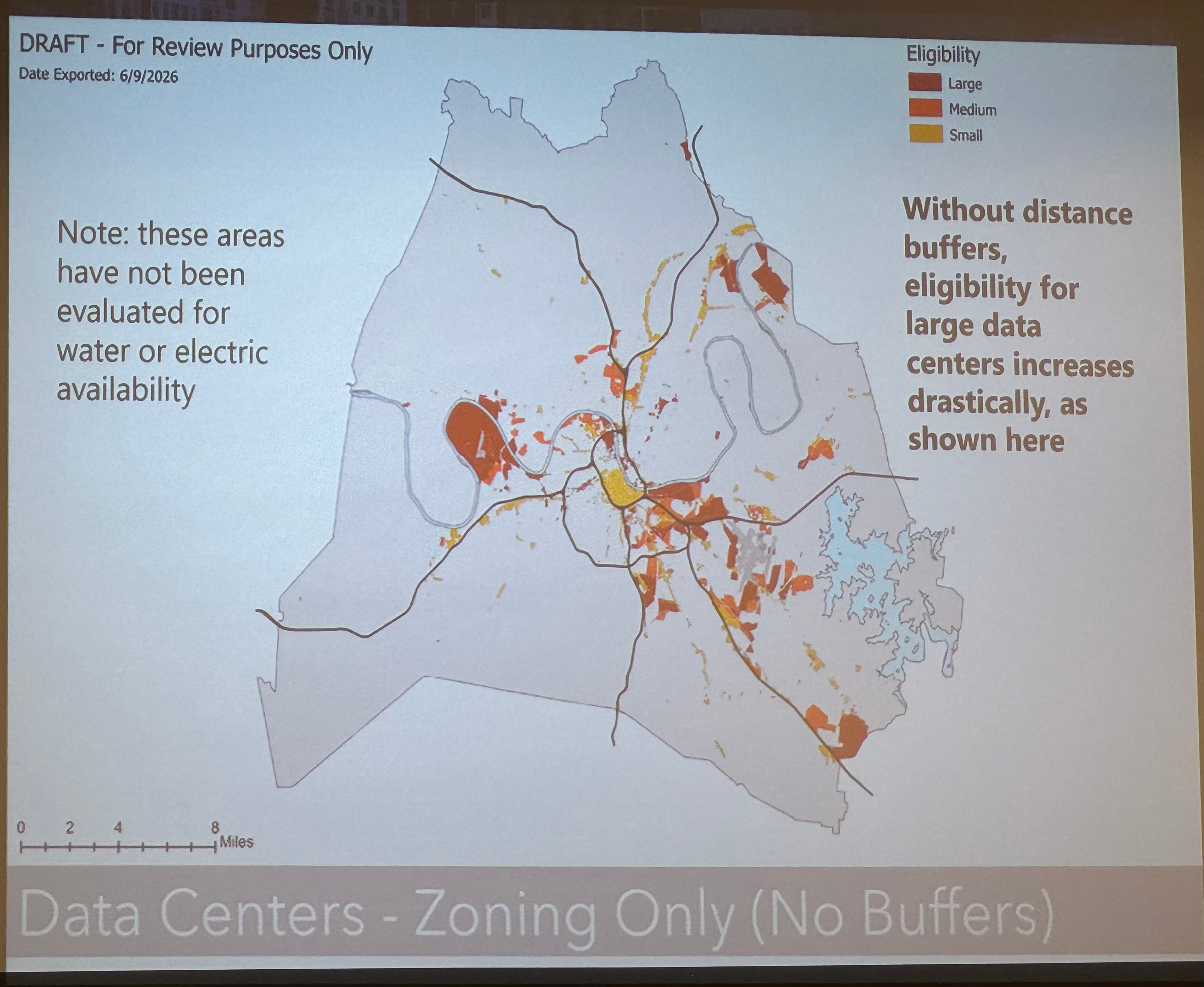
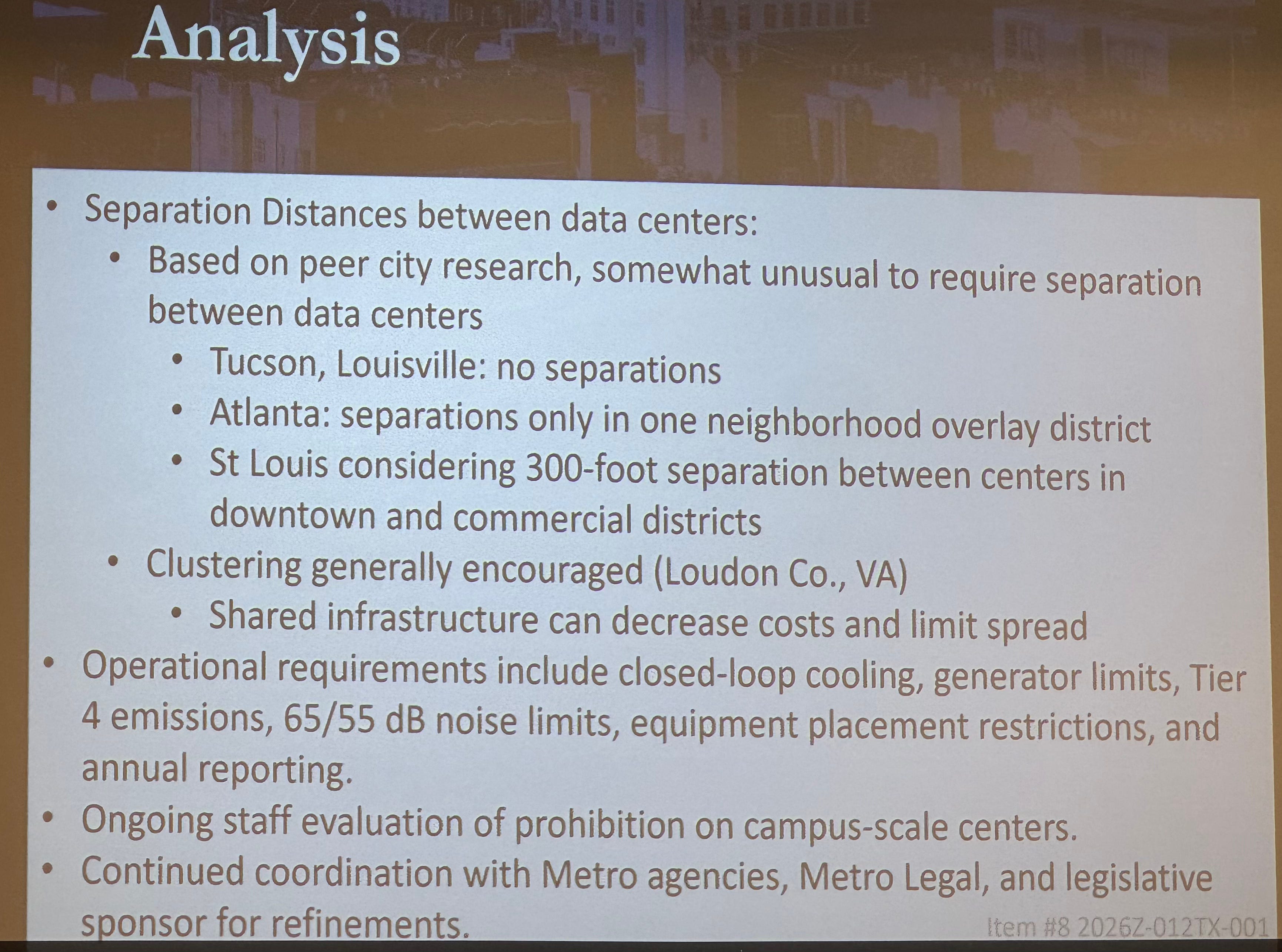
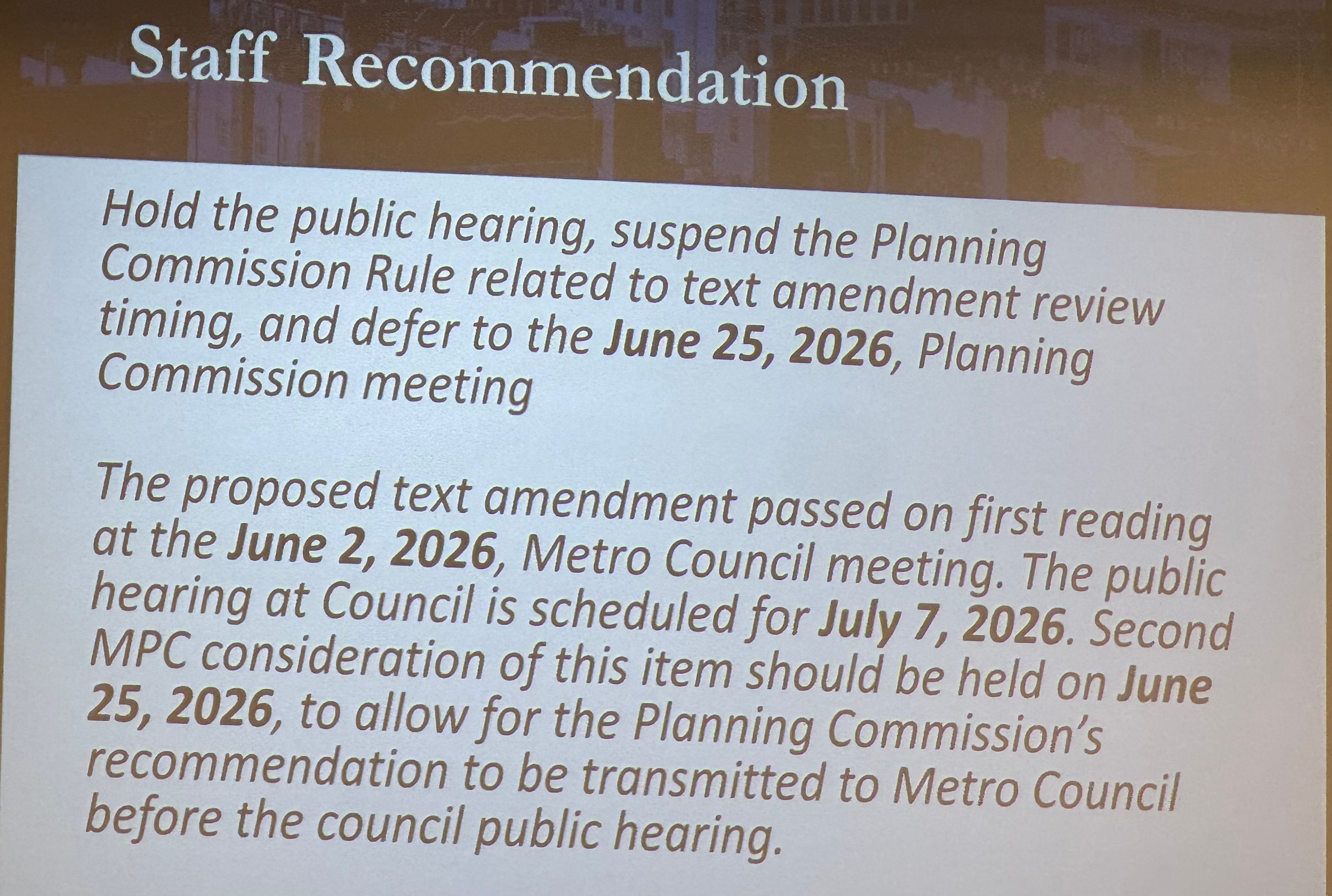
PLANNING STAFF SLIDES ANALYZING HORTON’S REGULATION BILL
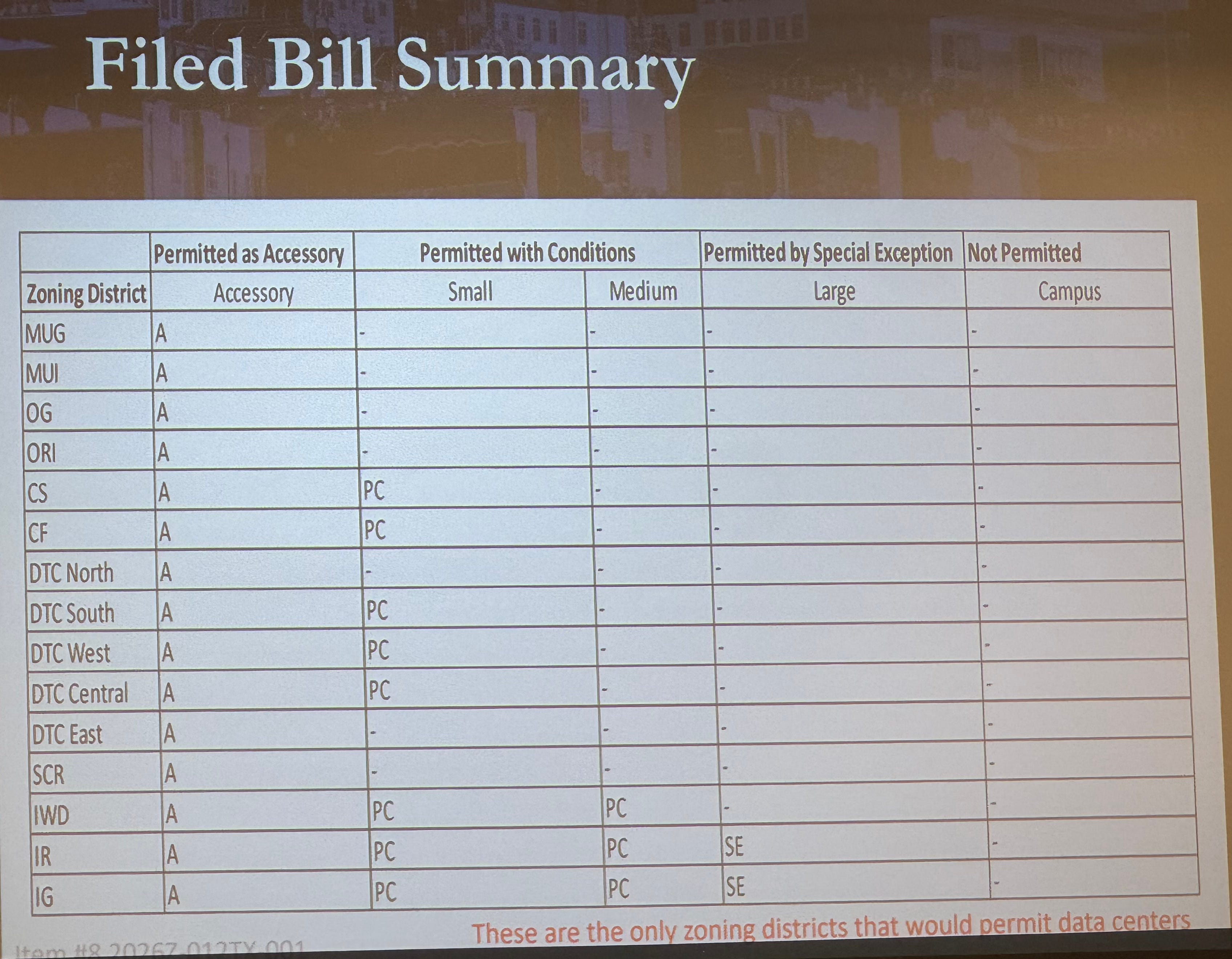
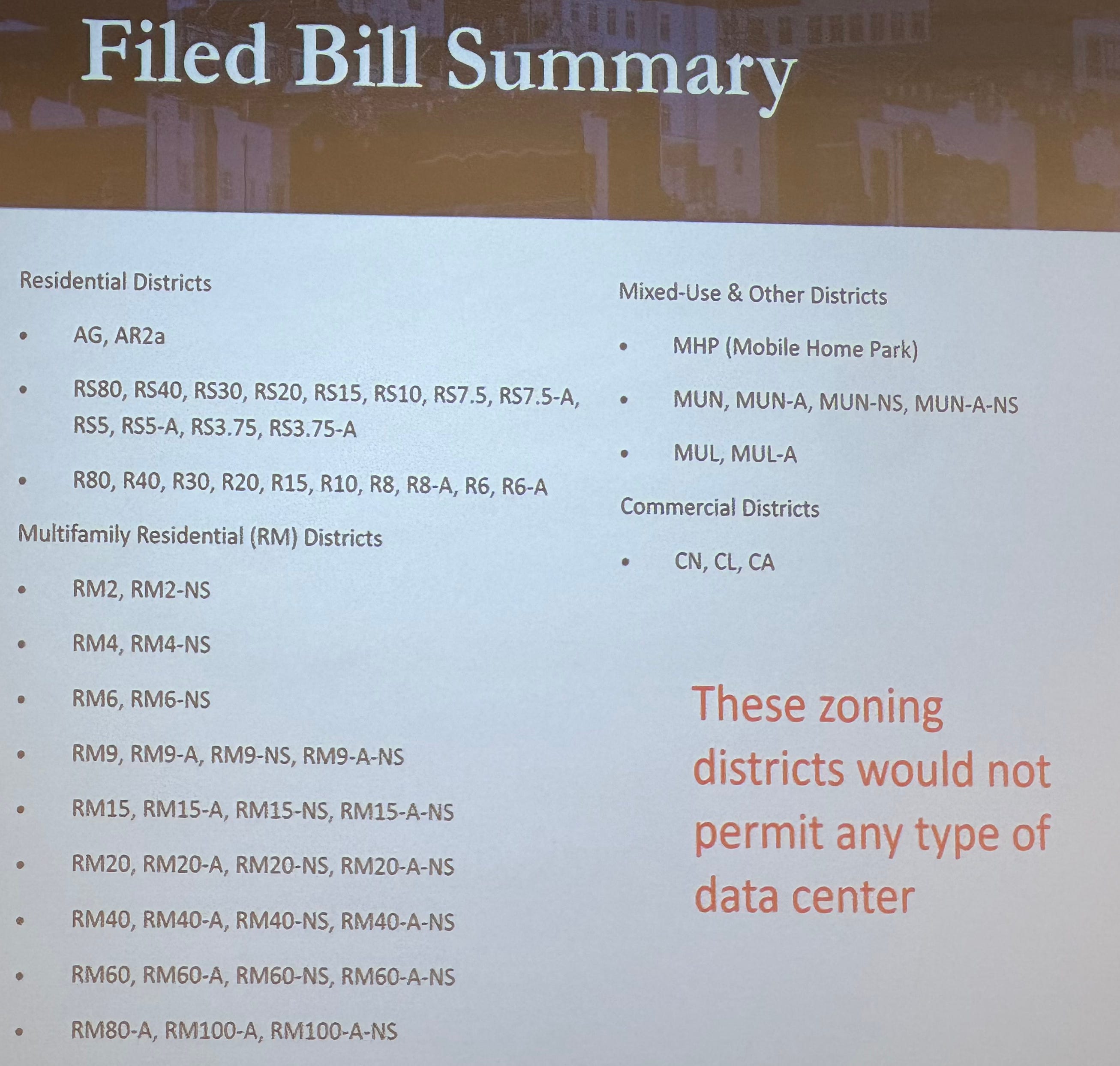
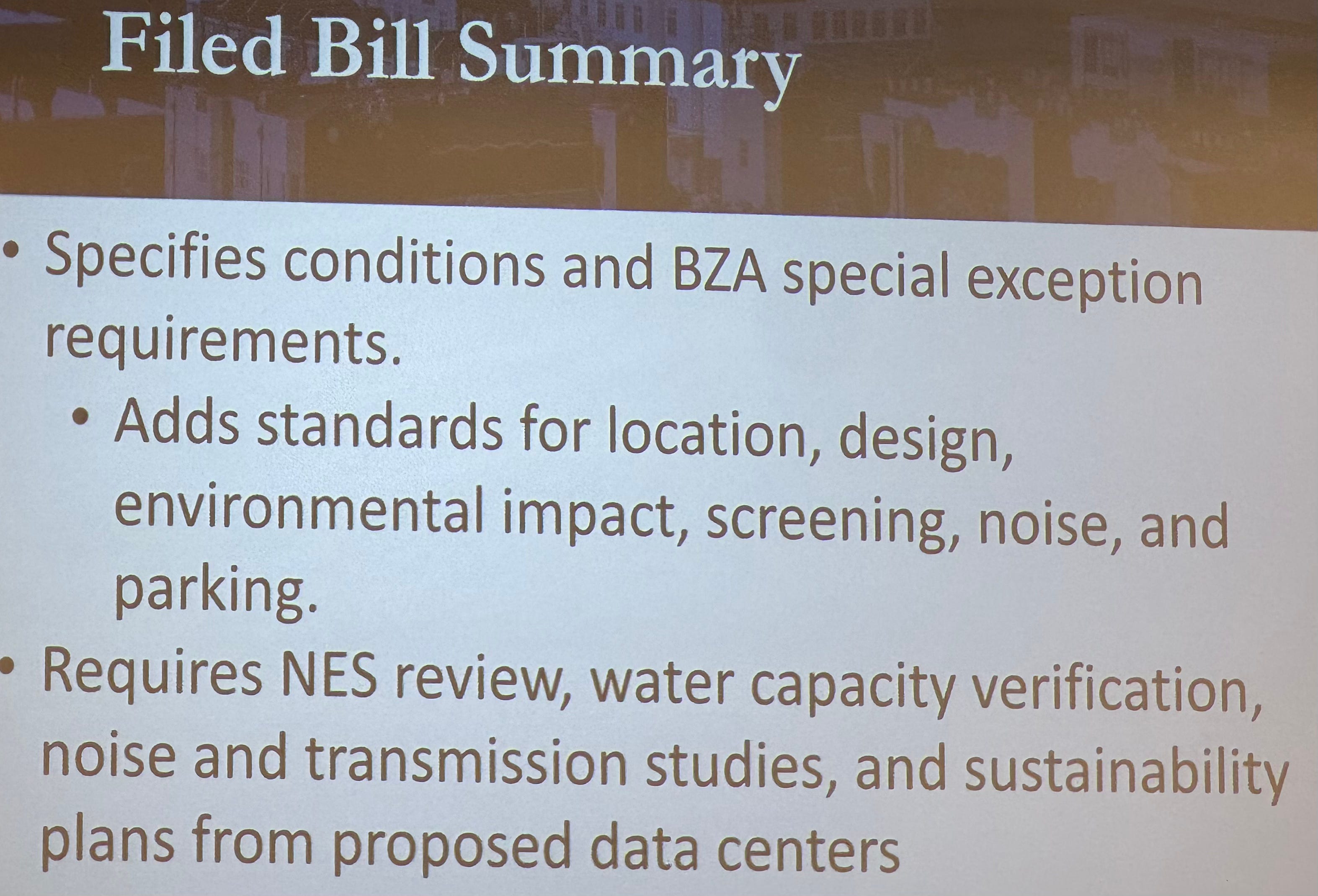
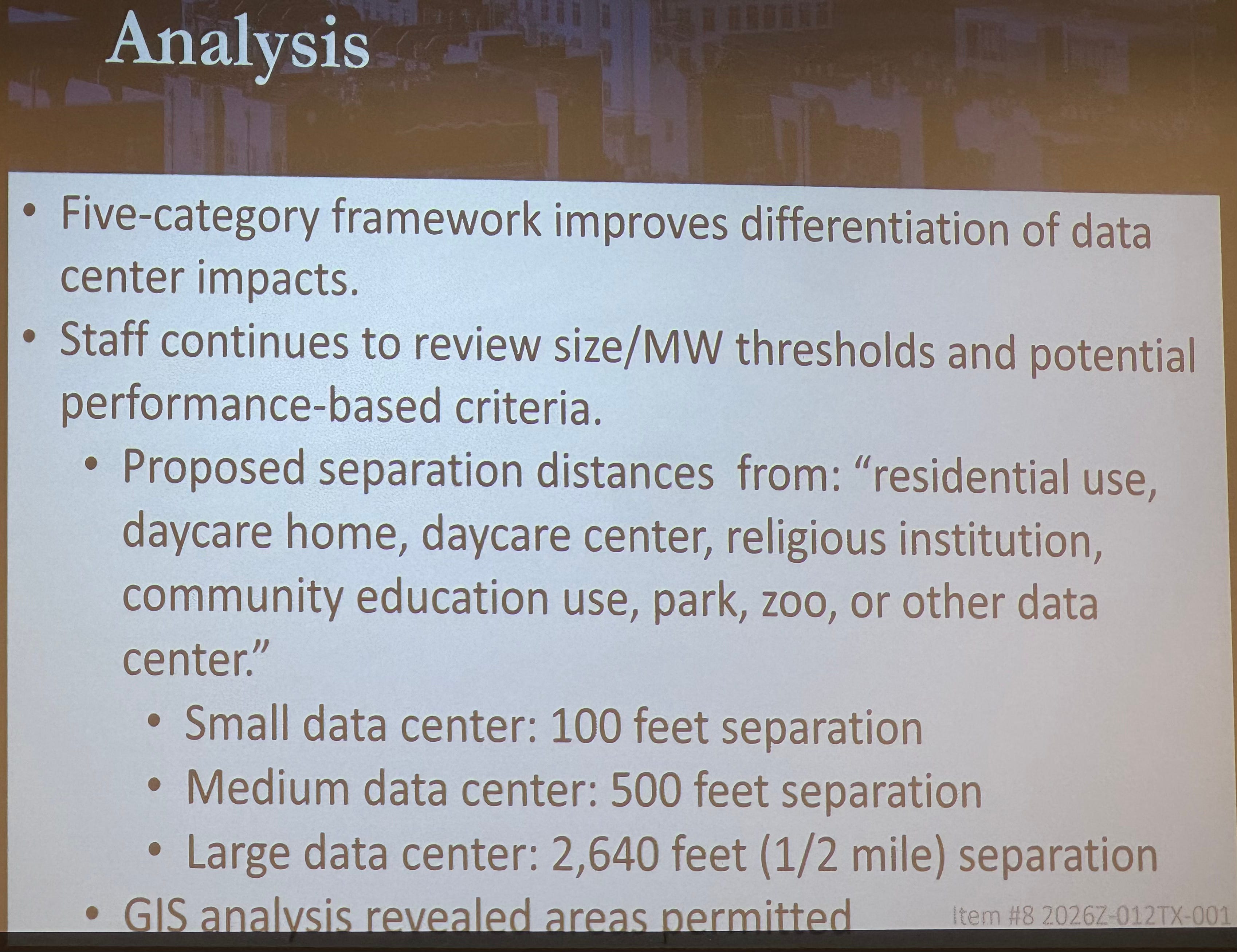
A FEW of the 148 PUBLIC COMMENTS SUPPORTING REGULATING DATA CENTERS (many also mentioned supporting a MORATORIUM)
To hear all of the public comments, including those from experts in the scientific, structural, data, and tech worlds, to to this link: YOUTUBE Recording of the Public Hearing)
Councilperson Gamble
Councilperson Sepulveda
Timothy Hughes, speaking regarding Fisk University.
Barbara Clinton, District 16, Woodbine neighborhood, Southeast Nashville
(?) Comments regarding negative health impacts resulting from Data Centers, including the effect of high decibel levels.
? Shields, lives in the Caldwell neighborhood, near the Zoo.
(?) resident living in District 24 noted that it is “abundantly clear” that people in Nashville don’t want Data Centers in their backyards.
(?) A resident and Fisk University graduate living in District 19 addressed her concerns about the environmental impacts of Data Centers.
(?) A resident of District 26, who lives two miles from the Nashville Zoo, talked about the legacy he wants to leave his children, which doesn’t include the “ginormous, ridiculous electric sucking devices” that are Data Centers
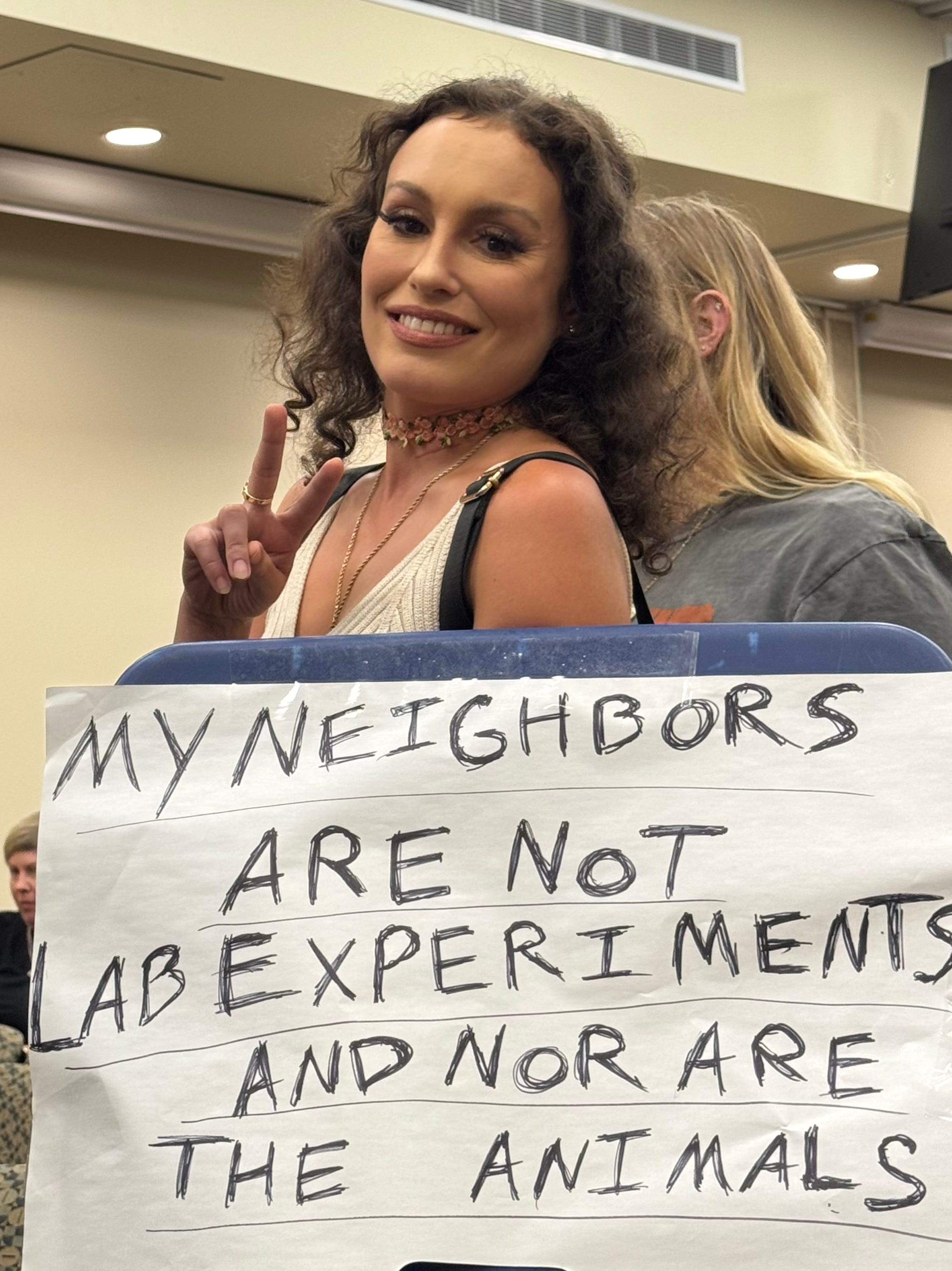
SOME OTHER COMMENTS
- “We know enough to know we don’t know enough.”
- “Data centers are anti-human”
- “85 decibels for 8 hours equals hearing loss.” Most Data Centers emit this decibel level or more
- “We need to expand the minimum distance”
- “A half mile is too small” (multiple comments that there needs to be an increase in the distance allowed between data centers and the protected areas
- “1/2 mile is not enough between data centers of any size”
-We need “more distance than is currently being recommended”
- “We need stricter Regulations”
- “People are caged in jails that are cages for humans,” just like animals in the zoo are caged. We have to treat those who are incarcerated with as much respect and care as we do animals. Data centers should not be located near where people are kept in jail or prison.
-There should be an “annual review” of health and scientific research related to Data Centers and the Regulations should be updated accordingly
-There needs to be an “audit process.”
-There needs to be “random checks” to make sure that the regulations are being followed. The staffing costs related to these random checks should be funded by the Data Centers.
-Staff, Commissioners and Council members need to be “innovative leaders”
-These “regulations may be a great start,” but we need more, and we need them to be updated as technology expands
- “A total moratorium” (many people called for this)
“Elimination is a goal.”
-There should be “no clustering allowed”
-There will be a “sensory strain on children from the sound.” Their nervous systems are going to be impacted.
- “Every data center should be required to tell what kind of water system they are going to use.”
-There should be an “expectation of electrical impact.”
-A “noise mitigation plan must be implemented.”
“DC Blox is an Atlanta-based company that will operate like a tax shelter.”
- “Regulations need to be based upon expected impacts.”
-Commissioners and Council “need to remain vigilant.”
-We should expect that the data centers will “continually and constantly burn fossil fuels.”
-We need to “use the total space footage,” the ground footprint as well as the height of these data centers, when measuring their impact
- “You need to close every loophole”
- “It is a fallacy that the closed water loop system will address the impact.” There’s heavier cooling and electrical use than identified, and “hidden water use should be expected.”
-There “will be increased heat,” so there will be “electrical overuse.”
- “I’m not sure there are enough safeguards proposed.”
COMMENTS and QUESTIONS FROM COMMISSIONERS and PLANNING DEPARTMENT STAFF
Councilperson and Commissioner Horton
Deputy Executive Director Lisa Milligan
Commissioner Dundon, Mayor Freddie O'Connell’s Representative
Staff clarified that the Commissioners should expect that a Moratorium Ordinance will be coming before them at their June 25th meeting.
The current timeline is the fastest.
Will the proposed Regulation pertain to those Data Centers under consideration?
What staffing resources will cover the cost of enforcing the Regulations at annual audits, and how many parcels of land will be zoned out of having Data Centers? Is this bill acting as a de facto ban? Should there be performance targets?
Will the bill be applied to existing Data Centers in the city?
Commissioner Smith agreed with applying minimum distance parameters.
He also asked whether the Data Centers should be clustered, such as placing all of them together at the airport. He also suggested Data Centers should be evaluated based upon the totality of their square footage, regardless of the number of buildings they are utilizing.
Dundon asked for clarification regarding what happens if an approved Data Center wants to expand.
Commissioner Marshall said they agree with the Amendments to Horton’s REGULATION bill but said there is a need to create policies and asked how this bill measures up against what other peer cities are doing
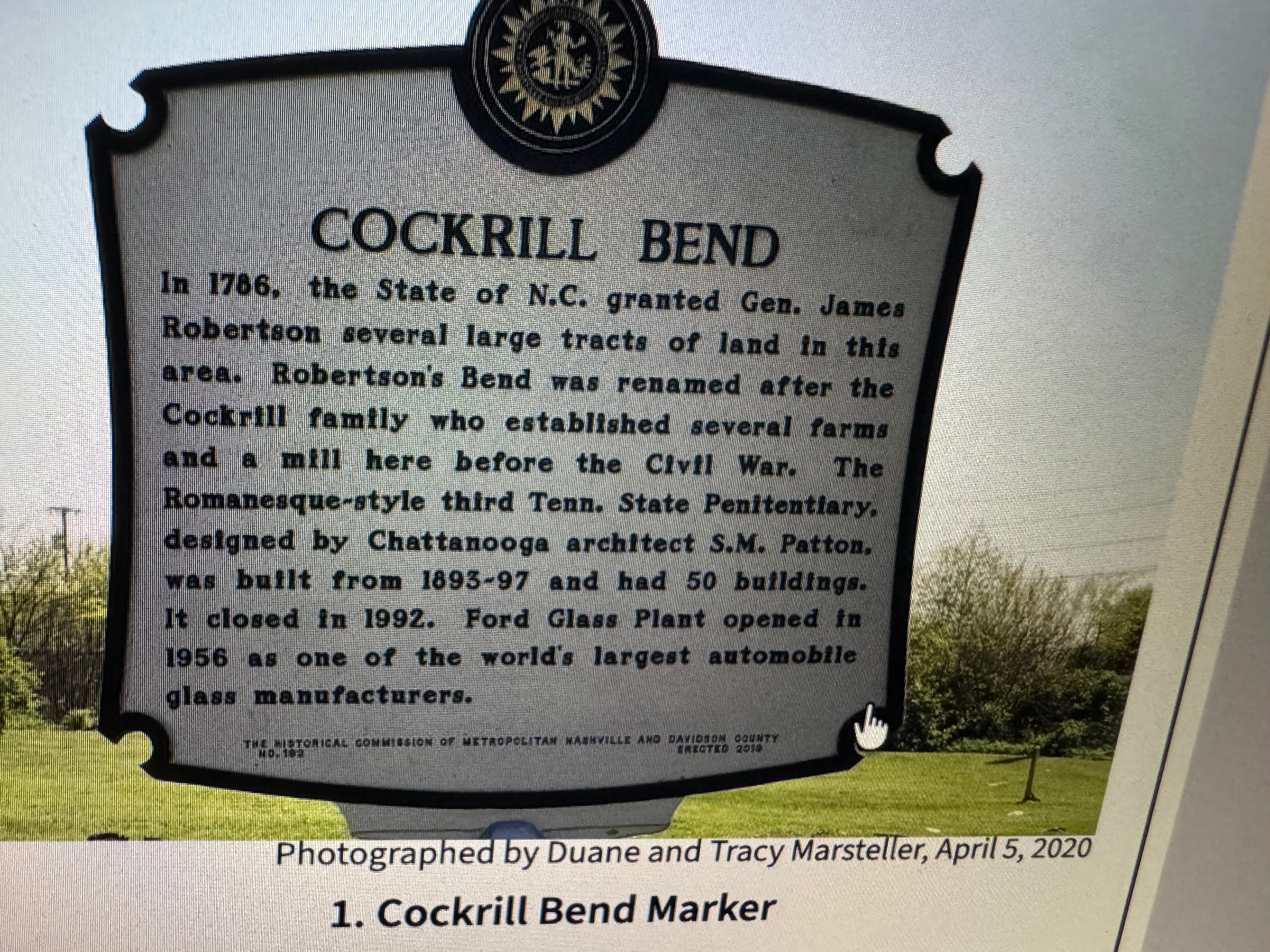
Staff mentioned more than once that the largest Data Centers would be limited to locating at Cockrill Bend and the edge of the county, given the current proposed regulations. (“Cockrill Bend is a Nashville neighborhood with a mix of industrial and residential areas. Known for its large prison complex, it also has a few local businesses. It's a bit isolated, but close to the Cumberland River and Bells Bend Park.”
Commissioner Leslie confirmed that most of the Public Comments related to the Zoo and Fisk University but remarked that Horton’s REGULATION Bill would be applied to Cata Centers throughout the County. She asked if the number of Data Centers could be limited. Staff responded “Possibly” but that it would need to be based on scientific studies.
Leslie then asked how staff had arrived at the the distance limitations they set, such as 100 feet from residential areas. She also confirmed that there can be no Data Centers local in a residential area. She then asked about enforcement and was told it would be driven by a complaint., She pressed, asking if a company was shown to have disregarded a regulation, would there be a fine, jail time, or what? This question was left unanswered.
Commissioner Henry expressed concern about the impact the decibel levels will have on the wildlife, and encouraged more caution rather than less, especially given the expectation that there will be major health and environmental impacts where Data Centers are located. Because technology is a “moving target” and the human impact is yet to be known, it is important to look outside of the US to ascertain what other countries have experienced with Data Centers and how they have addressed similar concerns.
Horton explained that the rationale for banning Data Centers of 500,000 square feet of more is related to the unknown impacts, and also this is why the regulations limit the size around businesses and neighborhoods, but the smaller size is recommended to have smaller distance requirements.
Dandon asked about the need for backup generators, especially if the electricity goes out, especially when hospitals are involved. She also recommended caution until more is known and emphasized that data is needed on the impact of Data Centers, especially on children and animals.
Commissioner Farr commented that she had never seen any item brought before the Commission of such significance, but needing to address it so quickly. She also mentioned that jails should be added as a special site of coverage.
Leslie expressed concern that they didn’t have enough information.
The Commissioners voted to accept the staff report and to review the new staff recommendations they will receive prior to their next meeting, which will reflect the research that the staff has undertaken to address the questions they raised. Action on Horton’s bill is deferred to the next Planning Meeting on 6/25, and reminded everyone that their recommendations will be entertained at the Council’s July 7th meeting.
FISK UNIVERSITY PETITION (12,405 signers)
The Issue
“The unprecedented growth of data centers built for generative AI across the country has been met with furious push back from communities that have been adversely impacted by the current development boon. Therefore, there is no reason that Fisk students, alumni & the surrounding community should not be able to do the same.
In the 1960s during the construction of interstate 40, leaders like Dr. Flournoy A. Cole, a Fisk Professor & renowned Black economist, fought against the city and state regarding the construction of interstate 40 and while ultimately losing, pushed the fight all the way to the supreme court. Now, in the 2020s... it’s time for us to fight our fight.
We understand that our beloved institution is in need. We also understand the serious health impact / implications of data centers built for generative AI on communities. We understand that throughout history, Black and working-class neighborhoods across the country have repeatedly been the desired location for developing harmful infrastructure for the sake of profit. This current era we find ourselves in is not new.
We come from a legacy of getting into good trouble ... even if that means pushing back against our alma mater. Sign this petition to ensure that our students and surrounding communities can remain in a safe, healthy environment, and to preserve Fisk’s legacy as an institution anchored in equity and justice.”
NASHVILLE ZOO PETITION (413,233 signers)
The Issue
AI Data Centers are being built at an alarming pace, posing possible risks to diverse and vulnerable communities. The next one could be located just feet away from one of the most fragile and rare collections of animals in the country unless Nashville Zoo supporters and city leaders intervene.
At Nashville Zoo, our top priority is to protect our precious animals and their environment. We are equally committed to the health and safety of our visitors, staff, and neighbors living nearby. Yet, with no regulations or safeguards for use in place, developers intend to build a 69,000 square feet data center on land abutting the Zoo. They assert the community need not worry, that building a data center next door to one of the region’s most delicate environments will cause no harm.
No one has shared studies or environmental impact assessments. Just their word. That’s why the Nashville Zoo is asking the community to join in vehemently opposing the proposed data center being built adjacent to the Zoo. One simple Google search shows growing concerns about data centers’ environmental and public health impacts nationwide. Data centers consume enormous amounts of electricity and water; straining power grids, depleting natural resources, and damaging our watershed. How are we to know this new data center will not lead to irreversible damage to the animals we exist to protect?
We cannot afford to find out years from now how this facility has negatively impacted our 1.4 million visitors, our local community, or the 3,000 animals entrusting us with their care. We are calling on the Nashville community to join us in our fight to stop this data center from being built, now.
Please sign our petition and say yes to the Zoo by saying no to the new data center. Express your concern and help us protect our vulnerable animals and the environment we call home. For media inquiries contact pr@nashvillezoo.org.
SELECT MEDIA COVERAGE
6/12/26- The Tennessee Tribune, “Fisk University data center sparks protest from Tennessee Rep. Justin Jones”
“Critics, including state Rep. Justin Jones, D-Nashville, called on Fisk to release more information about the plan, which is part of the school’s $1 billion Quantum Leap campus master plan…In a passionate appeal, Fisk student Eriqua Martin said the university’s campus is “sacred ground” and should not be treated like available land for corporate development… These conversations are not anti-technology,” Hughes said. “They are about ensuring the growth that occurs responsibly, transparently, and with meaningful public participation.”
6/12/26, Afrotech, “Tennessee Rep. Justin Jones Speaks Out About Data Center That’s Part Of Fisk University’s Estimated $1B Project” Fisk Univeristy, “Our North Nashville neighbors have played a critical role in that history but also remain essential to our future. We would never cause harm here.”
6/11/26- CBS EVENING News, “Proposed data center near Nashville Zoo sparks heavy pushback”
6/11/26- Nashville Scene, Nashvillians Push for Strict Data Center Regulations: Residents come out in droves to Planning Commission meeting to support crackdown on tech facilities’ operations
6/11/26- 90.3 WPLN, “Tennessee communities are blocking data centers. Nashville could be next.”
6/10/26- WSMV4 Nashville. “And it is the smoking gun that communities across America have been trying to find in their own data center fights.”
“Nearly 350 pages of permits obtained by WSMV show what an Atlanta-based company wants to build in an office park against the zoo property. On top of a one-story 69,000 sq. ft. data center, DC Blox has plans to build a second facility that is much larger. The documents show the current 10-megawatt data center and a three-story 202,000 sq. ft. 40-megawatt data center right across the parking lot. Each building will have its own generator yard, plus a power substation and a guard house, according to the plans… This is why communities across America are right when they say: we need to see the full plan before a single permit is approved. Because the full plan is never the first plan they show you.”
6/9/26- WSMV4 Nashville- Data Center Proposal Near Nashville Zoo Includes Second Building Three Times Larger Than First
6/2/26- The Nashville Banner- “Fisk Data Center Plans Spark Debate in North Nashville- Neighbors and alumni are questioning how the university’s proposed data center will impact the community.”
RESEARCH
https://www.brookings.edu/articles/why-community-benefit-agreements-are-necessary-for-data-centers/
https://goodjobsfirst.org/community-benefit-agreements-with-data-centers-can-help-mitigate-harms/
https://naacp.org/sites/default/files/documents/NAACP%20Stop%20Dirty%20Data%20How%20to%20Negotiate%20on%20CBAs%20and%20CAB%20template%20-%20Final.pdf
FULL TEXT OF HORTON’S BILL (Requiring Regulation of Data Centers)
Metro Nashville and Davidson County Legislative Information Center
Legislative Search- Details: File # BL2026-1391
Type: Bill Status: Public Hearing
File created: 5/26/2026. In control: Planning Commission
On agenda: 7/7/2026 Final action:
Title:An ordinance amending Title 17 of the Metropolitan Code of Laws, to add various new data center uses and related definitions and conditions to the Zoning Code (Proposal No. 2026Z-012TX-001).
Sponsors:Rollin Horton, Delishia Porterfield, Brenda Gadd, Jordan Huffman, Ginny Welsch, Kyonzte Toombs, Jeff Preptit, Emily Benedict, Jason Spain, Sean Parker, Sheri Weiner, Terry Vo, Russ Bradford, Jacob Kupin, Sandy Ewing, Courtney Johnston, Sandra Sepulveda, Erin Evans, Mike Cortese, Olivia Hill, Burkley Allen, Brandon Taylor, Clay Capp, Jennifer Gamble, Jeff Gregg, Zulfat Suara
An ordinance amending Title 17 of the Metropolitan Code of Laws, to add various new data center uses and related definitions and conditions to the Zoning Code (Proposal No. 2026Z-012TX-001).
BE IT ENACTED BY THE COUNCIL OF THE METROPOLITAN GOVERNMENT OF NASHVILLE AND DAVIDSON COUNTY:
Section 1. That Section 17.04.060 of the Metropolitan Code is hereby amended by adding the following new definitions in alphabetical order:
“Closed loop system” means a system that constantly reuses and recycles an initial load of water within its operation, reducing the draw on external water sources and minimizing wastewater discharge. A closed loop system shall not use evaporative cooling, and may consist of methods including, but not limited to, air-cooled (dry) cooling, rear-door heat exchanger cooling, hybrid dry economizer cooling, direct-to-chip cooling, or immersion cooling.
“Data center” means a physical room, building, or facility primarily used for housing and operating computer systems and associated equipment, including servers, data storage and processing systems, and accessory infrastructure such as cooling systems, power generators, electrical substations, and network hardware. Data center includes “data center - accessory”, “data center - small”, “data center - medium”, “data center - large”, and “data center - campus”. The square footage of a data center shall include the total square footage of each floor in the data center development, the square footage of any supporting uses, and the square footage of any additional exterior equipment, such as substations, electrical yards, mechanical yards, and all other exposed equipment, located within the property boundaries.
“Data center - accessory” means a data center of 5,000 square feet in size or less that has a maximum utilization capacity of 1MW of electricity and is accessory to another principal use. The principal use shall utilize more square footage than the data center.
“Data center - campus” means a geographically contiguous development of one or multiple buildings utilized as a data center and all associated supporting structures and uses, including a dedicated power substation, built across one or multiple phases totaling at least 500,000 square feet and/or has a maximum utilization capacity greater than 100MW. This use shall not be permitted in Davidson County.
“Data center - large” means a data center between 100,000 and 499,000 square feet in size and/or has a maximum utilization capacity between 20MW and 100MW of electricity and utilizes a dedicated power substation.
“Data center - medium” means a data center between 20,000 and 99,000 square feet in size and/or has a maximum utilization capacity between 5MW and 20MW of electricity and may utilize a dedicated power substation.
“Data center - small” means a data center of 20,000 square feet in size or less and/or has a maximum utilization capacity of 5MW of electricity and does not utilize a dedicated power substation. Data center - small uses may be located in mixed use structures that do not contain residential units provided that the data center makes up less than thirty percent (30%) of the total square footage of the building.
“Load” means the total power consumed by servers, storage, cooling, ventilation, generators, and other networking devices that operate within a data center.
“Megawatt (MW)” means the unit of measurement for electricity that is equivalent to one million watts.
Section 2. That Section 17.08.030 of the Metropolitan Code is hereby amended by adding the following to the Zoning District Land Use Table: “Data center - accessory” as an industrial use permitted as accessory (A) in the MUG, MUI, OG, ORI, CS, CF, DTC North, DTC South, DTC West, DTC Central, DTC East, SCR, IWD, IR, and IG zoning districts; “Data center - small” as an industrial use permitted with conditions (PC) in the CS, CF, DTC South, DTC West, DTC Central, IWD, IR, and IG zoning districts; “Data center - medium” as an industrial use permitted with conditions (PC) in the IWD, IR, and IG zoning districts; “Data center - large” as an industrial use permitted by special exception (SE) in the IR and IG zoning districts; and “Data center - campus” as an industrial use not permitted in any zoning district.
Section 3. That Section 17.16.090 of the Metropolitan Code is hereby amended by adding the following as a new Subsections C, D, and E and redesignating the existing Subsection C and subsequent subsections:
C. Data Center - Small.
1. Location. No data center shall be permitted on a parcel within one hundred linear feet of a parcel containing a residential use, daycare home, daycare center, religious institution, community education use, park, zoo, or other data center.
2. Buffer yards. Buffer yard standards shall comply with the provisions of Chapter 17.24 of the Metropolitan Code.
3. Design standards for data centers not incorporated within a mixed-use building.
a. When within 300 feet of a publicly accessible road or right-of-way, a minimum of thirty percent (30%) of the width of the front façade at the ground level of any building shall consist of fenestration.
b. A minimum of thirty percent (30%) of the width of the side and rear facades shall incorporate decorative faux windows, architecturally glazed windows, or other decorative treatment.
c. Building façades oriented towards a public right-of-way or a parcel zoned a non-industrial zoning district shall be constructed of brick, brick veneer, stone, cast stone, cementitious siding, glass, or materials substantially similar in form and function. The Zoning Administrator may waive this requirement if the building façade is not visible from the adjacent parcel or the public right-of-way.
d. Rooftop mechanical equipment, including but not limited to heating, air conditioning, ventilation, generators, and similar equipment, shall not exceed a height of thirty feet as measured from the base of the equipment. Such equipment shall be screened to fully conceal the mechanical equipment from the adjacent roadways and properties and from the site itself. No screening shall be required for renewable energy infrastructure or for green infrastructure, such as green roofs, rooftop cisterns, and other bioretention equipment.
e. Building height for any data center shall not exceed 75’ in height or the maximum allowed height permitted in the applicable zoning district the data center is located within, whichever is more restrictive. Any applicable height control planes shall also apply.
4. Operation standards.
a. There shall be no light trespass from the site onto surrounding properties, including any right-of-way.
b. All cooling and ventilation equipment shall operate on a closed-loop system.
c. Cooling, ventilation, and other external equipment shall not be located between the primary data center building and a public right-of-way, unless located on the rooftop of a data center building.
d. Excluding generator testing or commissioning activities, emissions producing electrical generation shall be for backup and emergency use only. Operation of such generators shall be limited to no more than seventy-two hours consecutively. This subsection shall not apply to the use of renewable energy sources including, but not limited to solar panels, small wind energy facilities, and waste heat recovery.
e. Any emissions producing electrical generators on the property shall comply with U.S. Environmental Protection Agency (EPA) New Source Performance Standards (NSPS) for at least Tier 4 emission standards.
i. Testing for these generators shall not exceed 10 hours per month.
ii. Testing for these generators shall only occur between the hours of 9:00 a.m. and 5:00 p.m.
iii. Generators shall be fully enclosed within a sound attenuation wall for noise reduction and to reduce pollution.
iv. A generator testing log demonstrating compliance with these standards shall be maintained and furnished to the Zoning Administrator or their designee upon request.
f. Maximum permissible sound levels shall not exceed sixty-five (65) decibels (dB) during the daytime (7:01 a.m. to (9:59 p.m.) and fifty-five (55) decibels (dB) during the nighttime (10:00 p.m. to 7:00 a.m.) as measured from any property line.
D. Data Center - Medium.
1. Location. No data center shall be permitted on a parcel within five hundred linear feet of a parcel containing a residential use, daycare home, daycare center, religious institution, community education use, park, zoo, or other data center.
2. Buffer yards. Where a data center is located on a parcel adjacent to a non-industrial zone district, there shall be screening in the form of landscape buffer yard Standard D applied along common property lines.
3. Design standards.
a. When within 300 feet of a publicly accessible road or right-of-way, a minimum of thirty percent (30%) of the width of the front façade at the ground level of any building shall consist of fenestration.
b. A minimum of ten percent (10%) of the width of the side and rear facades shall incorporate decorative faux windows, architecturally glazed windows, or other decorative treatment.
c. Building façades oriented towards a public right-of-way or a parcel zoned a non-industrial zoning district shall be constructed of brick, brick veneer, stone, cast stone, cementitious siding, glass, or materials substantially similar in form and function. The Zoning Administrator may waive this requirement if the building façade is not visible from the adjacent parcel or the public right-of-way.
d. Rooftop mechanical equipment, including but not limited to heating, air conditioning, ventilation, generators, and similar equipment, shall not exceed a height of thirty feet as measured from the base of the equipment. Such equipment shall be screened to fully conceal the mechanical equipment from the adjacent roadways and properties and from the site itself. No screening shall be required for renewable energy infrastructure or for green infrastructure, such as green roofs, rooftop cisterns, and other bioretention equipment.
e. Building height for any data center shall not exceed 75’ in height or the maximum allowed height permitted in the applicable zoning district the data center is located within, whichever is more restrictive. Any applicable height control planes shall also apply.
4. Operation standards.
a. Substations, electrical yards, mechanical yards, and any other exposed equipment shall not be located between the primary structure and a public road or right-of way and shall be fully screened from all adjacent parcels and rights-of-way.
b. There shall be no light trespass from the site onto surrounding properties, including any right-of-way.
c. All cooling and ventilation equipment shall operate on a closed-loop system.
d. Cooling, ventilation, and other external equipment shall not be located between the primary data center building and a public right-of-way, unless located on the rooftop of a data center building.
e. Substations associated with the operation of a data center shall only be permitted in the IWD, IR, and IG zoning districts, and shall be located at least fifty feet from any public right-of-way or adjacent parcel. Vehicle storage and service equipment shall not be collocated with the substation.
f. Excluding generator testing or commissioning activities, emissions producing electrical generation shall be for backup and emergency use only. Operation of such generators shall be limited to no more than seventy-two hours consecutively. This subsection shall not apply to the use of renewable energy sources including, but not limited to solar panels, small wind energy facilities, and waste heat recovery.
g. Any emissions producing electrical generators on the property shall comply with U.S. Environmental Protection Agency (EPA) New Source Performance Standards (NSPS) for at least Tier 4 emission standards.
i. Testing for these generators shall not exceed 10 hours per month.
ii. Testing for these generators shall only occur between the hours of 9:00 a.m. and 5:00 p.m.
iii. Generators shall be fully enclosed within a sound attenuation wall for noise reduction and to reduce pollution.
iv. A generator testing log demonstrating compliance with these standards shall be maintained and furnished to the Zoning Administrator or their designee upon request.
h. Maximum permissible sound levels shall not exceed sixty-five (65) decibels (dB) during the daytime (7:01 a.m. to (9:59 p.m.) and fifty-five (55) decibels (dB) during the nighttime (10:00 p.m. to 7:00 a.m.) as measured from any property line.
Section 4. That Section 17.16.185 of the Metropolitan Code is hereby amended by adding the following as a new Subsection A and redesignating the existing Subsection A and subsequent subsections:
A. Data Center - Large.
1. Location. No data center shall be permitted on a parcel within two thousand six hundred and forty linear feet of a parcel containing a residential use, daycare home, daycare center, religious institution, community education use, park, zoo, or other data center.
2. Buffer yards. There shall be screening in the form of landscape buffer yard Standard D-1 plus an eight foot tall masonry wall applied along all property lines of the parcel(s) containing the data center use.
3. Design standards.
a. When within 300 feet of a publicly accessible road or right-of-way, a minimum of thirty percent (30%) of the width of the front façade at the ground level of any building shall consist of fenestration.
b. A minimum of ten percent (10%) of the width of the side and rear facades shall incorporate decorative faux windows, architecturally glazed windows, or other decorative treatment.
c. Building façades oriented towards a public right-of-way or a parcel zoned a non-industrial zoning district shall be constructed of brick, brick veneer, stone, cast stone, cementitious siding, glass, or materials substantially similar in form and function. The Zoning Administrator may waive this requirement if the building façade is not visible from the adjacent parcel or the public right-of-way.
d. Rooftop mechanical equipment, including but not limited to heating, air conditioning, ventilation, generators, and similar equipment, shall not exceed a height of thirty feet as measured from the base of the equipment. Such equipment shall be screened to fully conceal the mechanical equipment from the adjacent roadways and properties and from the site itself. No screening shall be required for renewable energy infrastructure or for green infrastructure, such as green roofs, rooftop cisterns, and other bioretention equipment.
e. Building height for any data center shall not exceed 75’ in height or the maximum allowed height permitted in the applicable zoning district the data center is located within, whichever is more restrictive. Any applicable height control planes shall also apply.
f. If a data center includes the use of renewable energy sources to offset at least fifty percent (50%) of a data center’s total energy usage, the building height for the data center shall be permitted to increase to a maximum of one hundred fifty (150) feet if such additional height conforms to the permitted height and height control plane of the applicable zoning district the data center is located within. Renewable energy sources may consist of solar panels, on-site solar farm, small wind energy facilities, waste heat recovery, and other renewable energy sources.
4. Operation standards.
a. Substations, electrical yards, mechanical yards, and any other exposed equipment shall not be located between the primary structure and a public right-of way and shall be fully screened from all adjacent parcels and rights-of-way.
b. There shall be no light trespass from the site onto surrounding properties, including any right-of-way.
c. All cooling and ventilation equipment shall operate on a closed-loop system.
d. Cooling, ventilation, and other external equipment shall not be located between the primary data center building and a public road or right-of-way, unless located on the rooftop of a data center building.
e. Substations associated with the operation of a data center shall only be permitted in the IR and IG zoning districts, and shall be located at least fifty feet from any public right-of-way or adjacent parcel. Vehicle storage and service equipment shall not be collocated with the substation.
f. Excluding generator testing or commissioning activities, emissions producing electrical generation shall be for backup and emergency use only. Operation of such generators shall be limited to no more than seventy-two hours consecutively. This subsection shall not apply to the use of renewable energy sources including, but not limited to solar panels, small wind energy facilities, and waste heat recovery.
g. Any emissions producing electrical generators on the property shall comply with U.S. Environmental Protection Agency (EPA) New Source Performance Standards (NSPS) for at least Tier 4 emission standards.
i. Testing for these generators shall not exceed 10 hours per month.
ii. Testing for these generators shall only occur between the hours of 9:00 a.m. and 5:00 p.m.
iii. Generators shall be fully enclosed within a sound attenuation wall for noise reduction and to reduce pollution.
iv. A generator testing log demonstrating compliance with these standards shall be maintained and furnished to the Zoning Administrator or their designee upon request.
h. Maximum permissible sound levels shall not exceed sixty-five (65) decibels (dB) during the daytime (7:01 a.m. to (9:59 p.m.) and fifty-five (55) decibels (dB) during the nighttime (10:00 p.m. to 7:00 a.m.) as measured from any property line.
Section 5. That Section 17.16.300 of the Metropolitan Code is hereby amended by adding the following as a new Subsection A and redesignating the existing Subsection A and subsequent subsections:
A. Data Center - Accessory.
1. Location. Data center - accessory uses shall be fully located within the same structure containing the principal use.
2. Operation standards.
a. All cooling and ventilation equipment shall operate on a closed-loop system.
b. Cooling, ventilation, and other external equipment shall not be located between the building containing the data center and a public right-of-way.
c. Excluding generator testing or commissioning activities, emissions producing electrical generation shall be for backup and emergency use only. Operation of such generators shall be limited to no more than seventy-two hours consecutively. This subsection shall not apply to the use of renewable energy sources including, but not limited to solar panels, small wind energy facilities, and waste heat recovery.
d. Any emissions producing electrical generators on the property shall comply with U.S. Environmental Protection Agency (EPA) New Source Performance Standards (NSPS) for at least Tier 4 emission standards.
i. Testing for these generators shall not exceed 10 hours per month.
ii. Testing for these generators shall only occur between the hours of 9:00 a.m. and 5:00 p.m.
iii. Generators shall be fully enclosed within a sound attenuation wall for noise reduction and to reduce pollution.
iv. A generator testing log demonstrating compliance with these standards shall be maintained and furnished to the Zoning Administrator or their designee upon request.
e. Maximum permissible sound levels shall not exceed sixty-five (65) decibels (dB) during the daytime (7:01 a.m. to (9:59 p.m.) and fifty-five (55) decibels (dB) during the nighttime (10:00 p.m. to 7:00 a.m.) as measured from any property line.
Section 6. That Table 17.20.030 of the Metropolitan Code is hereby amended by adding the following as industrial uses in alphabetical order: “Data center - small” requiring a minimum of 1 space per employee, plus 1 space per 5,000 square feet; “Data center - medium” requiring a minimum of 1 space per employee, plus 1 space per 5,000 square feet; “Data center - large” requiring 1 space per employee plus 1 space per 10,000 square feet; “Data center - campus” requiring 1 space per employee plus 1 space per 15,000 square feet.
Section 7. That Chapter 17.40 of the Metropolitan Code is hereby amended by adding a new Section 17.40.575 as follows:
17.40.575 - Permits for data centers.
The application requirements for zoning permits for any data center use shall include the following in addition to all requirements of Section 17.40.530 of this code:
A. The developer shall provide written confirmation at the time of application for a zoning permit that Nashville Electric Service (NES) has reviewed the proposed data center and agreed to provide electric service to the data center. No zoning permit shall be approved if NES has not agreed to provide electric service.
B. The developer shall provide written confirmation at the time of application for a zoning permit that the utility providing water and sewer service to the site has reviewed the proposed data center and has determined that there is adequate capacity to service the data center. No zoning permit shall be approved if the applicable utility has determined that there is insufficient water and/or sewer capacity to service the data center.
C. A noise impact assessment shall be required as part of the zoning permit application and shall be assessed at a distance of 500 feet from the property line of the parcel(s) containing the data center. The noise impact assessment shall:
1. Define the scope of the assessment, including the geographic area, the noise sources to be studied, and the specific objectives of the assessment.
2. Measure pre-operation ambient noise, existing background noise, and provide acoustic mitigation strategies to ensure the post construction noise levels do not exceed sixty-five (65) decibels (dB) during the daytime (7:01 a.m. to 9:59 p.m.) and fifty-five (55) decibels (dB) during the nighttime (10:00 p.m. to 7:00 a.m.) as measured from all property lines.
D. A water consumption and sustainability plan addressing conservation and scarcity, outlining the total water requirement of the data center, including cooling needs, and any strategies to reduce or mitigate excessive water usage shall be submitted prior to approval of the zoning permit. The plan shall demonstrate that water usage will not significantly strain the local and regional water supply. The water consumption and sustainability plan shall specifically demonstrate or identify:
1. The vulnerability of the project and project site to water scarcity and drought.
2. Anticipated disturbances of public services, including but not limited to transport, communication, sanitation, fresh water, and electricity supply.
3. Any drought monitoring and forecasting systems that exist in the project area.
4. Proposed water scarcity/drought management measures to alleviate risk, including water storage, alternative sources, and reduced use of resources.
5. The adoption of advanced low-water or water-free cooling systems that align with the adopted Drought Management Plan of the Metropolitan Water Services Department.
E. An energy consumption and sustainability plan including the energy load before construction of the data center and the projected daily operational load once constructed shall be submitted. This assessment shall demonstrate:
1. Estimates of peak electricity demand and strategies for mitigating strain on local power infrastructure.
2. Estimates of proposed improvements and alternatives to minimize the need for additional transmission lines from the designated power provider.
3. The use of sustainable alternatives for power generation, such as solar panels, small-scale wind turbines, or other renewable energy sources that will offset at least 10% of total power usage.
4. A decommissioning plan for unsold or surplus data infrastructure, for recycling all on-site electronic infrastructure through certified recyclers that follow Responsible Recycling (R2) Standard for Electronics Recyclers and/or e-Stewards® Standard for Responsible Recycling and Reuse of Electronic Equipment.
5. Planned use of sustainable practices to limit or offset the data center’s use of power and water.
F. A lighting plan demonstrating that there will be no light trespass from the site onto surrounding properties, including any right-of-way.
G. Transmission line impact assessment: a transmission line impact assessment shall identify the need for new or upgraded transmission lines to meet the data center’s electricity requirements. This assessment shall include the potential environmental impact on public land, including tree removal from county-owned land and rights-of-way. This assessment shall also include information on any planned substation’s location and shall show the required screening mechanism(s).
H. Any additional information requested by any reviewing department or agency shall be submitted prior to approval of the zoning permit.
I. The operator of a data center shall submit an annual compliance report that details any changes to, and continuation of all, assessments submitted as part of the zoning permit approval process and demonstrate compliance and monitoring of all application requirements and conditions of zoning to the zoning administrator or their designee no later than the first of January of each year.
Section 8. The Metropolitan Clerk is directed to publish a notice announcing such change in a newspaper of general circulation within five days following final passage.
Section 9. This Ordinance shall take effect upon publication of the above said notice, the welfare of The Metropolitan Government of Nashville and Davidson County requiring it.
LATE-FILED “Temporary Moratorium” bill filed by Johnston
-As presented at the 6/2 Council meeting, this late filed-bill by Johnston failed because 2 Council members objected to it being heard, a rule for Late Filed Bills.